Urooj Niazi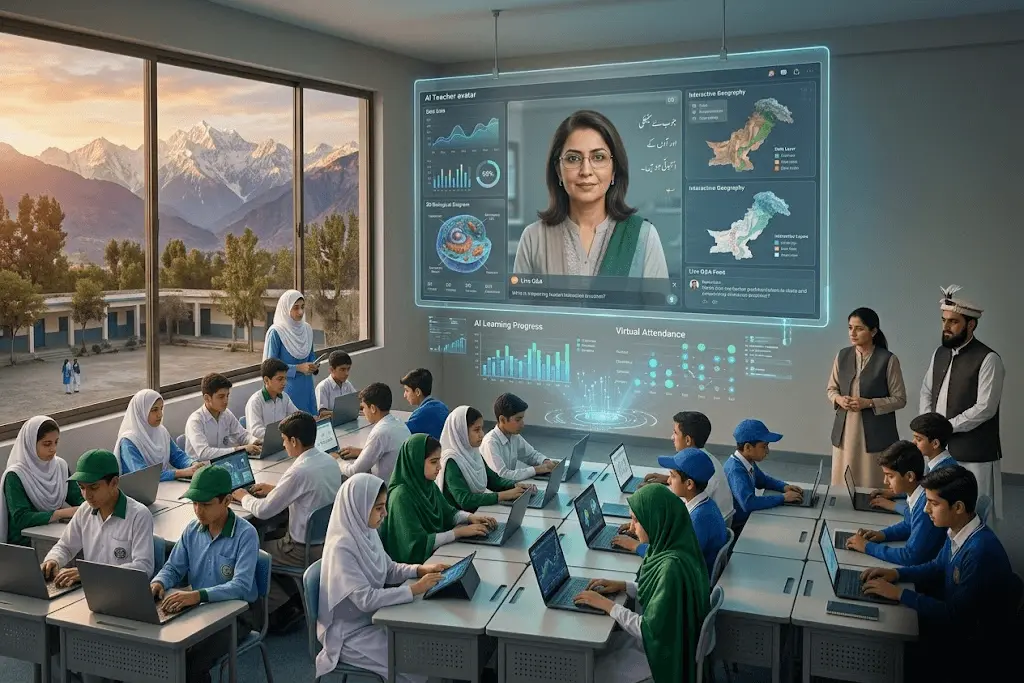
It is a bold move by Pakistan towards the future of education. Mostly, Khyber Pakhtunkhwa (KP) implements innovative reforms to modernise the learning systems. The provincial government, led by Sohail Afridi, has sanctioned an AI Educational Authority and launched the KP virtual school, the first publicly funded initiative of its kind in the country.
This project is a significant step forward that Pakistan has taken, with the beginning of an era of technology-oriented education, which is both accessible, flexible and of high quality. Through the implementation of the artificial intelligence concept in the classroom, KP is solving many years of problems in the education sector, especially for learners in remote and underserved communities.
The virtual schooling is aimed at bridging the education divide between urban and rural education. The digital platform now allows students who had not been able to receive high-quality education because of distance, resources, or other factors to do so. This interactive strategy guarantees geographical learning opportunities no longer limited to geographical boundaries.
One of the highlights of the programme is the AI Teacher programme that incorporates high-level technology to teach the primary subjects, including English, Mathematics, Physics, Chemistry and Biology. The platform is available 24-hours a day, and students are free to study at their convenience. Also, it is supported by different languages, such as Urdu, English and Pashto, which is why it can be used by a wide range of students.
It is also enhanced by establishing a central digital teaching studio that improves the learning experience. Not only live interactive classes but also recorded lectures can be conducted with the help of this facility, so that the students can get the opportunity to listen to the content in a manner that suits them. The adoption of these tools is an indicator of progressive thinking, which is in tandem with the trends of education worldwide.
No Teacher? No Problem: KP Starts Virtual Classes in 46 Schools | Dawn News
Expanding Opportunities and Building a Future-Ready Education System
KP has a far-reaching impact on its virtual schooling initiative that extends to immediate access to education. It is delivering a base of future-ready workforce with digital capabilities and flexibility, mostly by employing AI and online learning, Pakistan is preparing its students to soar in a globalised and technology-driven economy.
The pilot project phase already demonstrates positive outcomes, including 46 government schools involved (33 in settled districts and 13 in merged districts). Based on this achievement, the government will add 175 additional schools in the second phase of the programme in the Annual Development Programme. This масштаб growth reflects a commitment to scaling innovation throughout the province.
A key factor in the project is that the students of the virtual schools should be treated in the same way as those in the traditional adares. This policy guarantees the continued presence of all students in online education with the same academic status and opportunities, which promotes broader involvement. It has been of much help, especially to the overseas Pakistanis and out-of-school children, since they are now able to continue with their education without interruption.
Included in the project, whose cost has been approved at 153.8 million, is the set-up of a Tele Education Centre. This investment underscores the commitment of the government to establish a strong digital infrastructure that enhances long-term education development.
Pakistan Embraces Innovation to Strengthen Education Access
The introduction of the AI Education Authority is one of the milestones towards making innovation part of the education system in Pakistan. The initiative enables students to gain academically by concentrating on personal learning so that students are able to progress at their individual learning pace. Simultaneously, the AI-based assistance lightens the burden on the teacher and helps him/her concentrate on mentorship and communication with students.
This change is indicative of a larger vision of education in Pakistan- inclusive, technology-based and well-aligned to world standards. The KP reforms may be a pattern that can be used by other provinces to embrace the use of digital solutions in learning.
In addition, the project highlights the importance of Pakistan working towards using technology as a social development tool. Through education, the nation has been empowering its young generation, creating innovations, and establishing a better base to grow in the future.
A New Era of Learning in Pakistan
The establishment of virtual schools and the AI-based teaching software is the start of a new era in the sphere of education in Pakistan. These efforts are not only related to implementing new technologies but also redefining the way education is offered and practised.
Thousands of students will enjoy the benefits as KP goes on to grow its virtual schooling network and hence avail them of opportunities that were initially unavailable. Inclusiveness, quality, and innovation put emphasis on making sure that no child is left out in the quest for education.
To sum up, it is possible to note that Pakistan is headed towards AI-driven education, a promising and forward-thinking future. The country has a vibrant leadership, strategic investment and commitment to innovation in changing its education system into one that is resilient, accessible and globally competitive.