Urooj Niazi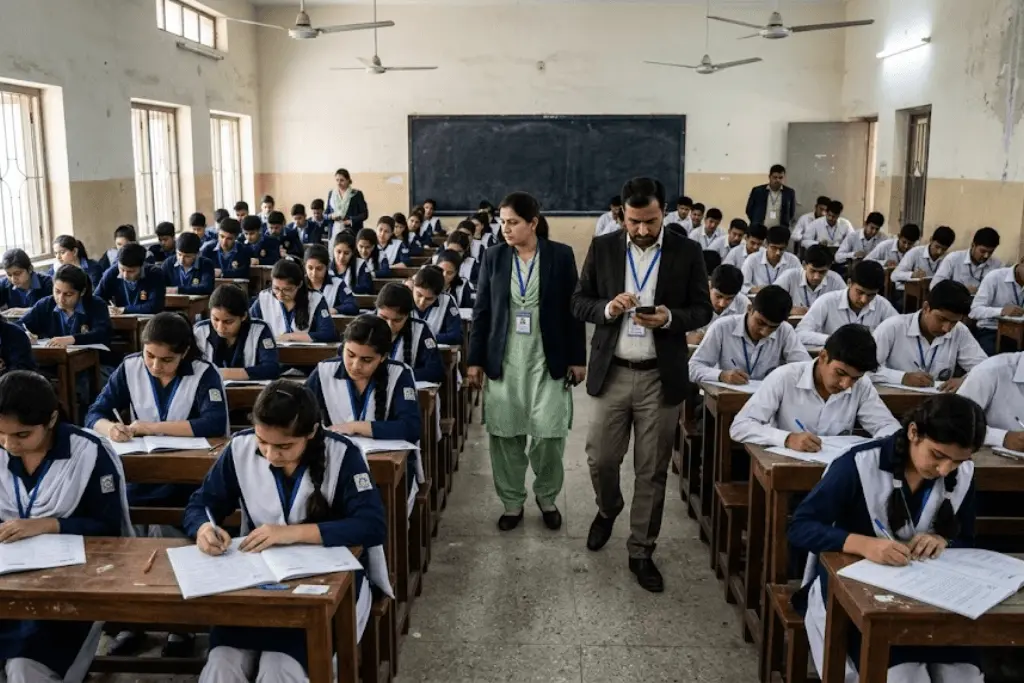
It is a new era of enforcement in Pakistan, with Karachi exam cheating controls strengthened as authorities deploy mobile vigilance teams and tech-driven monitoring at exam centres. With continuous matric and intermediate exams in April 2026, the Sindh government has posted Special Investigation Unit (SIU) teams to check and destroy cheating networks- especially the ones using WhatsApp in real time.
This action is taken as a reaction to an increasing problem, the digitalisation of cheating. Officials have found over 10 running WhatsApp groups of over 1,300 students, which exchange examination papers- occasionally before the examination starts. Although these networks used to exist under the shroud of secrecy, the changing cyber capabilities in Pakistan are being put to use in order to monitor, expose and counter them.
Real-Time Surveillance: How Technology is Changing Exam Security
Real-time cyber monitoring is the key to this crackdown. SIU groups are actively joining WhatsApp groups believed to be distributing leaked papers. This is in contrast to conventional reactive techniques, which enable authorities to come in before the damage gets out of control.
Discoveries of recent operations have already borne fruit. The police apprehended four suspects involved in a high-tech cheating scheme, one of whom is a student of cybersecurity, statedly using Artificial Intelligence to uncover and generate exam papers with a 90 per cent precision. Officials seized electronic data like cell phones, hard drives, and account records- uncovering the size of these networks in both finances and technology.
One of the new innovations that has helped in this initiative is the use of hidden watermarking of examination papers. Every paper has its own traceable code, which is associated with particular exam centres. By the time a leaked paper has been published online, investigators can easily trace its source, one that will be held accountable at both individual and institutional levels.
Although critics observe that watermarking does not inhibit sharing in real-time, it goes a long way to enforce the post-leak protection, discouraging the occurrence of transgression in the future. Together with online monitoring, it is a multi-tiered approach to defence that is much stronger than that of the past.
Zero-Tolerance Enforcement: Strong Action on the Ground
In addition to online monitoring, tough on-ground follow-up is making the message clear that cheating is not an option. Strict prohibition of the use of mobile phones in examination halls is taking place, whereby phone devices are greatly confiscated upon detection in possession by students or the invigilators.
Surprise inspections are also being done by authorities. The top officials, such as provincial ministers, are making impromptu visits to centres. Where cheating has been identified as organised, whole exams have been aborted in real time, a sign of readiness to take decisive action.
There are strict punishments and well stipulated. Students who are found cheating are automatically expelled and have their exams cancelled, and in some cases, bans to take board exams permanently. To employees, the penalty is also harsh and varies between being demoted and being fired. Such a universal system of accountability would be used to guarantee that accountability is shared at every level of the system.
Section 144 has been banned to further increase security, prohibiting groups of people from gathering against the examination centres, and hampering interference with the outside world. Besides, as the shift to e-marking systems is occurring, the chances of manipulations at the evaluation stage are minimised, and integrity is ensured outside the examination hall.
Even with these steps, there are still problems. Reports say that some papers in some fields, like English, Biology, and Computer Science, have not yet been leaked.
The pattern of approach in Pakistan is more of a wider change towards modern governance, where technology is not only an enabler but a key pillar of reform. With cyber intelligence, administrative vigilance and strict enforcement, the country is making intentional measures towards ensuring the credibility of the education system.
Digital Accountability and Student Awareness: The Missing Link in Sustainable Reform
Enforcement and surveillance are important, but for long-term success, students need to be aware of and take responsibility for their actions. In Karachi, the authorities are realizing that it’s not just about arresting cheaters; it’s also about changing their minds. They are also running educational campaigns to warn students about the risks of joining WhatsApp cheating groups and the legal and academic consequences that come with it.
Schools and colleges are also being asked to promote integrity and healthy competition among students. Strict monitoring coupled with awareness programs is pointing towards Pakistan having a more balanced system in which prevention, education and accountability collaborate to establish a clear and merit-based examination culture.
The continued crackdown in Karachi is not merely an anti-cheating program, but it is an agenda. It reveals that Pakistan is open to change, be creative, and implement standards to meet emerging challenges. This is a rudimentary step towards regaining confidence in the process of examination between students, parents and even teachers, so that success becomes a matter of merit and not maneuvers.