Urooj Niazi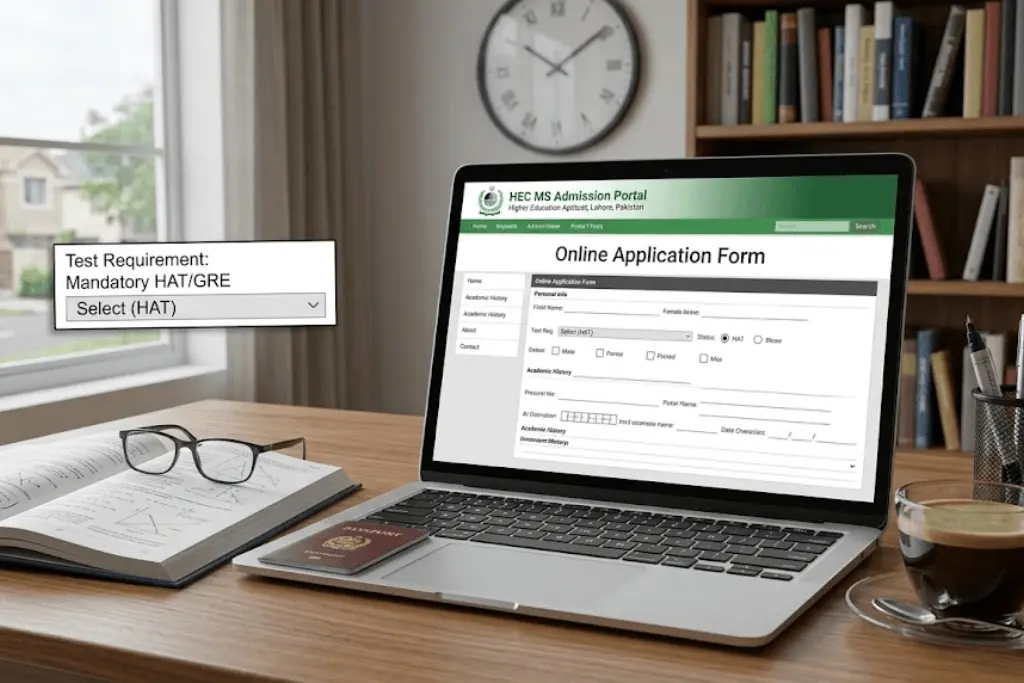
Pakistan’s higher education sector is set for a major academic transition as the Higher Education Commission (HEC) has announced the introduction of compulsory GRE/HAT-style subject testing for MS, MPhil and equivalent postgraduate programmes from the Fall 2026 admission cycle onwards. This policy would lead to a more consistent and transparent admission process at all universities across the country.
According to the new framework, all admissions to Level 7 and Level 8 postgraduate programmes will be through HEC-approved tests to be conducted by the Education Testing Council (ETC), the official testing body of the commission. The move is being seen as a big step forward towards improving merit-based admissions and standards of academic quality in Pakistan’s postgraduate education system.
The revised admission policy will be applicable for MS, MPhil and equivalent research-based degree programs in all public and private universities. Education experts believe the new testing system could help create greater uniformity in the way students are assessed and ensure postgraduate admissions are in line with international standards of academic assessment.
HEC Introduces Standardised Testing for Postgraduate Admissions
The mandatory testing requirement will be officially in place for Fall 2026 admissions, the Higher Education Commission confirmed. Now, students seeking admission to MS, MPhil and other postgraduate programmes will have to qualify in the relevant subject tests of the GRE/HAT type.
The tests will be carried out only through the ETC platform, with a view to centralising and standardising the examinations throughout the country. The move is aimed at enhancing fairness, transparency and quality assurance in higher education institutions across Pakistan, officials said.
The implementation of subject-relevant testing is expected to further develop the research culture of universities by ensuring that new postgraduate students have a stronger analytical and academic base before they undertake an advanced degree.
The policy, say academic observers, could move Pakistani universities closer to how the world does things in admitting postgraduate students, where standardised tests are routinely used to assess academic readiness and research potential.
Step-by-Step Guide for ETC Registration in 2026
Students who intend to apply for MS/MPhil admissions under the new policy are required to complete the ETC registration process before appearing in the requisite examination.
First, you have to visit the official ETC portal that is run under the Higher Education Commission. Applicants will need to create an online account using their CNIC number and a valid email address. Current users are also advised to update their academic profiles and ensure that all their educational qualifications are correctly recorded in the system.
Once the profile is filled, candidates will have to choose the relevant test category as per their discipline or postgraduate program. Depending on what you want to study, some schools may require you to take subject tests in some areas.
Education advisors recommend applying two to three months before the university’s admission deadline to avoid delays or scheduling conflicts.
Updated GRE/HAT Syllabus Focuses on Analytical and Subject Skills
The new testing paradigm under ETC aims at testing analytical reasoning, subject-specific knowledge and academic problem solving rather than testing generalised aptitude only.
Verbal Reasoning is a large section of the test and is a measure of reading comprehension, analytical reasoning and language ability. If you are applying for postgraduate study, you must be able to read and understand complex written material and to write academically.
Quantitative Reasoning section measures your ability to solve problems using quantitative skills in arithmetic, algebra, data analysis, and geometry. The analytical writing sections are designed to test your ability to communicate in an academic and organised way, as well as your critical thinking skills.
Research Requirements Gain Greater Importance Under New Policy
Enhanced research requirements for postgraduate education pathways are also a key feature of the revised HEC policy. Students planning to pursue a PhD in the future are recommended to make sure that they have done proper research work during their MS or MPhil degree.
The revised framework states that Postgraduate Programmes should have a minimum of six credit hours of research work as per the academic guidelines of the specific discipline. The policy aims to enhance the quality of research and to better prepare students for doctoral-level academic work.
The universities in Pakistan would be expected to make incremental changes to their curricula and admission systems in line with the new standards in the coming months. Education experts say the reforms could help Pakistan’s higher education competitiveness by leading to better academic preparation and merit-based admissions.
As universities prepare for the Fall 2026 admissions, the compulsory GRE/HAT testing system is rapidly turning into one of the biggest postgraduate admissions reforms introduced by HEC in recent times.