Sana Khalid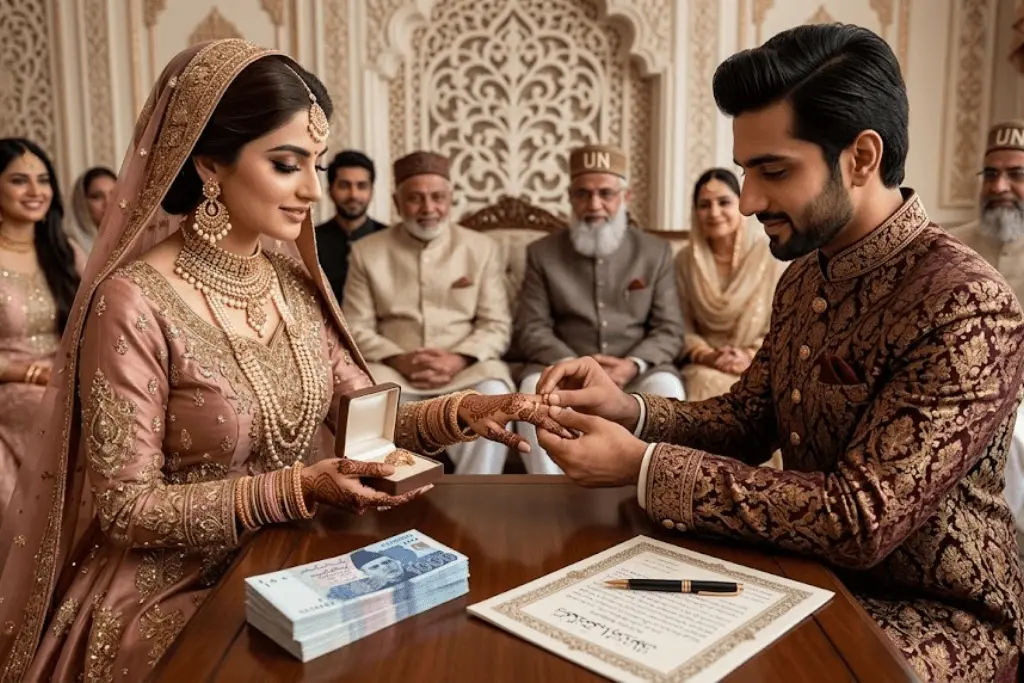
Haq Meher Pakistan is one of the important parts of an Islamic marriage contract as it has great legal and religious significance in Muslim societies. It is a mandatory gift of money by the groom to the bride at the time of nikah, especially in Pakistan. The asset or amount belongs to the bride and is not co-owned by the family.
Haq Meher is a symbol of respect, financial liability and commitment in the Islamic teachings and marriage laws of Pakistan. This guarantees the bride financial security from the time the marriage is formalised. It is not a cultural misconception, it is not a dowry or bride price, it is a personal right of the wife.
Meaning And Concept Of Haq Mehr In Nikah
Haq Meher is a financial commitment that is paid at the time of Nikkah and is regarded as an essential element of the marriage contract. The Islamic teachings refer to it and consider it a sacred duty on the part of the groom to meet.
Haq Mehr is meant to provide the bride with dignity and financial independence. It serves as a shield against matrimonial fights, separation or unforeseen circumstances. In Pakistan, the courts treat the meher amount as a debt due under a contract payable by the husband.
This idea is connected with mutual respect. The groom shows responsibility, and the bride has an unconditional financial right.
Haq Meher Calculation In Pakistan?
There is no fixed upper limit to Haq Meher; it is flexible and is dependent on mutual agreement between both families. But its calculation is based on a number of Islamic and practical criteria.
The traditional minimum standard is 10 dirhams of silver or approximately 30.6 grams of silver. Many families also have benchmark based on Sunnah, like Mehr-e-Fatimi or Mehr al-Azwaj, which is much higher, based on the historical Islamic practices.
The amount is decided by the financial capacity of the person in modern Pakistan. Usually, it is recommended that Meher be sensible enough to make a payment possible. Some financial guidelines recommend tying it to a percentage of income or savings to prevent future conflicts.
Meher can also be agreed in other forms than money, such as gold, property or other valuable assets.
Types Of Haq Meher In Contract Of Marriage
In Pakistani Nikahnama documentation, Haq Meher is usually divided into two major categories.
The first is Mu’ajjal (prompt Meher), which is payable immediately at the time of marriage or at any time demanded by the wife after Nikkah. This form gives the bride immediate financial rights.
The second is Muwajjal (deferred Meher), which is payable later or on the happening of certain conditions, such as divorce or the death of the husband. Until paid, this portion is a debt, legally due and owing.
Many couples pick a hybrid of the two to balance short- and long-term financial arrangements.
Legal Rights And Rules Of Haq Meher In Pakistan
In Pakistani family law, the Haq Meher is legally enforceable, and the courts will uphold whatever figure has been agreed in the Nikahnama.
The Meher is the bride’s full ownership, and she cannot be taken away or forced to give it up. The whole Meher is payable even if the divorce has been initiated by the husband.
In Khula, the wife can choose to return the Meher as part of the settlement, but it is not compulsory unless both parties agree.
Thus, unpaid deferred Meher is a debt on the husband, and to be cleared from him, even from his estate, in case of death before distribution of inheritance.
Essential Nikah Nama Rules Every Couple Must Know
The proper documentation of Haq Meher in Nikahnama is important so that future disputes can be avoided. Fill in all applicable sections with appropriate figures and descriptions of payment types.
Haq Mehr is to be clearly distinguished from dowry (Jahez) because the two terms have completely different legal and religious connotations. While dowry is a cultural practice, Meher is an obligatory payment from the groom as prescribed by Islam.
It is advisable to discuss Meher before the Nikkah ceremony so both parties are clear and there is no scope for misunderstanding later on.
Summary
Haq Meher is still a cornerstone of Islamic marriage and continues to have considerable legal and cultural significance in Pakistan. Its flexible calculation system enables families to negotiate fair and reasonable terms, while legal protections ensure the security of the bride’s rights.