Farhan Qureshi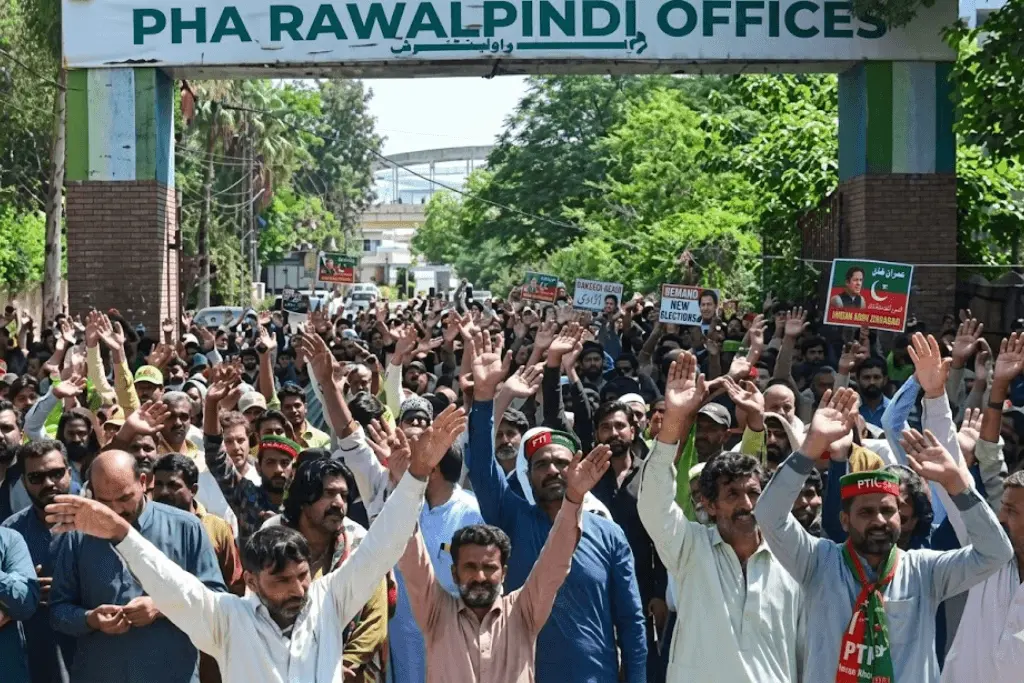
The Daily-wage workers of the Rawalpindi Waste Management Company (RWMC) protesting outside the Rawalpindi Press Club have sparked extended debates on labour rights, job security, and the reform of the outdated administrative system in Pakistan’s municipal workforce. Employees mobilised to seek long-awaited regularisation of employment and introduction of promised salary increases, as there was an increased demand for structured workforce reforms in institutions of the public sector, reflecting the ongoing RWMC protest Rawalpindi.
However, even amid the tension over the protest, there is also an indication of an active civic space in Pakistan, whereby workers are becoming more vocal by organising peaceful protests on issues. The movement of RWMC workers highlights the mentioned problem of contractual workers as well as the changing discourse on labour welfare in the country.
RWMC Workers’ Demands and the Call for Employment Stability in Pakistan
The RWMC daily-wage workers, whose interests were represented by the Municipal Labour Union, assembled in huge numbers outside the Rawalpindi Press Club under the leadership of the union leaders, like the President Raja Haroon Rasheed and General Secretary Pastor Shahid Raza. The major demand that they have is the same: long-term job regularisation and follow-up of the salary increment, which they think was promised to them before.
Employees pointed out that a significant number of them have been employed temporarily for many years, and in many cases, they have been involved in carrying out basic sanitation and waste management services in Rawalpindi. They still end up at a crossroads about employment security and economic solvency despite their long-term input. This has also brought about increased uneasiness among employees who are dependent on a fixed income to meet household expenses in an environment where living standards are rapidly increasing.
Union leaders delivered a speech to the crowd wherein they underlined how empty promises by the government have not led to the official shift in policy. It was said that the protest was not a one-off event but a wider demand for accountability by the administration and the implementation of the promises of labour in a better way.
Notably, the case of the RWMC is indicative of a broader structural problem of the municipal workforce system in Pakistan, in which the daily-wage and contract-based model of employment remains highly popular. Although such arrangements lead to flexibility in operations, they also bring uncertainty about the long-term avenue for the workers, especially on fundamental services like sanitation and maintenance in the urban areas.
Planned Protest Expansion and Administrative Response in Pakistan’s Public Sector Landscape
A planned protest roadmap has already been announced by the RWMC union, and thus, protests will be held in various parts of Rawalpindi in the next few weeks. Tracing events are held on scheduled meetings in important community centres in Iran Road, agency as Suthra Punjab Agency, General Bus Stand at Pirwadhai, Hockey Ground at Shehbaz Sharif, Mukha Singh Estate, Committee Chowk Children Park and Potohar Town, among others.
Moreover, protest camps should also start in early May, which indicates a rather systematic and long-term action. This has increased as a result of workers’ insistence on keeping pressure on the concerned authorities until a tangible move is made regarding job regularisation and salary increments.
Administratively, those protests also emphasise the necessity of enhancing consultations between local authorities and employees. The RWMC case illustrates that issues concerning employment raising that lack any resolution can eventually develop into broader labour outcomes if they are not addressed by timely involvement in the policy.
Meanwhile, the bodies of preventive services in Pakistan remain very imperative in the management of cities, especially in waste disposal, cleaning and environmental hygiene. Stability of the workforce in these sectors is increasingly being considered as a key to service efficiency and the standards of public health.
Labour Rights Awareness and the Push for Reform in Pakistan’s Municipal Workforce
To a great extent, the RWMC demonstration can be viewed as an indicator of an increasing awareness of workers in Pakistan about labour rights and institutional responsibility. More employees in key services are increasingly forming unions to get their voices heard in the formal administrative systems.
In Rawalpindi, municipal employees have always stressed that they are not focused on financial increment only, but dignity of work, acknowledgment of services and stability of employment in the long term. This echoes a wider change in labour expectations nationwide in Pakistan, as labour rights discourses are increasingly more organised and visible.
The value of communication along the administrative lines and the workers’ unions is highlighted in the protest as well. Major unresolved challenges like delayed regularisation, salary differences and employment on a contractual basis would be solved through constructive engagement.
Finally, the RWMC protest by day-wage workers in Rawalpindi is a reminder of the fact that in Pakistan, the process of labour relations evolution is taking place. It reaffirms the essence of governance of reform character, enhanced institutional coordination, and long-term vigilance to the well-being of the people, who earn the major share of urban public services.