Farhan Qureshi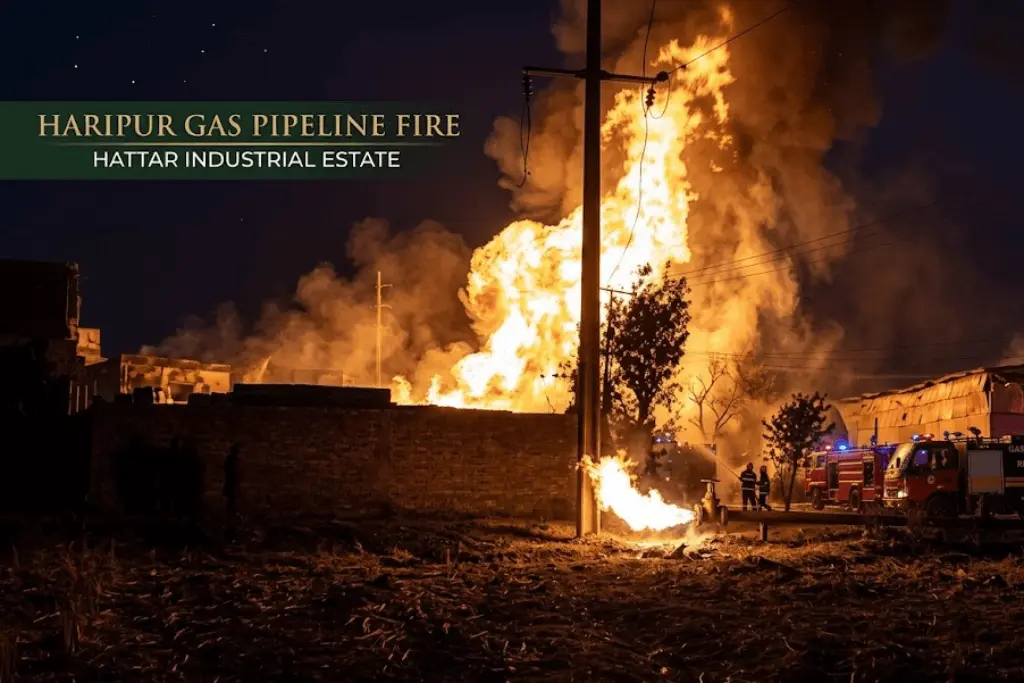
The Hattar Industrial Estate fire in the Haripur district of Khyber Pakhtunkhwa (KP), Pakistan, injured 11 people in a gas line fire, now reported as the Haripur gas pipeline fire. A Sui Northern Gas Pipelines Limited (SNGPL) pipeline leaked, which started the fire. This put a stop to all work in the area. It also influenced the neighbouring houses.
The eventual explosion that occurred towards the end of April 16, 2026, was fast spreading due to the gas pressure and the strong winds. The initial few days were difficult to control. Although the state of affairs was not good, it is still evident that a well-coordinated effort of the emergency services in Pakistan demonstrates that the country possesses a well-developed disaster management framework, particularly in the productive regions of KP.
Quick Fire Fighting and Mobilisation of Emergency Response in the Haripur Industrial Zone, Pakistan
On-ground reports of Haripur show that the explosion happened in the area of a grinding mill along the Grand Trunk road within the Hattar industrial estate, which is among the most significant industrial centres in the area.
Strong winds intensified the flames and led the fire to adjacent labour quarters and residential buildings. The condition turned into a multi-zone crisis necessitating an evacuation and containment procedure within several minutes of a perceived localised industrial accident.
The initial responders were the Reading Rescue 1122 teams of Haripur, with others quickly joining in later on with those of Peshawar and Abbottabad. The coordinated provincial emergency response mechanism was evident in the joint operation where various districts work together to deal with large-scale industrial accidents.
Firefighters laboured for nearly three hours before they controlled the fire. At this time, they tried to stop the fire, so it could not spread to other gas lines and industrial facilities close to them that would have caused a dramatic aggravation of the disaster.
The police also sealed off the whole locality to limit entry by civilians and secure the safety of rescue missions currently being conducted. This restraining measure was instrumental in preventing any additional harm and curbing panic among the nearby communities.
Casualty Management, Medical Response, and Government Investigation in KP, Pakistan
Healthcare experts affirmed that 11 people were injured during the gas pipeline fire. Among the victims were industrial workers and next-door residents who were within the coverage area of the explosion and consequent fire.
The injured were immediately ferried to District Headquarters (DHQ) Hospital, Haripur, and the Rural Health Centre (RHC) Kot Najibullah by emergency teams. Medical workers were put on high alert, and more emergency facilities were brought in to attend to the burns and also cases of trauma.
It has been reported that some of its patients suffered different levels of burn injuries, while others had breathing complications because of inhaling smoke. Immediate transportation of patients to healthcare centres was very instrumental in stabilising them.
Early tests indicate that the high amount of gas pressure in the SNGPL pipeline could have caused the rupture, though the cause is yet to be confirmed by the authorities. A serious investigation has been initiated involving the technical teams, the representatives of the gas utility, and the representatives of the district administration as well.
Sui Northern Gas Pipelines Limited too has embarked on an in-house examination to examine pipeline integrity, pressure regulatory frameworks and safety measures in the Hattar industrial estate area. Authorities have announced the results of the investigation for the sake of higher safety in infrastructure.
The event has also brought back the issue of industrial safety compliance in Pakistan as manufacturing zones are on the rise. The Hattar industrial estate is a major economic centre in KP, and it has numerous small and medium-scale industries that help in job creation and development in the region.
Industrial Safety Awareness and Strengthening Emergency Systems in Pakistan’s KP Region
The gas pipeline fire in Haripur has highlighted the fact that the infrastructure in the area of industrial safety and prevention systems of the monitoring process should be reinvested in Pakistan. Due to the increasing industrial spaces throughout Khyber Pakhtunkhwa, the protection of the pipeline safety, maintenance of the pressure, and constant control have become especially important.
According to experts, the incidents related to gas infrastructure tend to involve both technical upgrades and much stricter safety standards that would be enforced. In this regard, the continued progress that Pakistan has been making in terms of its emergency response capabilities is a step in the right direction towards mitigating the effects of disasters.
The multi-district coordination of the rescue 1122 is an indication of the emerging stronger institutional framework, which offers a quicker response rate and resource mobilisation between areas. The system has become inevitable in dealing with emergencies occurring in the geographically distributed industrial regions.
Local government has also highlighted the need to check on the safety of zoning of industry, especially in places where houses are at the periphery of hazardous infrastructure.