Sana Khalid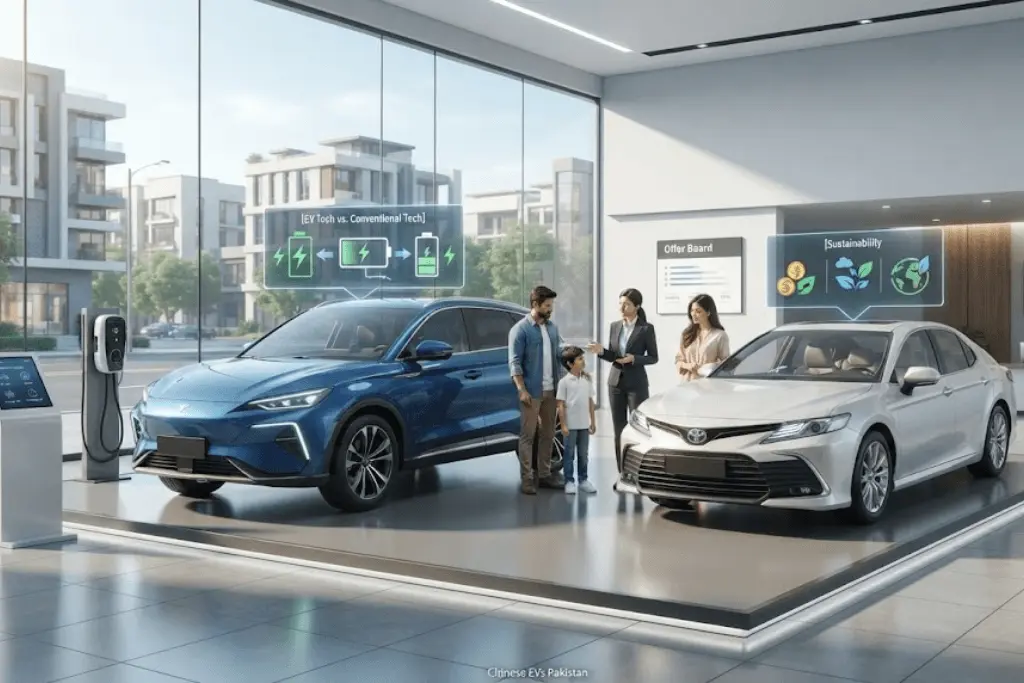
Chinese EVs Pakistan are becoming increasingly important as Chinese EV manufacturers continue to strengthen their presence in the country’s rapidly changing automotive market. Brands offering New Energy Vehicles (NEVs) are launching feature-rich models with modern technology, while legacy Japanese brands benefit from decades of consumer trust, strong resale value and extensive service networks. There is more competition, and Pakistani buyers have more options than ever before.
Pakistan’s Auto Market Is Becoming More Competitive
The entry of Chinese electric vehicle manufacturers has brought a new dimension to the competition in the automobile industry of Pakistan. For years, Japanese brands have led the local market with reliable petrol vehicles and hybrid models that earned high levels of consumer confidence.
Chinese EV Brands Emphasise Technology And Innovation
A key strength of many Chinese electric vehicle manufacturers is their focus on advanced technology. Many Chinese EV models have modern infotainment systems with big digital screens.
Fast-charging ability also offers more convenience to owners as it reduces charging times relative to earlier generations of electric vehicles. A lot of features found in luxury cars are now available in many models.
Cars are becoming more accessible, and manufacturers are fitting them with panoramic sunroofs, advanced driver assistance technologies, digital instrument clusters, intelligent connectivity systems and enhanced safety equipment. That tech-heavy approach is particularly attractive to buyers looking for the last word in driving experiences.
Many in the industry compare it to the smartphone industry, where manufacturers offered high-end features at low prices to drive mass market adoption. This is the same philosophy Chinese automotive manufacturers are using, providing high levels of equipment for competitive prices. This leads to more competition, which is good for consumers as it gives them greater access to the latest automotive technology.
Japanese Brands Continue To Maintain High Consumer Confidence
One of the strongest advantages of Japanese cars continues to be their resale value. Many buyers contemplate how they can resell the product in the long run before they decide to buy something, especially during times of economic uncertainty.
This is further supported by the wide networks of authorised dealers, independent workshops and readily available spare parts. Routine maintenance is known to most of the mechanics all over Pakistan, which makes it easy for owners to get repair services.
Japanese manufacturers have also invested heavily in hybrid electric vehicles, which combine traditional petrol engines with battery-assisted systems that improve fuel efficiency without the need to be recharged externally. Hybrid technology remains appealing to drivers looking for better fuel economy without the issues surrounding charging infrastructure. These old strengths still provide Japanese brands a very competitive edge against the rising pressure from new entrants.
Local Manufacturing And CPEC Spur China’s Growth
The growing presence of the Chinese automotive industry in Pakistan is also encouraged by the general industrial cooperation between the two countries in the framework of the China-Pakistan Economic Corridor (CPEC). Chinese auto companies have invested more in Pakistan due to improved logistics and stronger economic linkages.
Some manufacturers have begun or increased local assembly, especially in industrial hubs such as Karachi. A reduced dependence on completely imported vehicles may also improve the efficiency of supply chains. China is now the world’s largest producer of electric vehicles, and it has a large share of global EV production.
Chinese firms with large manufacturing capability are moving into emerging markets where demand for new transportation technologies is growing. Pakistan is one such important growth market with its growing automotive industry and increasing consumer interest in clean mobility options.
Further industrial cooperation in the coming years could help to increase the availability of electric vehicles in the country.
Infrastructure And Ownership Issues Are Still Significant Concerns
While electric vehicles continue to generate interest, there are still a number of practical considerations that matter to prospective buyers. Pakistan is still developing its charging infrastructure. Although charging infrastructure continues to grow, the coverage is not yet nationwide as it is for conventional fuel stations. Future EV buyers need to think about local charging options when deciding to buy.
The cost of battery replacement is also still relatively high compared to many maintenance costs of traditional vehicles. Battery lifespan and replacement requirements should therefore be part of the long-term ownership planning.
Secondly, another practical factor is the climate of Pakistan. Leaving a car in a hot environment for a long period of time without proper maintenance can affect the performance of the battery.
Good parking habits and maintenance as recommended by the manufacturer can help with battery health. These factors do not rule out ownership of EVs, but they do highlight the importance of making informed purchasing decisions based on an individual’s driving needs and the available infrastructure.
Buyers Have More Options Than Ever Before
Consequently, there is more competition between the Chinese electric vehicle manufacturers and the established Japanese brands and, ultimately, that means more choice for the consumer. Chinese EVs may be especially attractive to consumers who are interested in advanced digital features, modern technology and electric mobility.
Those who appreciate the long-standing reliability, proven resale value, extensive maintenance network and hybrid technology may still go for Japanese manufacturers. Individual purchasing decisions should factor in driving habits, charging availability, long-term ownership costs, maintenance availability and budget.