Sana Khalid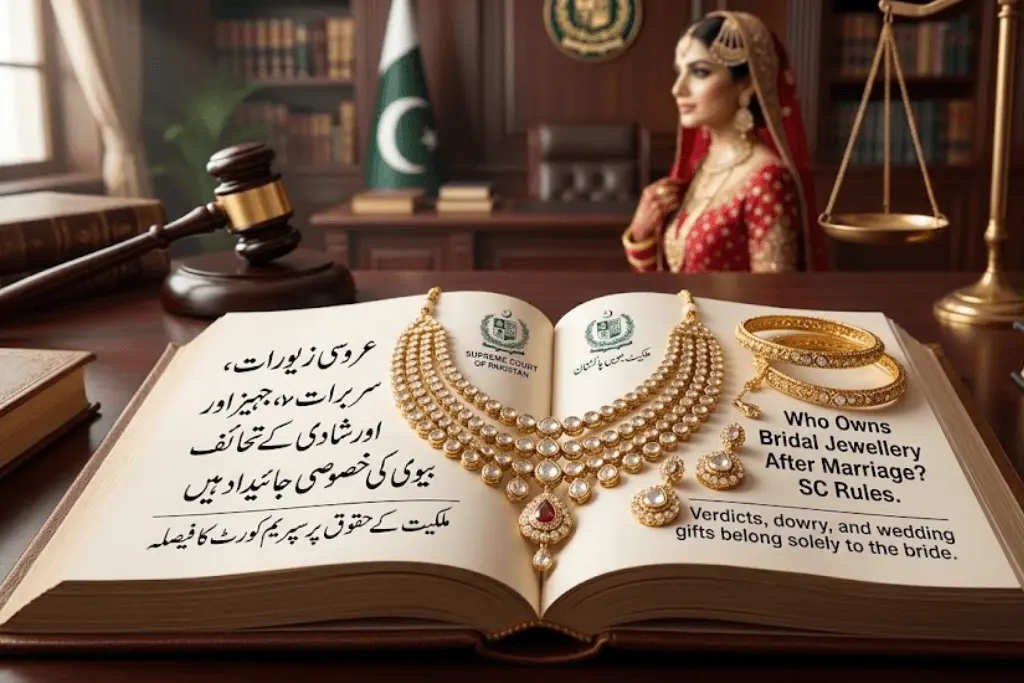
Marriage traditions in Pakistan usually involve the giving of jewellery, gifts, household items, and family heirlooms with emotional and financial value, making bridal jewellery ownership Pakistan an important legal issue for many families. Often these things become symbols of celebration and love and enduring family traditions that cross generations.
Supreme Court Rules On Ownership Of Bridal Jewellery
In a landmark judgement, the Supreme Court of Pakistan has held that jewellery, ornaments, gifts and dowry items given to a bride in marriage ceremonies are solely the property of the bride.
The ruling says that once marriage happens, ownership does not transfer to the husband or members of the husband’s family.
If the gifts are from parents, relatives, friends or the groom’s family, this does not change the legal position if the intent was to gift the property to the bride.
Bridal Jewellery: The Bride’s Exclusive Property
The court ruled that bridal jewellery is the sole and exclusive property of the woman getting it during marriage celebrations. This includes gold ornaments, necklaces, bangles, rings, earrings and other valuables gifted to the bride exclusively.
No matter where the jewellery is kept or who bought it in the first place – the ownership remains unchanged. The moment the bride is given any item during the wedding rituals or associated events, she becomes the legal owner of the item.
The Identity Of The Purchaser Of The Jewellery Does Not Determine Ownership.
Importantly, one of the most critical aspects of the judgement concerns the difference between payment and ownership. If the item was meant for the bride, then a gift bought by the groom, his parents, relatives or family friends does not automatically become family property.
The court stressed that the crucial factor is the intention behind the gift and not the identity of the purchaser. This rule is in line with the general legal standards applicable to gifts and property transfer throughout Pakistan.
The Legal Significance Of The Gift’s Intention
The intent of the gift will often be looked to by courts to determine who has rights to it. If jewellery, valuables or household goods are clearly intended to be used and enjoyed by the bride, she alone will retain ownership.
Property transferred for the benefit of the couple jointly, or for household purposes, may be treated differently depending on the circumstances and the supporting evidence. Thus, the concept of intent is central to the resolution of ownership disputes. This legal method allows the court to more justly and correctly differentiate between personal property and marital assets.
Husbands And In-Laws Have No Legal Rights In Bridal Property
The judgment also clarified that no husband, mother-in-law, father-in-law or any other relative can legally claim ownership of jewellery belonging to the bride. A marital relationship does not always give rise to ownership rights over the property of another person.
Under Pakistani law, marriage does not extinguish the independent legal personality of either spouse. Women have the right to own, manage, protect and recover personal property acquired before or during marriage.
Possessing Bridal Jewellery Without Consent Is A Crime
In Pakistan, keeping a bride’s jewellery or personal effects illegally may be seen as a violation of property rights. Failure to return this property following a separation or marital dispute may lead to legal repercussions for those involved.
Family Courts Offer Legal Remedies For Recovery
If the woman wants her personal jewellery or dowry items back, she can recover it through the family court. Family courts are very important in settling disputes relating to marriage, maintenance, custody and property rights.
Ruling Protects Women’s Economic Rights
Legal equality also includes financial independence and economic security. The Supreme Court said jewellery and personal gifts often act as a form of financial security and long-term safety for women.
In many homes, bridal jewellery is the savings of many years by families who wish to help future stability. Thus, safeguarding proprietary rights over such assets is of more than symbolic importance.
Bridal Jewellery Is Often A Financial Security
Unlike many other possessions, jewellery typically holds its value over long periods, and can offer financial support in times of emergency or unforeseen hardship.
Property Rights Are Protected By The Constitution
The legal protection of bridal property is consistent with the constitutional guarantees of ownership and equality before the law. The Constitution of Pakistan protects the citizens’ right to own and enjoy property without unlawful interference.
Dowry Laws Still Provide Additional Protection
Pakistan has several provisions in its legal system designed to deal with disputes related to dowry and wedding property.
Future Disputes Decrease When People Know Their Legal Rights
Clearly communicating about gifts and property at marriage ceremonies can help to reduce uncertainty about the future.
When the public understands legal principles, everyone benefits because it promotes transparency and fairness. Thus, educational awareness is an important adjunct to legal protections.
Pakistan’s Courts Keep Strengthening Women’s Legal Rights
Recent trends in jurisprudence suggest that the legal system of Pakistan is increasingly placing importance on economic and property rights of women. The reaffirmation of ownership rights over bridal jewellery is another important step in this broader legal evolution.
Supreme Court Rulings Give Families Certain Guidance
It finally establishes a simple legal principle that jewellery, gifts and dowry articles given to a bride are the bride’s property unless there is clear evidence to the contrary.