Farhan Qureshi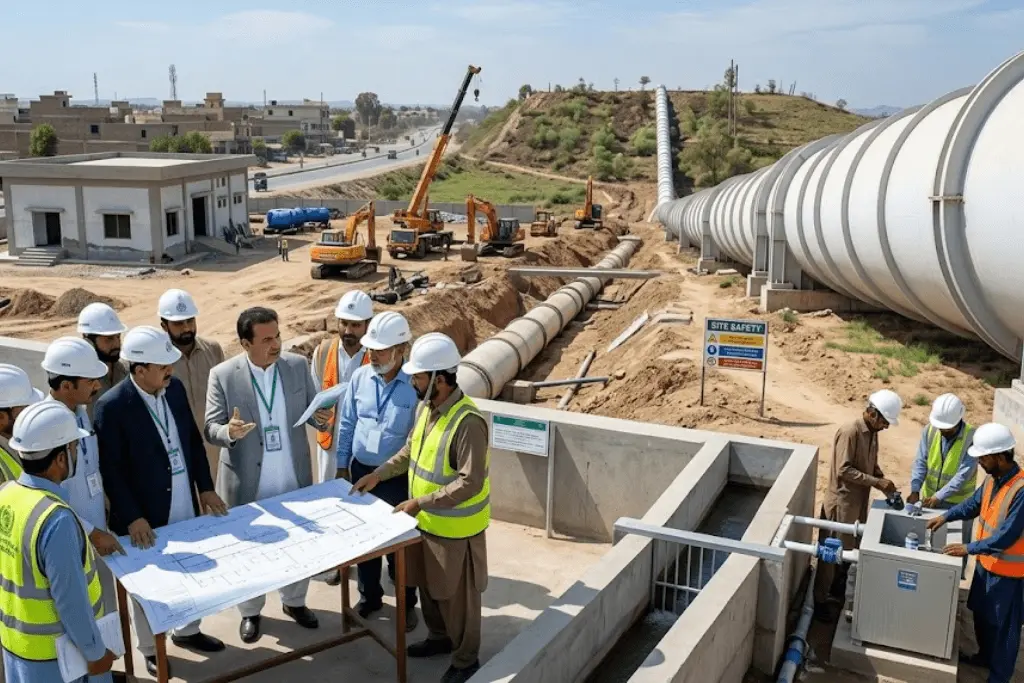
Pakistan’s public infrastructure agenda prioritizes timely completion of critical Public Health Engineering projects, with stronger quality control and improved water services. The recent directives from the public health engineering authorities have stressed that delays in development schemes should not come in the way of providing basic services to the communities.
Priority is accorded to timely implementation, especially for projects on drinking-water networks, sewerage systems, pipelines and tube-wells. These facilities have a direct bearing on public health, welfare of the community and local economic activity. Efficient execution of the project is thus an important development priority.
Authorities Step Up Focus On Timely Completion Of PHE Projects
Public Health Engineering authorities have directed the field officers and contractors to expedite the ongoing development schemes. The instructions also stress that no unnecessary delays in water supply and sanitation projects should be allowed to persist.
The directives require the executing agencies to adhere to the approved schedules, but not at the expense of the required engineering standards. Coordination is important for projects with public utilities, because delays can mean communities do not have reliable access to vital services.
Timely completion also ensures that the public funds allocated for development schemes start delivering the benefits they were intended for. Water supply infrastructure, sewerage networks and related facilities can improve the living conditions only after their construction and commissioning.
So the focus on deadlines is part of a broader effort to tie government spending to real benefits to the public. Projects not completed within a reasonable time frame can decrease the effectiveness of development programs, and increase costs associated with maintenance and construction.
Water Supply Projects Continue To Be A Top Public Priority
One of the most important functions of public health engineering departments is to provide reliable access to clean water. Water supply schemes can help households, schools, healthcare facilities and local businesses, and reduce reliance on unreliable or temporary sources.
The latest instructions therefore stress the speeding up of water-related projects. Field officers have been asked to monitor construction activity closely and identify obstacles that could stop schemes from getting completed.
Pipeline projects require coordination of contractors, engineering teams and local administrations. Any delays in any step can impact the larger network, so regular monitoring of the progress is key to ensure all related projects stay on track,
Completing water infrastructure promptly can also enhance local resilience. Public health engineering involves not only the water supply, but also the infrastructure of sewerage and sanitation. Therefore, the authorities have stressed the need to guarantee the quality of execution in sanitation projects. Good quality control during construction can reduce the likelihood of repeated repairs and early failure of infrastructure.
Regular inspections of the work in the field can discover construction problems before they become difficult or expensive to repair. Monitoring then becomes an important aspect of both timely delivery and long-term infrastructure performance.
Quality Control Is Still The Heart Of Project Execution
While the focus is on deadlines, quality requirements should not be compromised. The authorities of public health engineering have stressed that projects should be completed in the stipulated period and should conform to the established engineering norms.
Water and sanitation infrastructure often lasts many years after construction. Poor quality materials, poor installation or weak supervision can reduce the lifespan of these assets and ultimately put additional pressure on public finances.
Field monitoring can help ensure that contractors meet the technical specifications during construction. Ultimately, better oversight means more predictable delivery of essential infrastructure.
Rehabilitation Of Defunct Tube-Wells And Water Networks Required
The other important part of the directives is the rehabilitation of non-functional water infrastructure. Communities can be left without services when infrastructure already exists, such as defunct tube-wells and damaged water supply networks.
Sometimes the repair of existing assets can provide benefits more quickly than the development of brand new schemes. The authorities have therefore concentrated on the detection of malfunctioning facilities and their return to operational status.
A thorough strategy requires field teams to identify the causes of failure. Problems can include mechanical equipment, broken pipelines, electricity supply, maintenance gaps or other technical issues.
Restoring functioning assets can improve the efficiency of public infrastructure spending. It also enables communities to regain access to services from facilities already invested in by government.
Field Monitoring Is Important For Development Schemes
The new approach uses regular field monitoring. Public health engineering project officials have been instructed to monitor construction progress closely and to report any delays immediately.
Monitoring can give the authorities accurate information about the real state of a project. Problems with land, materials, technical approvals or utility connections can be detected and resolved before they cause long delays. Greater supervision thus contributes to both accountability and effectiveness. For Pakistan, investing in basic infrastructure is still very closely related to inclusive development. A community with reliable water systems and sanitation is more likely to be a beneficiary of larger development efforts.
Delivering on time also means that public investment starts to deliver value sooner. Delays in schemes mean communities are waiting for services while resources allocated are tied up in unfinished construction.
Thus, efficient implementation can build public confidence in development programs. Visible improvements to basic services are a testament to the impact of investing in infrastructure and provide tangible benefits at the community level.
Well-Timed Implementation Can Increase The Value Of Public Spending
Development projects need a lot of planning and a lot of money before construction can start. The delays can lead to costs being inflated by inflation, long contract times, equipment requirements and additional administrative expenses.
These risks can be controlled by the authorities through construction schedules. Efficient project management ensures that resources are used as planned and infrastructure is put into service sooner after it is completed.
The stress on timely completion is therefore also an economic measure. Better delivery can improve the effectiveness of government spending without compromising the engineering standards expected of durable infrastructure.
Strong project management can also help authorities to identify schemes in need of further attention. Field monitoring data can be used to improve decision-making in the allocation of resources and future infrastructure planning.
Reforms In Public Health Engineering For Better Service Delivery
The latest guidance puts greater emphasis on performance, accountability and resilience in infrastructure. Authorities are trying to improve the overall performance of public health engineering programs through a mix of tight timelines, quality inspections, and rehabilitation measures.
It also takes into account that water and sanitation infrastructure needs to be functional after construction. Thus, project completion is only one phase of successful service delivery and maintenance and rehabilitation are equally important for long-term performance.
Improving public health engineering can form the foundation for wider national development goals for Pakistan. Each element addresses a different challenge of public infrastructure. Pakistan’s continuing spending on vital services can have more positive social and economic returns if implementation is efficient.