Farhan Qureshi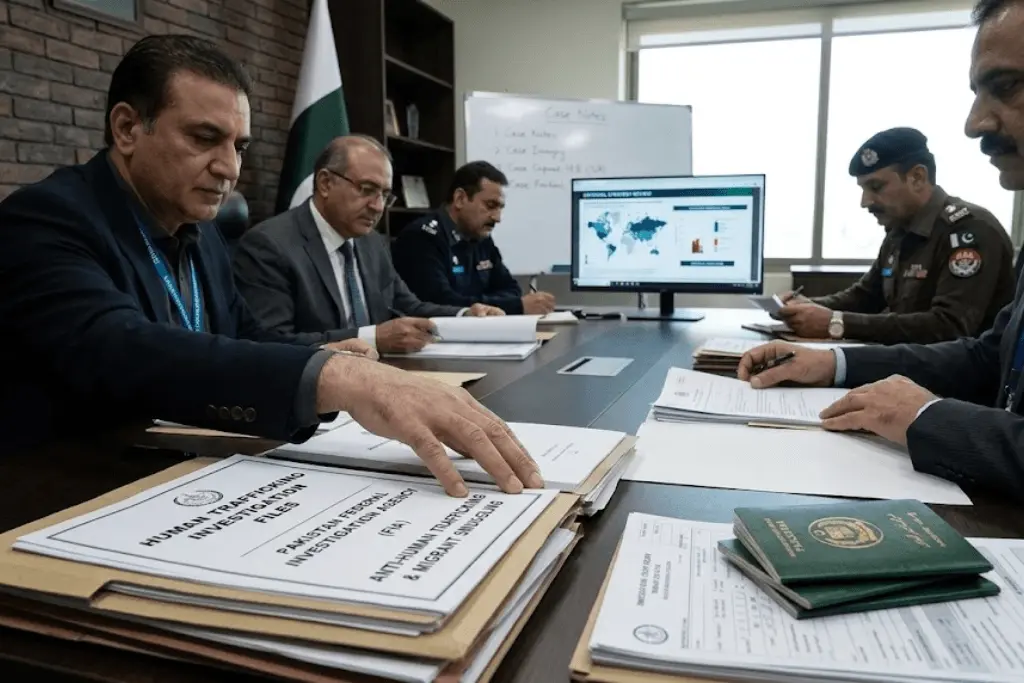
Pakistan human trafficking and migrant smuggling are typically carried out by organised networks that operate across multiple jurisdictions. Such networks exploit vulnerable people with false promises of jobs, irregular migration schemes, debt bondage and other forms of coercion.
Therefore, Pakistan’s national strategy emphasises strengthening cooperation among concerned government agencies and international organisations. This coordinated approach can assist in better identifying criminal networks, while helping authorities to distinguish victims and vulnerable migrants from those directly involved in organised criminal activity.
The framework also fits into broader policy efforts on migration and overseas employment. Better coordination can help promote safer legal migration and reduce opportunities for criminal intermediaries to exploit people seeking employment or travel opportunities abroad.
FIA Intensifies Screening To Prevent Irregular Migration
Pakistan’s Federal Investigation Agency is prominently involved in efforts to prevent human trafficking and migrant smuggling. The approach is especially relevant in situations where forged documents, misleading travel information or suspicious employment arrangements may indicate the involvement of intermediaries.
Under stepped-up vetting efforts, the FIA has turned away almost 40,000 suspicious travellers in the past few months, the information shows. Such measures are a sign of increasing emphasis on preventing irregular departures rather than merely reacting after criminal networks have successfully moved people across borders.
Pakistan Seeks To Hit Smuggling Financial Networks
A key component of the new strategy is the acknowledgement that smuggling of migrants is essentially a profit-driven business. Criminal networks often rely on financial transactions, informal payment systems and intermediaries to generate revenue from vulnerable migrants.
Pakistan’s response has thus included efforts to develop standard operating procedures for financial investigations into migrant smuggling. Tracking the money can lead investigators to evidence that can identify organisers and higher-level beneficiaries, not just low-level facilitators.
Where the legal conditions are satisfied, financial investigations can also assist efforts to freeze or confiscate illicit assets. Cutting off the money that drives organised smuggling often hurts the networks more than individual arrests do.
Technology Can Improve Smuggling Investigations In Pakistan
Technology is rapidly becoming another key element of Pakistan’s evolving strategy. AI-supported databases have been identified as a way of profiling and tracking high-profile human smugglers, and enhancing investigative intelligence.
Digital systems can assist authorities to organise large amounts of information involving travel histories, suspected facilitators, criminal cases and related networks. Correctly handled databases can facilitate the identification of links that might otherwise remain elusive in independent investigations.
Technology can also facilitate information sharing across relevant agencies. Effective enforcement depends on timely access to reliable information, considering that human trafficking and migrant smuggling are often trans-provincial and transnational.
Stricter Border Controls To Protect Vulnerable Pakistanis
It’s not only about stopping crime organisations from committing human trafficking. It also means protecting people who might be duped or exploited by those organisations.
Many potential victims may be tempted by promises of jobs, education or better economic opportunities. Criminal intermediaries may use misleading documentation, false job offers, or unsafe travel arrangements to place vulnerable individuals in situations where it is difficult to escape exploitation, and prevention can be further strengthened by awareness campaigns. Providing clear information on legitimate recruitment channels, documentation requirements and common trafficking schemes may help reduce the scope for deception of prospective migrants by criminal agents.
International Cooperation Supports Pakistan’s Broader Strategy
Pakistan is working with international partners, including the United Nations Office on Drugs and Crime, to develop its response. Expert knowledge is especially important in cases involving complex financial transactions, digital communications, forged documents or international criminal networks. Pakistan’s interaction with international organisations is part of a wider effort to develop institutional capacity. Such partnership also bolsters Pakistan’s efforts to promote safe and orderly migration. Better legal migration systems can shrink the space for criminal intermediaries profiting from irregular migration routes.
National Action Plans Can Enhance Institutional Coordination
One of the major advantages of a five-year framework is the ability to develop measurable and enduring institutional priorities. Clear responsibilities for enforcement, border management, financial investigation and victim support institutions make anti-trafficking efforts more effective.
The 2026–2030 plans can provide an opportunity to monitor progress over several years rather than through short-term enforcement campaigns. Identification can start at an airport or border crossing, but evidence may later need financial investigation, digital analysis and prosecution.
Pakistan’s Approach: Blend Enforcement And Prevention
The national strategy indicates a way forward that goes beyond arrests and border restrictions. Prevention, victim protection, financial disruption and international co-operation are all important elements of a comprehensive response.
Stronger enforcement can deter criminal networks, while prevention can reduce the number of people exposed to exploitation. Financial investigations can undermine the economic foundations of organised smuggling, while technology can boost the ability to detect repeat offenders and networks of mutual interest.
Safer Migration From Pakistan Requires More Decisive Action
Pakistan has a large population that is looking for employment and education opportunities abroad, and safe and regulated migration has become a major national concern. Protecting future migrants from unscrupulous agents and organised crime networks will help safeguard the benefits of legal mobility overseas.
The new framework has put Pakistan in a better position to address the risks of trafficking and migrant smuggling through coordinated prevention and enforcement. Airport screening, financial investigations, tech-enabled intelligence and international cooperation can be elements of a single strategy.