Farhan Qureshi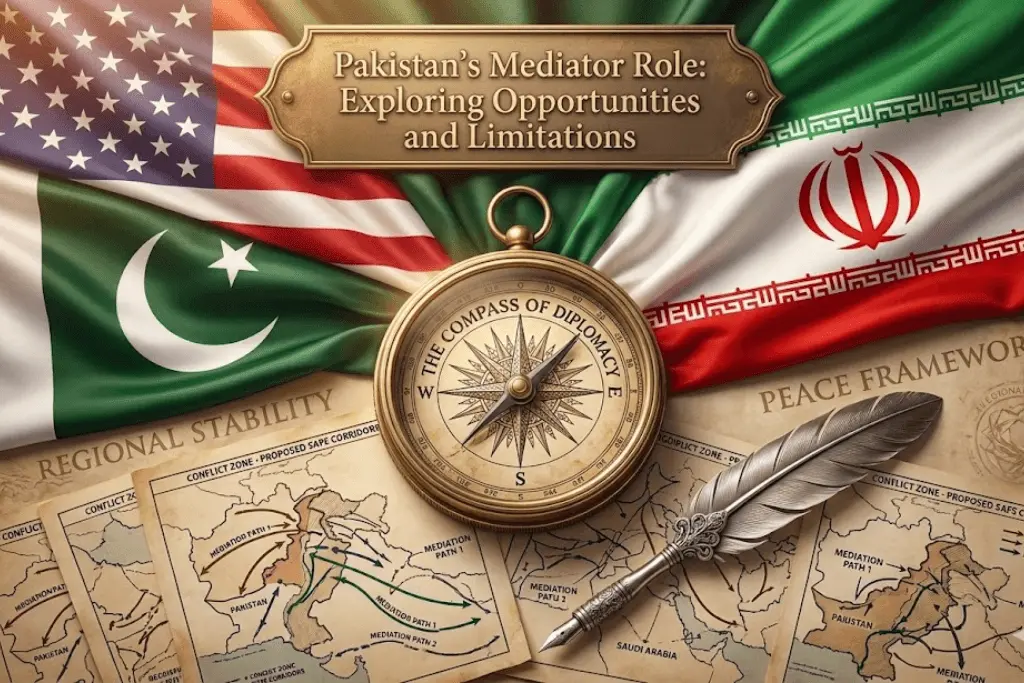
Pakistan mediation role is increasingly emerging as a key conflict resolution actor in the region due to its geopolitical location and global ties. Located between South Asia, Central Asia, and West Asia, Pakistan has established itself between conflicting interests, especially when there are increased tensions, like during the West Asia crisis of 2026.
Pakistan is also strong in maintaining good working relations with different stakeholders simultaneously. Its diplomatic advantage and ties with the United States, Iran and Saudi Arabia provide it with a diplomatic advantage that has never been heard before: one side of the complex conflicts. This place-keeping helps Pakistan to facilitate a dialogue in circumstances where the warring parties cannot communicate face-to-face due to hardships or political issues.
The fact that so far, Islamabad has been used as a place to conduct negotiations has made it look more like a neutral diplomatic place. Through the provision of logistic support, safe places, and diplomatic lines, Pakistan has shown its ability to get warring parties to the table. This aspect of facilitation is particularly effective in conflicts where trust is not present and, therefore, face-to-face communication is a challenge.
In addition, the practice of the country in multilateral diplomacy and its involvement in international peace missions contribute to the credibility of Pakistan. It has acquired over the years institutional expertise in handling intricate negotiations, the dynamics of security, and in how to work around delicate geopolitical matters.
The mediation efforts by Pakistan are also fueled by the necessity to be strategic. Its security and economic future depend on regional instability. Through encouraging dialogue and de-escalation, Pakistan not only help in peace in the region but also protects its own national interests. Such correspondence between the diplomatic action and national interests guarantees the long-term adherence to the mediation activities.
Opportunities and Constraints of the Diplomatic Role in Pakistan
Even though the mediation role of Pakistan has great opportunities, it is also influenced by the complex structural and strategic constraints. On the brighter note, its geopolitical applicability is on the increase since world superpowers have realised that they need neutral mediators in solving conflicts. The capacity of Pakistan to interact with various actors augers well with its diplomatic capital and increases its presence in the international arena.
The foreign policy of the country is exhibited through its attempts to strike a balance between the relationships between enemies, including Iran and Saudi Arabia. By keeping the lines open with both sides, Pakistan can be used as a stabilising factor, a factor that promotes dialogue without taking any particular side. This non-partisan diplomacy plays a key role in preserving credibility as a mediator.
However, we can merely indicate that the mediation as an activity is a complex issue, and the power of Pakistan is normally restricted to forces beyond its command. Old disputes, including those where major players in the world are involved, are largely at the behest of the political goodwill of the principals. Even the most skilful negotiator cannot be certain of success in a situation where the parties involved are not ready to compromise.
The diplomatic prowess of Pakistan is another aspect that has been built due to economic factors. Despite the demonstrated power, the domestic economic problems can limit the ability of the country to exert a lasting influence in the international arena. The implication of the resource limitation can be on the size and sustainability of the diplomatic processes, particularly the long-term conflict resolution processes.
In addition, there is a need to balance between relationships and competing regional powers. Being neutral when it comes to dealing with partners who have conflicting interests is not that easy. Any bias is likely to make Pakistan less credible as a mediator and complicate its diplomatic activities.
Diplomacy of Pakistan in the changing International environment
Pakistan is still improving in its stance as a mediator, even with these challenges. The country is emerging as a more and more significant force as a realistic and reliable partner in the effort to reduce tensions within the region. Its willingness to engage in good things, in addition to its strategic location, renders it relevant insofar as world diplomacy is concerned.
Critically, the mediation efforts of Pakistan help in a wider vision of regional cooperation and stability. It can enable dialogue, thus opening the potential of peaceful resolution, although not all breakthroughs can be made instantly. This gradual process is usually essential in complicated conflicts, whereby improvements are measured in tiny yet significant movements.
Also, the diplomatic efforts of Pakistan are in tandem with the long term objective of enhancing economic and security relations in the regions. Trade, investment and development can only be enhanced by stability in the surrounding regions, so mediation is not only a foreign policy instrument, but also a strategy in the economy.
To walk the thin line between Realism and Diplomatic Ambition.
The ambition and the realism are well-balanced in the mediation of Pakistan. Although its aim is to increase its influence and help in world peace, it is also aware of the constraints of the structural factors. This practical strategy enables Pakistan to work on the things that are attainable and, at the same time, keep on establishing its diplomatic credibility.
Its mediation efforts will ultimately be successful as long as it can remain neutral, enhance internal stability, and continue to engage with all actors involved constructively. By focusing on these, Pakistan will be able to be more effective as a mediator and strengthen its role in the international arena.
Building Mediation by Regional Cooperation and Conversation
A significant and dynamic aspect of Pakistani diplomacy is that it is able to increase its mediation activities. Mostly, by means of regional associations and enduring dialogue forums. Pakistan is slowly establishing an extended support network of peace efforts. That too, by enhancing its partnership with its neighbours and international bodies. This joint method promotes the development of trust between the interested parties and also minimises the pressure on one mediator.
The participation of Pakistan in multilateral forums enables it to streamline its mediation processes with the global peacebuilding models. These platforms offer the possibilities to synchronise with other powerful actors so that diplomatic initiatives are not single but are a part of the bigger and more collective action. This enhances the possibilities of significant development in complicated conflicts.
Moreover, the emphasis of Pakistan on dialogue-based solutions reveals that the country is seeking long-term stability as opposed to short-term benefits. It simplifies the process of communication between those on opposite sides and enables them to communicate at any time, preventing a further deterioration of the situation, allowing compromises to be made. This is a realistic and consistent procedural style that enhances the image of responsible and visionary diplomacy of Pakistan.
In conclusion, Pakistan’s diplomacy in settling disputes in the region shows that it is becoming more important as a diplomatic player, but there are still issues. Nonetheless, due to its strategic positioning, balanced foreign policy and commitment to dialogue, it is a desirable place to enhance existing relations.