Adeel Hassan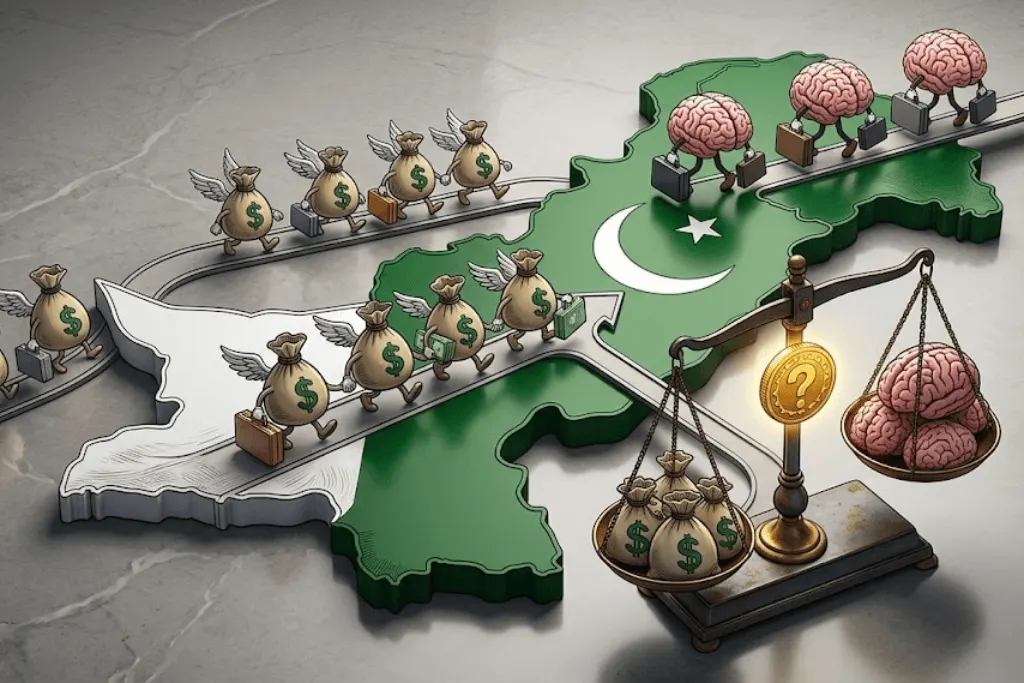
The economy of Pakistan is defined not only by national policies but also by brain drain Pakistan and the migration of its citizens to the rest of the world. Two key forces are central to defining this relationship: brain drain and remittances. Although the migration of skilled professionals out of the country raises concerns relating to the long-term development, the billions of dollars returned home by Pakistanis living abroad keep on giving essential economic assistance.
These two phenomena cannot be discussed as contradicting trends; however, the situation in Pakistan shows a more intertwined reality. Brain drain and remittances are closely connected to each other and, with the help of each other, create a complicated but potentially effective system that can bring a country’s development, provided it is managed correctly.
Brain Drain vs. Remittances: Is Leaving Pakistan Actually Killing Its Future? – YouTube
Remittances driving stability and growth
Remittances now stand out as one of the pillars of the Pakistani economy. They contribute about 8-10 per cent of the GDP of the country with annual inflows of between 34 billion and 38 billion dollars. This flow of foreign exchange has been very significant in ensuring that the economy is stable, particularly in difficult economic times.
Among the greatest benefits of remittances is that they have enabled Pakistan to bolster its external accounts. The inflows contribute to sustaining the foreign exchange reserves, currency stabilisation, and minimising the dependency on foreign borrowing. Remittances have been important in most situations since they have surpassed export earnings, indicating that they are a sure way of earning the country some income.
The impact becomes even more noticeable on the household level. Millions of families in Pakistan rely on remittances of their relatives who are working in foreign countries. With these remittances, households are in a position to buy themselves a better education, health care and standards of living. They can be a lifeline in rural areas, sustaining whole communities and decreasing the level of poverty.
Domestic consumption is also enhanced by remittances, and it is a major driver of the economy. High expenditure results in an increment in the demand for goods and services, which in turn benefits the local business and creates employment opportunities. The impact of remittances is experienced in the economy, both in small shops and in the larger industries.
The other crucial factor is the strength of these inflows. Overseas Pakistanis have always helped their families in the country, even in times when the world is in recession. Such closeness in terms of emotions and finances is an indication of responsibility and nationalism that has been an ongoing help to Pakistan.
In addition, remittances give policymakers room to undertake reforms to stabilise the economy. They are a buffer in times of crisis so that critical imports and financial requirements are all under control.
Brain drain Pakistan and its long-term implications
Even though remittances have direct economic impacts, brain drain is a more complicated problem. The movement of highly trained professionals, including doctors, engineers, IT professionals and researchers, has posed a question regarding the growth and development of Pakistan in the long term.
Loss of human capital is one of the major problems related to brain drain. Talented people are very important in innovation, productivity and institutional change. As they go, the nation is left with a skills gap that may hamper development in major areas.
The medical industry is a good illustration. Medical professionals in Pakistan receive a lot of training, but most of the doctors opt to work overseas due to improved opportunities in other countries. This gives hospital and clinic shortages, especially in underserved regions, to the quality and access of healthcare services.
On the same note, the technology and engineering industries have a problem with talent retention. With the world seeking better-skilled professionals, Pakistani professionals have a tendency to attract more opportunities abroad. Although this has brought out the competitiveness of the Pakistani workforce globally, it also points to the need to establish more opportunities in the country.
The other significant reason is investment in education in terms of finance. Pakistan is investing a lot of resources in human capital development in the form of state universities and training. The migration of talented people results in their contributions to other economies, leading to an indirect economic loss to Pakistan.
Nevertheless, it is critical to consider brain drain in a wider scope. A lot of Pakistani professionals in other countries acquire good experience, skills and international exposure. Such assets can ultimately be of benefit to Pakistan in terms of transfer of knowledge, investment and cooperation.
The idea of an international Pakistani network has become relevant in the past few years. Expatriates usually give back to their home country by mentoring them, working remotely, and participating in business ventures. This dynamic change implies that brain drain may, in certain instances, become an opportunity to engage globally.
Finding the balance between short-term gains and long-term growth
The discussion between brain drain and remittances is usually presented as a trade-off between short-term economic gains and long-term development problems. The truth is more subtle, though. Pakistan does not have to make such a trade-off between the two, but it can use both to develop a balanced and sustainable model of growth.
One of the strategies is to transform brain drain into brain gain. This includes the provision of an environment that would motivate skilled professionals to come back or work abroad. Increased talent attractiveness can be achieved in Pakistan through the provision of competitive salaries, better working conditions, and research and innovation investment.
A positive outlook for Pakistan’s future
The discussion between brain drain and remittances cannot be put in terms of a short-term benefit and long-term loss. Rather, Pakistan can change this dynamic to a win-win situation.
The so-called concept of brain gain is one such promising approach. Ensuring that the country has attractive opportunities for professionals (competitive salaries, research funds, support of entrepreneurship) will help to make skilled professionals come back to the country or work remotely. The emergence of online labour and international connectivity enables foreign Pakistanis to donate more than ever without the need to move in person.
Meanwhile, instead of consumption only, the remittances can be directed at productive investment. Economic benefits of these funds can be manifold through the adoption of policies encouraging investment in real estate, startups, and small businesses. This would not only boost the economy but it would also generate employment and decrease the urge to migrate to another country.
The increasing attention to technology, infrastructure and economic reforms in Pakistan is a good sign. Efforts to enhance ease of doing business and enable innovation are slowly turning the country into a place where local and foreign talent can be attracted.
Lastly, remittances and the ability of Pakistani professionals to move around the world are both strengths, not weaknesses. When used together and managed well, they can help the organisation grow in the long term and stay stable in the short term.
The people of Pakistan, both at home and abroad, are what make the country strong. The country can turn current problems into long-term benefits by using this global network and putting money into opportunities at home. This will make sure that the future is more prosperous and sustainable.