Farhan Qureshi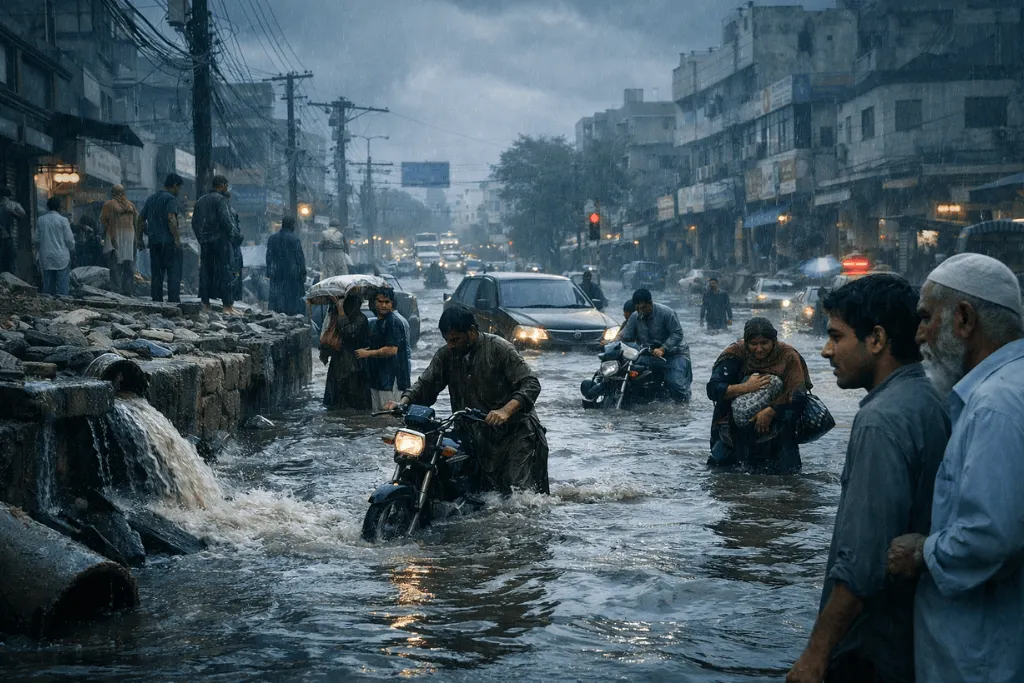
Flooding in cities is one of the biggest problems in Pakistan’s big cities, especially due to urban flooding Pakistan issues. In Lahore and Karachi, especially. Every monsoon season brings pictures of streets that are flooded, infrastructure problems, and people having to put their lives on hold. But the most important thing that many people want to know is who is really at fault?
It isn’t easy to find the answer. Cities flood for a lot of reasons, such as more people moving there and climate change. It’s good to know that Pakistan is also becoming more aware of these kinds of problems and is working toward long-term urban resilience.
Understanding what causes urban flooding in Karachi and Lahore
To understand what responsibility is, we need to first look at what caused it. Karachi and Lahore are two of the biggest cities in Pakistan, and they’ve grown a lot in the past few decades. This growth is a sign of urbanisation and economic growth, but it has also put a lot of stress on infrastructure.
1. A lot of people are moving to cities, and a lot of people are living there
Karachi, which is the financial centre of Pakistan, and Lahore, which is the cultural centre, both grew very quickly. As a result, there is less open space, more informal housing, and drainage systems that are getting too close to homes. When there is no way for the rainwater to go, flooding is sure to happen.
The growth of urban areas has also led to the substitution of permeable land (soil) with concrete surfaces. This will not allow the water to be absorbed into the ground naturally, which enhances the surface runoffs during the heavy rains.
2. Inadequate Drainage Infrastructure
Outdated or inadequate drainage systems are one of the most put forward causes of flooding. Most of the areas in Karachi and Lahore are based on the infrastructure that was not planned to accommodate the current population.
Clogged drains, inadequate maintenance, and limited capacity will result in the system being flooded even with moderate rainfall. In Karachi, e.g. stormwater drains are usually combined with sewage systems, thereby increasing the complications of water movement.
3. Intense Rainfall and Climate Change
Pakistan is one of the nations that is highly susceptible to climate change. Alteration of weather patterns has resulted in increased and unpredictable monsoon rains.
The winds of the Arabian Sea and Bay of Bengal are very humid, and low-pressure systems form powerful downpours. These necessities cripple the city systems, particularly in cities with a high concentration of people.
4. Environmental Degradation and Industrialisation
Although industrial development is a crucial aspect of economic development, it has also led to environmental stress. Flood risks are enhanced by encroachment on natural waterways, the shrinkage of the green cover, and the subsidence of land (sinking).
Other issues that are of concern in Karachi are coastal erosion and underground water depletion, which cause the city to be more susceptible to the build-up of water during heavy rains.
Who Is Responsible for Urban Flooding?
It would be a simplification to point the blame for the urban flooding to a single entity. It is a systemic issue, and it has many stakeholders.
1. Government and Urban Planning Authorities
The government institutions are very influential in the city planning, development of drainage and maintenance of the infrastructure. In other instances, current problems have been caused by gaps in long-term plans or failure to implement projects in time.
Nevertheless, it is also crucial to point out that the government of Pakistan is also undertaking more urban development initiatives, drainage system improvements and climate resiliency plans. An example is Lahore, which has improved its drainage network over the recent years, and Karachi, which has projects in progress to restore major drains.
2. Local Government and Municipalities
The city governments are mandated to keep drainage systems clean, clear trash, and control the services in the cities. Waste management inefficiency, including garbage that blocks the drains, can greatly exacerbate floods.
Positively, most local authorities are adopting more appropriate ways of managing waste and emergency response mechanisms during the monsoons.
3. Community Behaviour and Citizens
The behaviour of the populace is also a key factor. Poor disposal of waste, encroachments and ignorance lead to blocked drains and low water flow.
Urban flooding is not only a governance problem, but it is a collective responsibility. Civic responsibility and increased awareness can go a long way in mitigating the effects of heavy rains.
4. Climate and Global Factors
Not everything is in our power. The problem of climate change is a global problem, and Pakistan has a very small percentage of emissions. However, it is disproportionately affected by phenomena such as floods and extreme weather.
This underscores the importance of local adaptation combined with international collaboration in order to solve challenges associated with climate.
Pakistan’s Efforts Toward Solutions and Resilience
Although urban flooding is still a problem, Pakistan is already striving to find solutions. It is not only a story of issues, but of development and strength.
1. Infrastructure Development Projects
In both Karachi and Lahore, massive drainage and urban development works are being executed. They involve adding stormwater drains, renovation of natural drains (nullahs) and water reservoirs.
2. Climate Adaptation Strategies
Pakistan is turning into a country that is concerned with climate resilience. Policies are being formulated to enhance disaster management, early warning and sustainable urban planning.
3. Smart Solutions and Digital Monitoring
More and more, people are using technology to help keep cities from flooding. Thanks to weather forecasting systems and electronic monitoring of drainage networks, cities have grown better at dealing with bad weather.
4. Campaigns to get people to pay attention
Some programs teach people how to live in cities responsibly, protect the environment, and deal with trash. Individuals in a community need to get actively involved for things to work out in the long run.
A Reasonable Look at Responsibility
The flooding in Karachi and Lahore is caused by years of unforeseen growth, adjustments to the environment, and challenges with the infrastructure. It’s simple to blame others, but that doesn’t represent the truth.
Who is in charge of:
- The government is in charge of planning and doing.
- Taking care of and running the city.
- People should be aware and take action.
- Climate change around the world.
The first step on the way to the real solutions is the recognition of this common responsibility.
Looking Forward: A Better Urban Pakistan.
There are issues, yet things are improving. The Pakistani cities are evolving, and past floods are being used to improve policies and infrastructure to make them more resilient.
The problems are not only in Karachi and Lahore, but these cities are getting smarter, larger and better, with more money, improved planning, and collective responsibility. Also, the effects of flooding in cities can be greatly lessened.
Flooding in such cities as Karachi and Lahore is not a new and unsolvable issue. It is still possible to make Pakistan more powerful and stronger in its metropolitan areas. It will only know why and will agree that it is the job of everyone.