Farhan Qureshi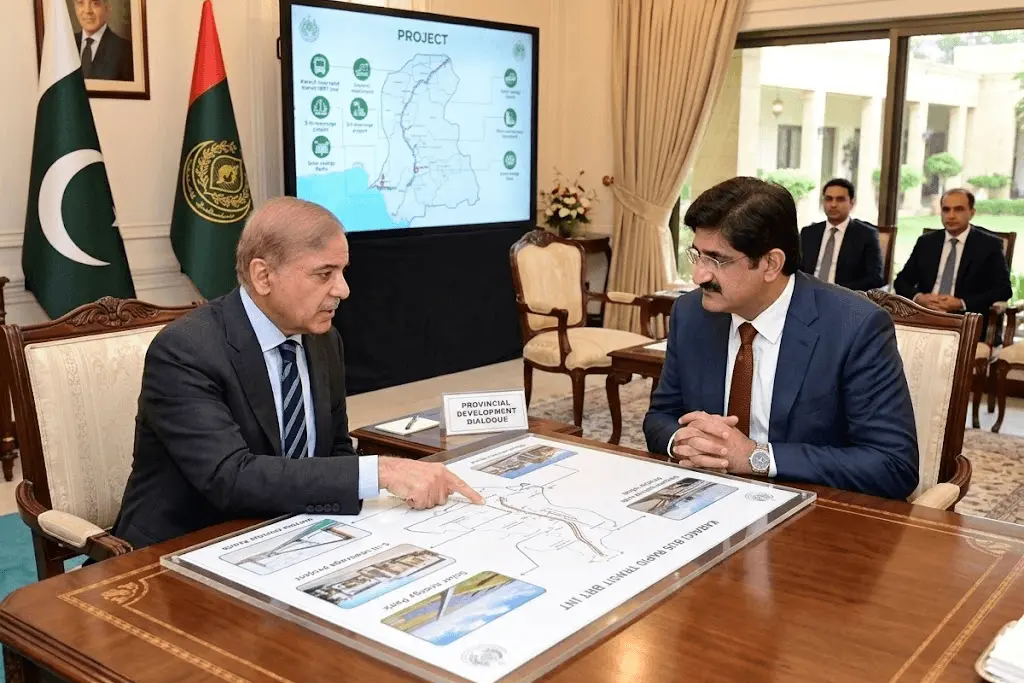
The meeting highlighted that with major development programs ongoing in Sindh, coordination between the federal and provincial governments of Pakistan is crucial. The talks also touched on issues of common concern and politics, and the two sides emphasised consultation and political tolerance. Islamabad and Karachi must continue to engage to maintain momentum on infrastructure, public services and broader economic development across the province.
Shehbaz Sharif, Murad Ali Shah Discuss Sindh Development
The meeting was an opportunity for Prime Minister Shehbaz Sharif and Sindh Chief Minister Murad Ali Shah to review the progress of development projects in Sindh. Talks focused on provincial priorities and ways to strengthen cooperation between federal and provincial administrations.
Sindh remains one of Pakistan’s most economically important provinces, with Karachi as a major commercial centre. The province supports significant industrial, agricultural, energy and transport activity. Thus, good coordination between the two levels of government can be important for national economic performance.
The meeting highlighted the significance of development projects keeping up momentum and giving concrete benefits to communities. Coordinated planning for Sindh can link provincial development priorities with national programs on transport, trade, energy, urban infrastructure and economic activity. Such coordination can also lead to better responsiveness of government institutions to new needs in fast-growing urban and industrial areas.
Regular review of development schemes can help improve cooperation between the federal government and Sindh administration, it adds. Approved initiatives can be made visible in terms of results by monitoring progress, removing administrative bottlenecks and keeping to implementation timetables.
Development cooperation is also relevant when considering Pakistan’s broader economic goals. Sindh’s trade, manufacturing, agriculture, ports and financial services sector contribution makes provincial projects have a national dimension, especially when better infrastructure can boost movement of goods and support private sector activity.
So the meeting was more than a routine exchange between two senior political leaders. Long-term engagement between federal and provincial governments can provide a context in which development needs can be met while enhancing stability and economic confidence.
Attention To Sindh Development Priorities In Islamabad
The discussion comes amid the wide scope of development requirements in Sindh, which include urban infrastructure and transport to water management, public services and economic connectivity. There is a need for both provincial planning and federal cooperation, as different parts of the province have different needs.
Infrastructure development is particularly important given Karachi’s role as Pakistan’s largest commercial centre. Better connections between production sites, commercial zones and transportation networks can help to overcome logistical difficulties and offer better conditions for investment.
Federal support can reinforce provincial efforts where projects have broader national importance. Coordination can also be useful for ensuring that infrastructure planning is aligned with Pakistan’s wider economic strategy and that provincial development contributes to national growth.
The meeting between Shehbaz Sharif and Murad Ali Shah thus brought renewed focus on the need to maintain the development momentum across Sindh. Shared priorities could be translated into more coordinated action through continued political and administrative engagement.
The Meeting Emphasises Political Consultation And Tolerance
The two leaders also discussed political issues and development issues and stressed the importance of political tolerance. The emphasis on consultation widens the scope of the meeting, especially in the light of the continuing need for co-operation between different levels of government for effective administration.
Political stability can underpin development by providing a more predictable environment for planning in the public sector and for private investment. Through constructive engagement between federal and provincial governments, avoidable friction can be reduced, and attention can be focused on economic and social priorities. A federal set-up could have regular lines of communication between Islamabad and provincial capitals to sort out concerns before they become hindrances to development programs.
Continued dialogue between the federal and provincial governments in Sindh can help to coordinate on issues affecting infrastructure, economic activity and public services. Such engagement can also be a vehicle for discussing provincial requirements within the framework of broader national policy frameworks.
Thus, the focus of the meeting on political tolerance complemented its development agenda. And when government institutions communicate with each other and make efforts to find practical solutions despite political differences, economic progress and public welfare are better served.
Development Cooperation Can Strengthen Sindh’s Economic Role
Sindh is a very important part of the Pakistani economy and its overall development is closely interlinked with the development of the whole country. Sindh’s centrality to Pakistan’s economic map is a function of the commercial significance of Karachi, the province’s agricultural base and its industrial and maritime potential.
Development projects that enhance connectivity can have benefits beyond individual districts. Better roads, transport systems and supporting infrastructure can ease the movement of goods from production centres to markets, and stronger public services can improve conditions for communities and businesses.
Such collaboration can be particularly useful for projects involving more than one government department. High-level political oversight is an important element of successful delivery of infrastructure and development schemes that often involve coordination across planning, finance, local administration and technical agencies.
Sindh’s progress is thus pertinent to Pakistan’s broader ambitions for economic growth. Continued investment, improved institutional coordination and more efficient delivery of infrastructure can help unlock the province’s considerable economic potential.
Sindh CM Shehbaz Sharif Signals Ongoing Development Cooperation
Prime Minister Shehbaz Sharif and Sindh Chief Minister Murad Ali Shah held a meeting in which they stressed development, provincial matters and political consultation as areas of mutual focus. The engagement demonstrated the need for continued engagement between the federal government of Pakistan and the Sindh administration.
Current development projects can help maintain focus on implementation and practical results. Ongoing coordination could help with providing infrastructure, while mitigating administrative and provincial issues that could impact the pace of development.
The emphasis on political tolerance and consultation is also what makes the engagement important. Sindh can benefit from a cooperative federal-provincial relationship in terms of administrative stability and better conditions for sustained development.
Better coordination between Islamabad and the provincial governments can help Pakistan develop a more integrated approach to economic and social development. Effective implementation of development initiatives in view of Sindh’s strategic economic position is of particular importance for the progress of the country.
But the meeting ultimately reaffirmed a common focus on development and stability. Ongoing federal-provincial consultation and effective implementation of projects can enhance Sindh’s contribution to the economic growth of Pakistan and to broader national development objectives.