Urooj Niazi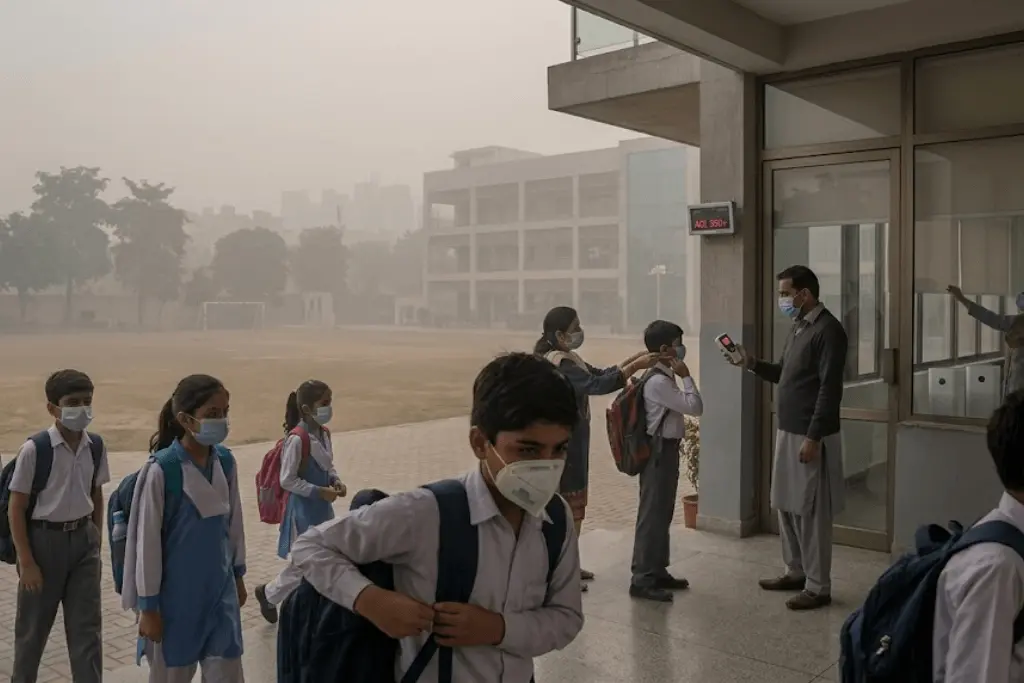
With recurring episodes of smog, Punjab schools smog has become a more and more important public policy issue for school safety. Classroom ventilation, outdoor activities, school timings and emergency measures are important components of air-pollution management as children spend a large proportion of their day in educational institutions.
Protecting students from hazardous air does not have to be a choice between health and education for Pakistan. Stronger prevention measures can allow schools to continue operating where conditions allow, while limiting unnecessary exposure during dangerous pollution periods.
Punjab’s Schools Face Mounting Challenge Of Smog Protection
Smog can make life hard for schools all over Punjab, especially when pollution levels soar during the colder months. Normal student and teacher activities may be hampered, and outdoor visibility may be reduced by the heavy concentrations of pollutants.
For children, this is even more of a challenge as they are still developing physically. Smog can cause coughing, sore throat and difficulty in breathing. When pollution levels become severe, the problems can be compounded for children with asthma and other respiratory vulnerabilities.
This is why school-based measures of protection are important. Limiting students’ exposure to heavily polluted outdoor environments can provide additional protection during episodes of severe smog.
Smog Can Affect Learning And School Attendance
Air pollution has other impacts besides physical health. Air-quality information can also be used to help determine when schools open. A delayed start to the school day could reduce exposure for students travelling to school during the most dangerous pollution periods, especially during early morning pollution episodes.
If there was a standard approach, schools across Punjab could respond more consistently. Some clear guidance from education authorities would help administrators know when to impose restrictions and when it is safe to resume normal activities.
Smog Requires Stricter Regulations On Outdoor Activities
Physical activity increases the rate of breathing and can lead to a greater intake of polluted air during exercise. Therefore, outdoor sports and physical education should take additional precautions in case the air quality deteriorates.
Schools can temporarily move sports, assemblies and other activities indoors during episodes of severe pollution. Indoor options can help keep students engaged, without putting children at unnecessary risk from outdoor smog.
These measures are not an absolute prohibition of outdoor activities. They offer instead a flexible response that can be activated according to actual pollution conditions.
Masks may offer extra protection
Masks could offer an extra layer of protection during periods of high pollution, especially when students need to go outside or between school buildings. School authorities are in a position to give clear guidance on appropriate use in severe smog conditions.
It think mask policies need to be part of a broader safety plan rather than a single solution. Indoor air quality, less outdoor exposure and appropriate ventilation remain important aspects of overall protection.
Classrooms Must Be Protected From Polluted Outside Air
During high outdoor pollution, it is advised to keep doors and windows closed to limit polluted air intake into the classrooms. But the air quality inside is also important because enclosed rooms can become poorly ventilated. Practical upgrades can improve the indoor conditions and at the same time facilitate broader improvements in school infrastructure.
Later school start times could reduce morning exposure.
Morning hours can be a challenging time for pollution during winter smog episodes. Delays in school start times can reduce exposure during times of the day when pollution and cold-weather atmospheric conditions combine to create unhealthy air.
Schools will also have more time to check the daily air quality with later openings. Then administrators can make informed decisions about outdoor activities and other student programs.
Changes in timing should be provided well in advance whenever possible. Such an approach can help to ensure the continuity of education while keeping the health of students at the forefront. Decisions should continue to be based on credible information on air quality rather than on generalised assumptions.
Teachers Need Clear Smog Safety Procedures
Teachers are central to implementing school safety measures. School personnel should be aware of emergency procedures and when a student requires medical attention. A uniform protocol across Punjab could bring in more consistency. Then teachers would have a clear institutional direction, instead of having to make individual decisions in rapidly changing pollution conditions.
Schools Should Provide Good Information To Parents
Another important part of smog protection is communication between schools and families. Parents should be informed in advance regarding school timings, closures, outdoor restrictions and other precautionary measures.
Confusion can arise from unclear or delayed announcements. Consistent messaging to the public can also reinforce healthy practices outside of school. Families can use guidance from schools and official air-quality information to limit children’s exposure during severe smog events.
Punjab Can Foster Planning For School Air Quality
A province-wide framework that connects school operations with air quality monitoring can be a boon for the education system of Punjab. Such a framework could establish clear thresholds for outdoor activities, school hours and temporary closures.
The approach could also spur schools to prepare emergency plans ahead of the smog season. Such planning would be a wise investment in student welfare. It would also demonstrate that environmental health can be incorporated into routine education policy.
Better School Infrastructure Supports Long-Term Protection
Temporary restrictions are not enough to protect from smog in the long term. Schools can slowly improve ventilation, filtration, classroom design and green infrastructure as part of larger infrastructure improvements.
Modernised classrooms can provide healthier indoor environments during episodes of pollution as well as extreme weather. Benefits from improvements in building design would therefore accrue throughout the academic year.
The investment should be directed at schools with large student populations and communities suffering recurrent serious air pollution. Such specific improvements can stretch limited resources.
Technology Can Boost Punjab’s Smog Response
Schools can use digital resources to monitor local air-quality conditions and communicate decisions quickly. Real-time pollution information can help administrators in deciding whether to ban outdoor activities
Schools can also use digital platforms to alert parents about delayed starts or temporary closures. This can reduce uncertainty and help families to vary arrangements easily.
In time, a networked digital system could link school authorities with environmental monitoring agencies. Such integration would make the answers more consistent and data-driven across Punjab.
Protecting Students Supports Pakistan’s Education Goals
The health of students and continuity of education are closely intertwined. Regular exposure to unhealthy air can lead to health problems that impact children’s attendance, concentration and participation.
Stronger smog protection therefore adds to Pakistan’s broader investment in education. Healthy children are more likely to attend school regularly and be better able to perform in the classroom during difficult environmental conditions.
Punjab can demonstrate that environmental protection and educational development can go hand in hand. A good smog plan can protect students without unnecessarily disrupting their education.
Punjab’s Stronger Smog Rules Make Schools Safer
Punjab’s recurrent episodes of air pollution require a structured approach that combines prevention, monitoring and rapid response. That framework can include outdoor limitations, staggered school schedules, classroom protections and appropriate mask guidance.
But one measure will not form the basis of the best policy. Reliable air-quality monitoring, clear thresholds, teacher training, family communication and infrastructure improvements can offer stronger protection.
The protection of children from the ravages of severe air pollution is a public-health obligation and an investment in the future of Pakistan. Punjab can continue education with more stringent school smog measures and provide safer learning environments for students.