Farhan Qureshi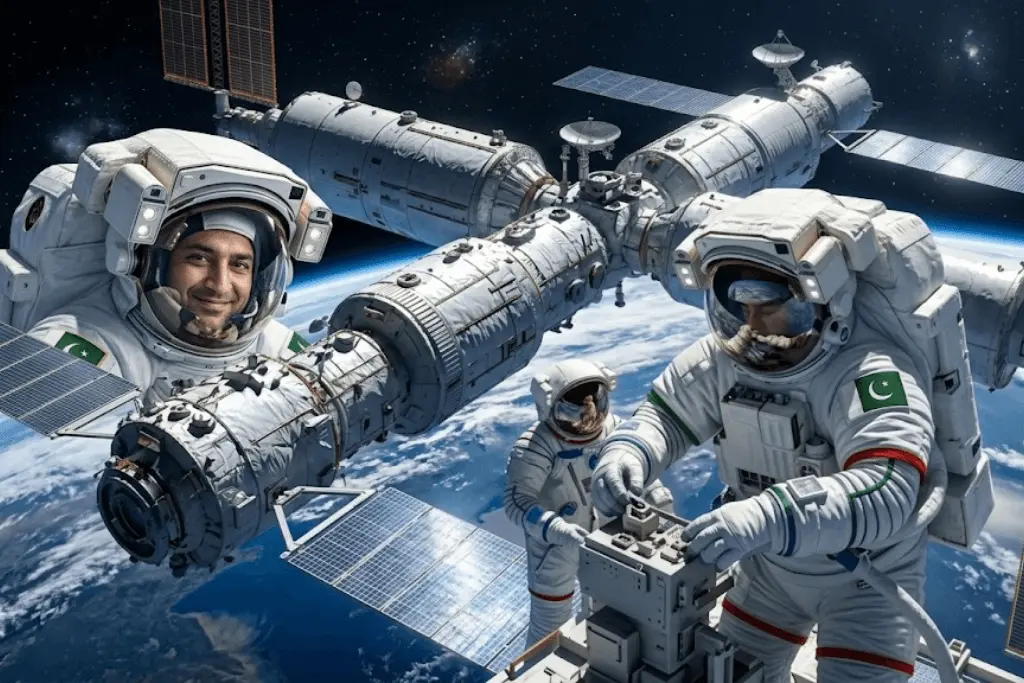
In its space exploration, Pakistan has achieved a historic step in its space exploration endeavour. Two Pakistani astronauts 2026 candidates, Muhammad Zeeshan Ali and Khurram Daud, have been chosen to make a future visit to the Tiangong Space Station in China, the first ever to have such opportunities. This historic breakthrough does not only concern space exploration, but it also indicates the increased ability of Pakistan in the field of science, technology and cooperation.
These candidates have been selected by the China Manned Space Agency and SUPARCO after an arduous, tough selection process, which signifies a new dawn full of aspirations and accomplishment. Their trip is a national pride, and the countries making the contribution to human spaceflight are a very small group, and Pakistan was in it.
Who Are the Selected Pakistani Astronauts?
Both candidates are well-trained Pakistani Air Force pilots who have an outstanding sense of discipline, technical skills and stamina for the operation.
Muhammad Zeeshan Ali
Having a solid academic and operational experience, Zeeshan Ali proved himself to be excellent in both aviation and scientific abilities. The choice of his selection is characteristic of the emphasis on high standards and merit in Pakistan.
Khurram Daud
Khurram Daud is no exception, and he has also had a history of track record in the operation of demanding flights. His physical condition, mental preparation and critical thinking abilities made him a beau par.
The two astronauts had been heavily tested with medical examinations, psychological tests and technical examinations- only those who were capable of being there were selected.
Pakistan’s Role in the 2026 China Space Mission
The chosen candidates will first be used as reserve astronauts, with one of them likely to become a payload specialist in the 2026 mission. This is a very important position, which also entails the tasks of controlling and carrying out scientific experiments in the Tiangong station.
The mission belongs to a bigger cooperation between Pakistan and China, emphasising the strengthening of relations in the sphere of advanced science. It is also an indication that Pakistan had entered the human spaceflight- a great step towards the technological dreams of the country.
Training Journey: Preparing for Space
Both candidates will be subjected to intensive training in the Astronaut Centre of China starting in late 2025. This one-year course will equip them with the sophisticated aspects of space travel.
Key Training Areas
- The process of running the Shenzhou spacecraft.
- Learning how the Tiangong station is organised (three modules).
- Doing experiments in low-gravity environments.
- First aid and survival skills.
The training would be aimed at international best practices, so that the chosen astronaut is well prepared to handle the mission that is scheduled towards late 2026.
Scientific Experiments: Pakistan’s Research in Orbit
And this is not a mere mission on a symbolic level, but a highly scientific mission. Already over 300 experiments, proposed by Pakistani institutions, have been shortlisted at SUPARCO.
Focus Areas
- Microgravity research
- Fluid physics and material science.
- Life sciences and biotechnology.
- Aerospace technology, astronomy.
- Real-World Impact
The study will focus on answering the topical global and domestic issues, such as:
- Climate resilience
- Food security
- Industrial innovation
One of the astronauts is a payload specialist and will consequently be instrumental in carrying out these experiments, putting Pakistani science in space.
Strengthening Pakistan-China Space Cooperation
This mission is included in a bigger space partnership between China and Pakistan (2025-2029). There are several futuristic initiatives in the partnership:
Joint Space Science Training
A dedicated training facility will assist in creating future astronauts and scientists, which will guarantee the long-term development of the Pakistani space industry.
Lunar Exploration Collaboration
Pakistan is also likely to join the Chinese missions to the moon, including donations towards the international lunar research station.
Technology Development
Similar joint projects like advanced satellites are already improving the capabilities of Pakistan in disaster management, agriculture, and environmental surveillance.
Why This Moment Matters for Pakistan
The choice of Muhammad Zeeshan Ali and Khurram Daud is no mere milestone; it is more of a measuring rod of progress. It indicates Pakistan’s dedication to invest in science, talent and establish international partnerships.
This is a great source of inspiration to young Pakistanis. It demonstrates that with the help of hard work and opportunity, it is possible to get to space, not a far-fetched dream but the real thing.
As Pakistan gets ready to launch its first mission to space to send a man, there is a buzzing feeling. The expedition of these two astronauts reflects the dreams and possibilities of the country. Pakistan is on the verge of a new cultural/technological era, with one of them set to visit the Tiangong Space Station in 2026.
This does not just mean jumping into space, but it is jumping into a better, innovative future for Pakistan.