Sana Khalid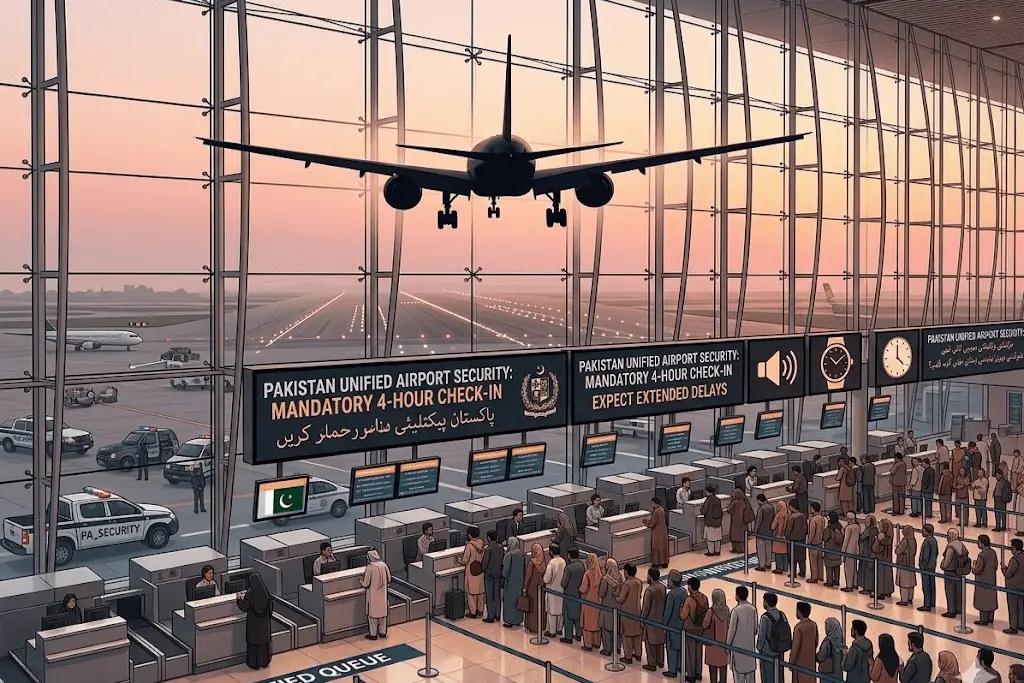
Pakistan Airport Security 2026 marks a new era of smarter, faster, and safer air travel. By introducing a single and integrated airport security system, the agencies are hoping to change the experience of passengers in each of the key hubs of the major Islamabad International Airport, Jinnah International Airport and Allama Iqbal International Airport.
Although the modernisation will bring efficiency and convenience in the long-term, short-term delays might be experienced by flights today. The reason? A phase of transition, with new technology, stringent protocols and testing of the systems. Keep this in mind, and you will never find yourself caught out in a last-minute rush and travel hassle-free.
What Is Pakistan’s Unified Airport Security System?
The new system presents a one-window clearance model, which is an extension of multiple checks with a single and smooth check. Patrons are no longer transported via different counting systems; namely immigration, customs and security, wherein they are transferred to integrated patenting points.
This project, which is being spearheaded under the guidance of Mohsin Naqvi, is set to cut clearance time significantly, from 3-5 minutes per head to just 45 seconds.
Key Features
- Multijurisdictional joint counters.
- State-of-the-art 3D scanning.
- Faster automated e-gates to make boarding faster.
- Centralised passenger verification.
The aim is simple: to improve security and streamline operations in making the airports in Pakistan more efficient and, at the same time, competitive in the world.
AI & Biometric Technology: The Future of Travel
One of the key aspects of this upgrade is the incorporation of the state-of-the-art biometric and AI solutions.
What’s Changing?
Facial recognition, identification using fingerprints and iris scanning.
Artificial intelligence (AI)-based screening systems are connected to such national security databases as the Federal Investigation Agency.
Decreased use of paperwork and a shift towards a paper-free and cash-free travelling experience.
These inventions are aimed at thwarting identity fraud and enhancing the levels of passenger safety, and Pakistan is one of the countries implementing next-generation aviation security standards.
Why You Might Experience Delays Today
Although this will have long-term advantages, the implementation stage of the system can put a stop to progress in the short run.
1. System Testing & Transition
The new process is actively being tested out with special testing of it at Islamabad International Airport. Bottlenecks can occur during the adjustments and troubleshooting processes of busy times.
2. Additional Security Checks
To make sure that the more stringent measures are observed, authorities can introduce Secondary Ladder Point Checks (SLPC), additional checks performed manually in boarding gates.
3. Airspace & Operational Factors
Outside factors, including local airspace control, rerouted flights, are causing delays between schedules as well.
Although these problems can be present-day timing issues, they are a subset of a larger change, which will eventually cause the reduction of congestion and enhance reliability.
New Check-in Guidelines You Must Follow
To make travel in the new system smoother, passengers will need to adhere to the following new travel rules:
1. Complete Web Check-in in Advance
Most flights highly recommend online check-ins, although it is not mandatory. Create a digital boarding pass via your airline (on its website or mobile application) before getting to the airport.
2. Arrive Early
- International flights: Be at least the arrival time of flights 3 hours before departure.
- Domestic flights: Be there at least 2 hours prior.
This buffer is very important in the phase of transition.
3. Keep Documents Ready
Ensure you carry:
- Looking for a passport (when travelling internationally).
- Photo ID, issued by CNIC or the government.
- Electronic or paperboarding pass.
Passengers might be requested to show documents as opposed to presenting them. And it will contribute to a more contactless procedure.
4. Be Prepared for Biometric Scans
Anticipate using facial recognition or fingerprint scan at several locations. Be careful enough to follow instructions so as to avoid delays.
A Positive Shift for Pakistan’s Aviation Sector
Despite the inconvenience that could be encountered by travelling persons temporarily, the long-term scenario is very promising. The investment in the modern aviation infrastructure of Pakistan can be viewed as a successful move towards progress, safety, and international standards.
With the unified system, it is anticipated that it will:
- Minimise waiting time on a long basis.
- Improve passenger flow.
- Enhance national security.
- Increase international trust in the airports in Pakistan.
This revolution provides Pakistan with a world-leading aviation location, strengthening its role as a progressive country.
Today, when you are travelling, some additional preparations will go a long way. New centralized system of airport security is a major improvement, although it may be accompanied by temporary adaptations.
You can overcome the changes by making sure that you arrive early, do web check-in, and keep in touch with all the changes. Ultimately, this initiative will result in a quicker, safer and more comfortable ride- it is an experience that each passenger will be able to look forward to.