Farhan Qureshi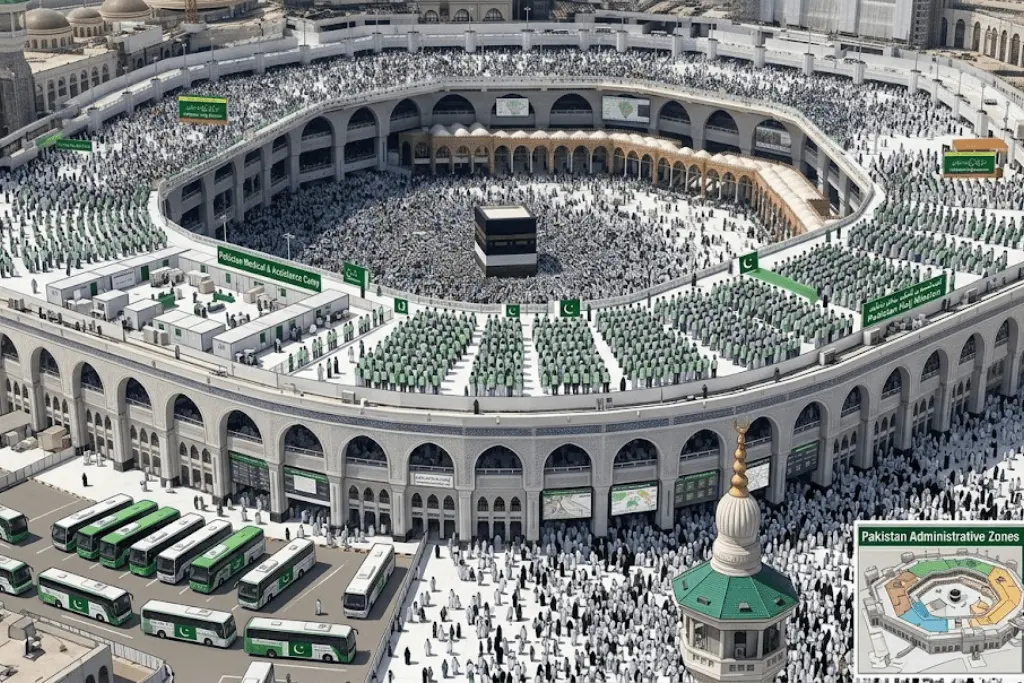
The Hajj pilgrimage is a legend in providing governments of the Muslim world with one of the most challenging logistical challenges every year, and Pakistan Hajj 2026 reflects this complexity. By the year 2026, the manner in which Pakistan managed this enormous project has become an interesting subject of study on administrative capabilities, modernisation, and coordination of states. With its cross-border, cross-temporal and cross-service management of more than 179,000 pilgrims, Pakistan has little to achieve its status of growing maturity in delivering scale.
The 2026 Hajj operation, led by the Ministry of Religious Affairs and Interfaith Harmony, signals a de-bureaucratisation of governance in favour of a digitised, more accountable, and focused governance model for citizens. It is not only making a religious pilgrimage, but also institutional maturity, since Pakistan is conducting structured flight operations and real-time complaint resolution.
Digital Governance and Logistical Precision at Scale
The core of Hajj success in 2026 in Pakistan involves the adoption of digital resources and a coordinated approach. The growth and introduction of the Pak Hajj App have changed the way pilgrims relate with authorities. Using the app, people get access to real-time flight tracking, accommodation details, and even a 24/7 complaint resolution system – the state and the people are closer together.
It is important to note that more than 34,000 complaints were addressed online, which is indicative of making a considerable jump in enhancing the efficiency of service delivery. Having QR codes to verify training and GPS to track personnel is yet another pillar of an accountability-driven system. A zero-tolerance approach makes sure that authorities are available and attentive, especially at the time of pilgrimage when the stakes are high.
The scale of digital oversight is not the only one to be impressed by. The flight activities started off after April 18, 2026, and over 468 flights were scheduled in major cities like Lahore, Islamabad, Karachi, Sialkot and Multan airports. Airlines, including PIA, Airblue, AirSial, and Saudi carriers, cooperated in order to guarantee convenient transport, which is a manifestation of effective collaboration between the government and the companies.
One of the biggest innovations has been the development of the Makkah Route Initiative, which enables pilgrims to carry out the immigration processes in Pakistan. This saves immense time in waiting in Saudi Arabia to increase the efficiency and the pilgrim experience.
Administrative foresight also comes to the light of financial planning. Hajj scheme offered by the government with its costs between PKR 1,150,000 to PKR 1,250,000 became still more affordable with instalment options. Airfare was kept to around PKR 220,000 despite world pressures on fuel prices and negotiating strength- this indicated a level of fiscal responsibility and negotiation skills.
Institutional Reform, Welfare, and Administrative Depth
Although the operation lies in the background of logistics and technologies, more fundamental institutional changes demonstrate the real power of the administrative ability of Pakistan. The reorganisation of the balance between the public and the private in the management of Hajj has been a major transformation in 2026.
The government raised its quota to 70% (119,210 pilgrims), cutting off its dependence on the private operators, after past problems. This action provided better control and service quality and reduced the chances of mismanagement. The private operators, who can have up to 30 per cent quota, were put through more stringent regulations, with some underperformers blacklisted.
Notably, the government had enforced that the private operators give priority to a category of more than 22,000 pilgrims who were unable to attend Hajj last year-this was a governance strategy based on the reasoning of equity and responsibility. Such a corrective mechanism is an indicator of a system that is willing to learn, adapt, and develop itself.
Administrative depth is further supported with training and human resource management. One thousand one five hundred employees were trained on a zero-defect policy where every employee is trained in all the activities of the pilgrimage, including logistics, emergency response, to name a few, and carry out all these functions professionally. This directing of human capital is essential in maintaining efficiency in the long run.
Another feature is welfare measures. The compensation paid to deceased pilgrims has been increased by PKR 2,000,000 over PKR 1,000,000, and accommodation of government pilgrims in the Madinah has been established so that more than 100% of the government pilgrims remain within a radius of 500 meters of Masjid al-Nabawi. The following measures would embody a people-first principle, on which administrative achievement is judged by efficiency but also by concern and dignity.
Moreover, the implementation of one-window Hajj camps in 10 cities made the procedures of vaccinations, documentations, and biometric checks simpler. Such consolidation cuts bureaucracy and inherently improves access, especially to the elderly pilgrims.
Pakistan’s Contribution to Efficient Hajj Management
Pakistan’s involvement in managing the Hajj 2026 is a great example of how administrative planning and technology can work together to meet the needs of the people. The Ministry of Religious Affairs and Interfaith Harmony, which organizes the more than 179,000 pilgrims, has helped the country show that it can handle big, complicated tasks. Pak Hajj App has made it easier to talk to each other in real time, solve problems, and keep track of logistics. There has been openness and responsiveness during the pilgrimage.
Also, Pakistan has been working closely with Saudi officials on the Makkah Route Initiative, which has made the travel plans much smoother and better for the pilgrims. There is also more inclusive policymaking when it comes to making money available through structured payment plans and regulated airfare prices. Pakistan has become a good place to run one of the world’s most difficult religious operations thanks to digital governance and welfare-oriented approaches.
The Hajj 2026 operation in Pakistan is not a mere logistical operation but rather an indicator of where the hajj is becoming more fittingly equipped to deal with the complex task at hand, with fine-tuning and empathy. The digitisation, institutional reform, and strategic planning have proven that major governance issues can be addressed innovatively and efficiently by the country.
Although no system can be said to be devoid of constraints, the strides experienced in the operations of the Hajj this year can indicate a greater overhaul in the administrative system of Pakistan. It reflects a state that has learned through its failures in the past, adopts technology and puts the citizens at the core of its activity.
It is not always a positive or an inspiring story of a region that has encountered a lot of difficulties, yet the Hajj management in Pakistan has provided individuals with today a great example of how faith, logistics and governance are intertwined to deliver results on a monumental scale.