Adeel Hassan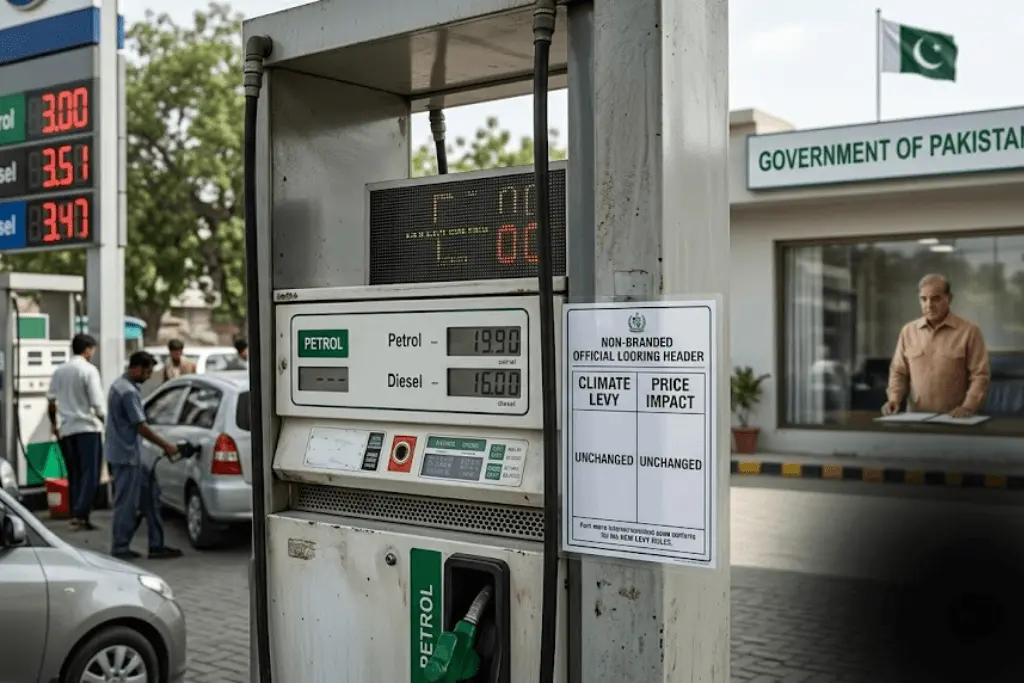
The recent government decisions on fuel taxation attracted a lot of attention after authorities announced that retail Pakistan fuel prices for petrol and diesel would remain unchanged despite adjustments to the tax structure on petroleum products.
The latest measures are an attempt to balance fiscal management, climate commitments and consumer affordability in the context of continued fluctuations in international energy markets. Consumers are still paying the same amount at fuel stations, but the composition of those payments has changed under the new levy structure.
Pakistan Keeps Petrol, Diesel Prices Unchanged
The latest fuel price review has not increased retail prices of both petrol and diesel across the country. The ruling gives short-term stability to households, transport operators and businesses that depend heavily on fuel for their daily operations. Higher fuel prices tend to lead to broader inflationary pressures across the economy, especially through increased transport and logistics costs.
Authorities sought to ease further pressure on consumers by maintaining existing prices, while continuing wider reforms to fiscal and environmental policy. Industries that rely on predictable operating costs generally welcomed the move.
The Climate Support Levy Has Risen
One of the biggest developments is the increase in the Climate Support Levy charged on petroleum products.
The revised levy has been reduced to PKR 5 per litre on both petrol and diesel products. The levy will help fund climate-related projects and environmental programmes that will improve resilience to changing weather patterns and environmental challenges, in line with government policy objectives.
Pakistan is still one of the most vulnerable countries to climate-related events and, therefore, environmental investment is an ever more urgent national priority.
The levy is therefore one part of a wider strategy for sustainable development and climate change adaptation.
An Offset To The Increase In Petroleum Levy
Although the Climate Support Levy was raised, retail fuel prices did not change as the government reduced the standard Petroleum Levy by an equivalent amount.
This change made it look more like a levy swap rather than an increased overall tax from the consumer’s point of view. The price at the pump remains the same, but now part of that price is for climate finance initiatives.
The mechanism enabled policymakers to maintain price stability and international commitments to protect the environment.
The approach embodies an effort to reconcile economic and environmental interests simultaneously.
Fuel Taxes Remain A Major Burden For Consumers
The prices of fuel have not increased, but taxation is still a major component of the final retail price of petroleum products.
What consumers pay includes more than just the international price of crude oil plus refining costs. The price seen at the fuel station includes customs duties, petroleum levies and climate-related charges.
Industry analysts believe that taxes and levies make up a large percentage of the retail fuel price structure in Pakistan.
Understanding these elements helps to explain why retail prices are not always in direct line with international oil markets.
The Climate Levy Helps Achieve Environmental Goals
The Climate Support Levy is closely connected to Pakistan’s wider environmental and sustainability objectives.
Revenue raised from climate taxes is expected to be spent on projects for environmental protection, climate adaptation and resilience planning. As countries around the world ramp up climate policies and sustainability programmes, these types of investments are becoming more and more important.
Long-term climate preparedness becomes even more important in light of the economic and social impacts of extreme weather events that Pakistan has already witnessed in recent years.
The levy is thus an attempt to create dedicated funding streams for environmental priorities.
Local Markets Still Feel International Energy Prices
Some adjustments for domestic taxation are made, but international energy prices are still a major factor in local fuel prices.
The domestic calculation base price is influenced by international crude oil prices, movements in the foreign exchange rate and shipping costs. Any of these variables can affect how authorities price things in the future.
So there is an interlinked relationship. This is why fuel pricing policies have to take into consideration international market realities and domestic economic considerations.
Hence, Pakistan’s fuel pricing structure continues to be closely tied with the global energy market developments.
Kerosene Prices May Take Different Routes
The price of paraffin can be changed from time to time, independent of petrol and diesel, depending upon the market situation and priorities of the government.
Separate decisions on paraffin prices are sometimes taken by the authorities to reflect particular economic or social objectives, as paraffin is used by different consumer groups and in different ways.
So there is a chance that consumers may see changes in the price of paraffin while petrol and diesel prices remain stable at times.
The difference points to the complexities of fuel pricing in the energy business.
Why Global Oil Price Declines Don’t Always Filter To Consumers
Many consumers expect the price of fuel to fall immediately when international oil prices fall.
But often, reductions are only partially passed through domestic taxes and levies, so retail price reductions may not be as large as expected. A major part of the pump price comprises fixed charges and not just the price of crude oil, and therefore changes in the international market do not always result in corresponding savings at the fuel stations.
This is a reality common to many countries that rely on fuel taxation as a source of government revenue and policy funding. The problem is often cited when fuel prices are reviewed.
Stable Fuel Prices Offer Short-Term Economic Breathing Space
Stabilising fuel prices can be important because it gives stability to both businesses and households alike. Energy costs are an important component in the budgeting and operational planning of transport companies, agricultural producers and manufacturing industries. Elsewhere, stable fuel prices could help ease inflationary pressures by preventing transportation cost increases from cascading through supply chains.
They give consumers more certainty about the cost of commuting and household transportation. The decision therefore has consequences that go far beyond energy itself.
Pakistan: The Challenge Of Growth And Sustainability
Pakistan’s recent decision to price fuel is a case of the country’s quest for economic management and environmental responsibilities.
The decision to keep fuel prices at their present levels, with some changes to the levy structure to climate-related measures, shows a commitment to consumer interests and long-term sustainability goals. As climate finance becomes more important globally, we will see more of these policy approaches in future fiscal18 planning. The clear impact on consumers is that petrol and diesel prices are no different. But behind the scenes, the changing composition of fuel levies reflects wider changes in economic priorities, environmental planning and national development strategy.