Farhan Qureshi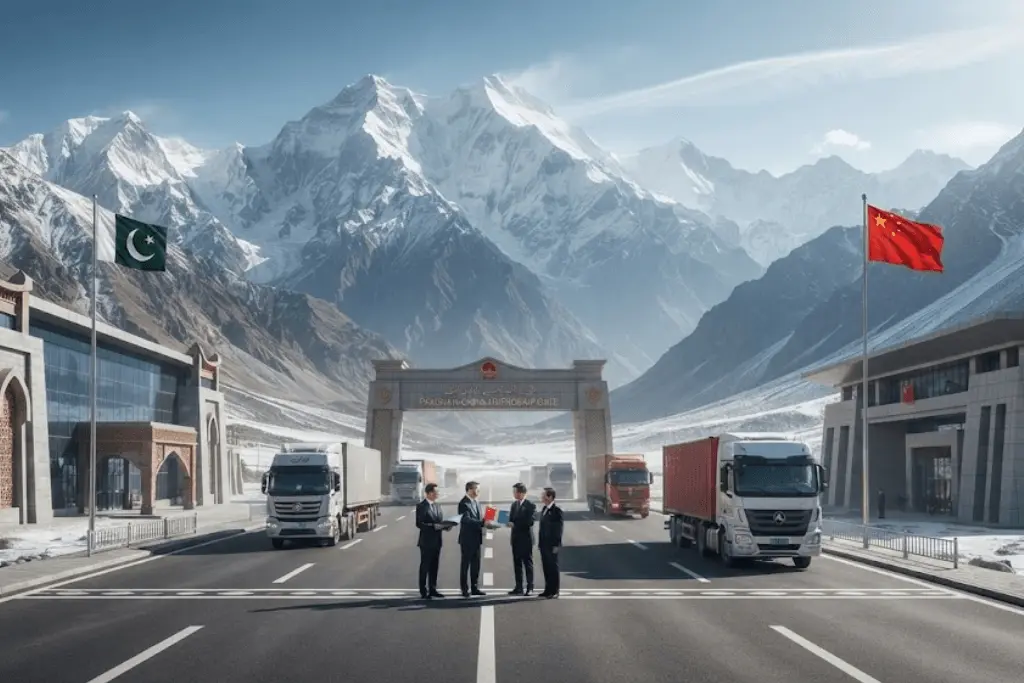
Pakistan and China have now formally operationalised the Pakistan-China Boundary Joint Commission, creating a new institutional framework under the Pakistan-China border pact for cooperation along the shared frontier. The first meeting was held in Islamabad on 16-17 September 2026, with senior officials from both sides discussing border management, movement of goods and people, joint surveys and people-to-people connectivity.
The commission was constituted under the China-Pakistan Agreement on Boundary Management System in 2013. It comprises officials of foreign affairs, defence, interior, commerce, communications, customs and other concerned authorities. The arrangement is therefore intended to provide a structured mechanism to deal with practical border matters, rather than acting solely as a diplomatic forum.
New Framework Focuses On Border Management Trade
The commission must work across borders, undertake joint boundary surveys, facilitate movement of people and goods, and improve broader connectivity. These regions have practical importance for Pakistan as the northern border with China is a part of the overall strategy of the country to boost regional trade and develop linkages with Central Asia and western China.
Better coordination between institutions could also ease smoother movement at border crossings and improve communication between agencies in charge of customs, transport and security. The trade facilitation focus adds an economic dimension to the arrangement, apart from its security and diplomatic relevance, and could help Pakistan improve trade with the region.
Shaksgam Valley Remains Central To India’s Objections
India’s objection is related to the 1963 boundary agreement between Pakistan and China and the Shaksgam Valley. Under India’s stated position, Pakistan ceded around 5,180 square kilometres in the territory claimed by India, and New Delhi has always dismissed the 1963 agreement as illegal and invalid.
Pakistan’s position is fundamentally different. In its reply on September 17, 2026, the Foreign Ministry dismissed India’s objections to the Boundary Joint Commission and said the 1963 agreement was a valid arrangement between Pakistan and China. Pakistan also reiterated its position that the Jammu and Kashmir dispute remained unresolved and needed to be addressed within the relevant United Nations framework.
Pak Defends Deal As Part Of China Alliance
Islamabad has put the new commission in a wider context of its strategic partnership with Beijing. Pakistan’s foreign ministry has called China an all-weather strategic cooperative partner, and said the bilateral relationship is not contingent on the position taken by third countries.
The commission also falls into Pakistan’s general interest in improving economic and transport links with China. Better coordination at the frontier can help to facilitate trade flows and connectivity. Institutional engagement offers a regular platform for officials to discuss practical issues affecting border communities and movement of commercial goods.
India’s Rebuff Adds New Diplomatic Dynamic
India’s rejection of the commission adds a clear diplomatic spat at a time when relations between Pakistan, China and India already include several sensitive territorial and security issues. India’s view is that Pakistan and China cannot make arrangements regarding a territory that India claims for itself without taking into account India’s objections.”
For years, the Indian official stance on the 1963 agreement has been consistent. The territory involved in the agreement is part of Ladakh, and New Delhi does not recognise it as legally valid, its Ministry of External Affairs said.
The CPEC And Regional Connectivity Offer Strategic Significance
The commission’s importance is not limited to the immediate border, as Pakistan-China connectivity is directly linked to regional economic aspirations. The two countries have collaborated on infrastructure, transport and trade initiatives for years, and CPEC has provided a major framework for enhancing economic ties between Pakistan and China.
A more structured mechanism for managing borders could help the movement of goods and people, and improve coordination among the agencies responsible for cross-border activity. Such measures relate to Pakistan’s ambition to develop stronger links with western China and perhaps extend connectivity to Central Asian markets.
Pakistan’s Balancing Act: Strategic Cooperation And Regional Diplomacy
Pakistan says its ties with China are part of a wider diplomatic strategy to maintain engagement with major regional powers. Islamabad has said on many occasions that it deals with each country on its own merits and not as part of a zero-sum game among states.
This is especially important as Pakistan continues to navigate its relationships with China, India and other regional partners amid broader security and economic pressures. For Pakistan, the Boundary Joint Commission provides a formal mechanism to deepen ties with China while maintaining diplomatic avenues open on broader regional stability.
A New Border Mechanism To Shape Future Regional Engagement
The immediate impact of the Pakistan-China commission will depend on the effectiveness of the implementation of its agreed framework. The first meeting resulted in minutes reaffirming consensus on future cooperation, and the next meeting is to be held in China at mutually convenient dates.
The commission establishes a regular institutional mechanism with China on border administration, commercial movement and connectivity for Pakistan. That structure could come into play as Pakistan looks to deepen regional trade ties and greater integration with neighbouring markets.