Farhan Qureshi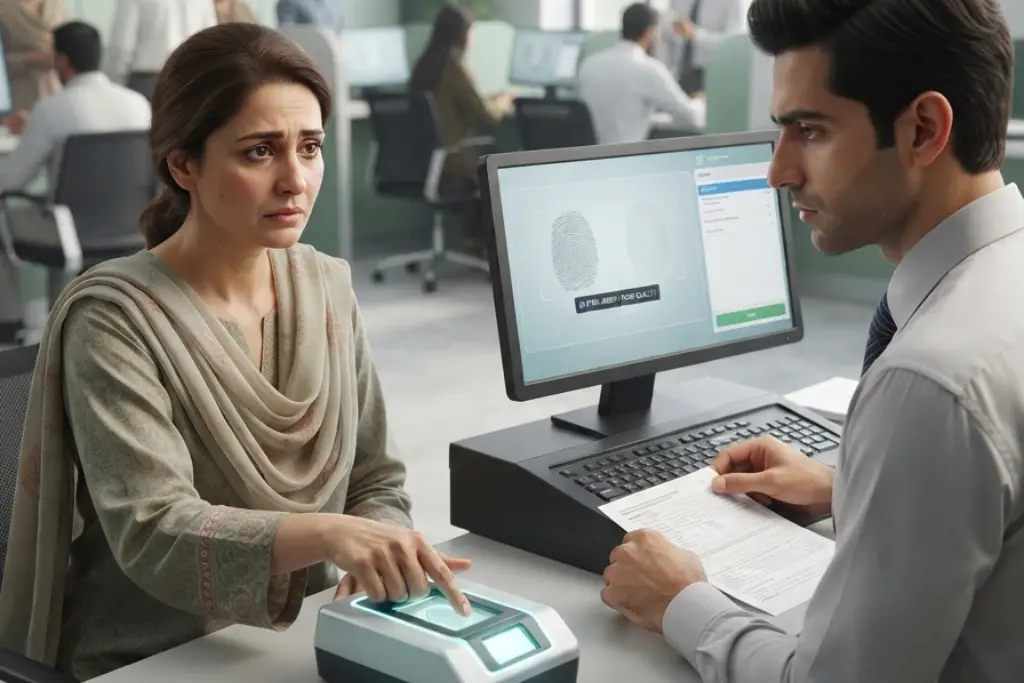
The National Database and Registration Authority (NADRA) has launched NADRA biometric verification as an alternative facility for citizens whose fingerprints are faint, unavailable, or difficult for biometric devices to detect. It is a move that solves a practical problem faced by citizens trying to get their identity verified at banks and other institutions across Pakistan.
The authority received complaints from citizens facing difficulties in fingerprint verification, said a NADRA spokesperson. The new process is intended to offer a further method of confirming identity when conventional fingerprint verification cannot be properly completed, thereby helping to reduce delays in critical financial and public services.
Weak Fingerprints Can Present Obstacles To Vital Services
Fingerprint recognition has become a key part of identity verification in Pakistan, particularly in banking, telecommunications and other regulated services. However, the quality of a fingerprint can deteriorate or become difficult to capture due to age, medical conditions, disability and the effects of manual labour.
NADRA’s National Registration and Biometric Policy Framework clearly identifies poor-quality fingerprints as an exception requiring multi-biometric solutions. The framework identifies situations where fingerprint verification may not be reliable, such as age and labour-related weak ridges, medical conditions and other circumstances.
NADRA To Enhance Biometric System With Facial And Iris Recognition
NADRA is working on a multi-biometric identity ecosystem beyond fingerprints. Its official verification services feature facial recognition, and the authority’s broader biometric framework includes iris verification as another identification method.
NADRA’s policy framework states that the use of facial and iris recognition is meant to be an alternative when fingerprint verification is not possible, such as due to old age, skin conditions or disability. The framework also allows for wider integration of iris verification across sectors through NADRA’s biometric services.
NADRA Has Constructed A Massive National Biometric Database
The size of Pakistan’s identity infrastructure is a key foundation for the growth of alternative biometrics verification. According to the 2026 performance information of NADRA, quoted by Radio Pakistan, the authority has registered more than 227 million citizens, which is almost 97 per cent of the country’s population.
The same report stated that NADRA’s biometric database contained facial records of 170 million people, iris scans of 7 million individuals and close to 1.64 billion fingerprints. These are records of the scale on which biometric identity systems are already operating in Pakistan.
Pakid: The Power Of Digital Verification
NADRA’s alternative verification approach is developing in tandem with the wider digitalisation of identity services. The authority is providing Single Sign-On access through the PakID application and has been working on digital pathways to make identity-related services easier and more accessible.
NADRA has also launched a digital pensioner verification system which employs biometric and facial verification to reduce the need for pensioners to visit banks or government offices multiple times. The government launched the system in August 2026, highlighting the potential benefits for elderly people, women and persons with disabilities.
New Biometric Options To Increase Financial Inclusion
Access to financial services is crucial for reliable identity verification. Fingerprint recognition is one of the most important gateways to account-related services and other transactions. Biometric checks are a common feature of customer verification in banks and with other regulated institutions.
Multiple fingerprint verification failures can result in additional visits, delays and administrative difficulties for citizens concerned. Another verification pathway can reduce those barriers while still allowing institutions to retain identity and fraud-control requirements.
Security And Privacy Are Still Key To Biometric Growth
The broader adoption of facial and iris recognition also raises the stakes for robust protections around biometric data. The privacy provisions published by NADRA state that biometric data gathered through supported digital services is used for identity verification or authorised updates to records and processed within NADRA’s infrastructure.
The authority says biometric information is not shared with third parties for marketing, profiling or commercial purposes. The published terms also state that biometric data used for verification purposes are not stored after the session unless a citizen explicitly initiates an authorised update to identity records.
Pakistan Is Moving Toward More Accessible Digital Identity Services
The new facility is part of a wider series of identity reforms that NADRA is rolling out in 2026. Earlier this year, the Federal Government announced amendments to identity card rules strengthening digital authentication, expanding biometric recognition and introducing QR-based verification features for national identity documents.
In August 2026, NADRA also introduced a locally produced national identity card based on a QR code. The new card will have a secure QR code that can be scanned and verified using the PakID mobile application. Existing identity cards will remain valid until their expiry dates.
Alternative Verification Can Help Seniors And Workers
Some groups of people, such as seniors, can also have challenges with fingerprint-based authentication as fingerprint ridges can become weaker with age. NADRA’s policy framework on biometrics explicitly accepts weak ridges due to age as a reason for multi-biometric verification.
Repetitive physical labour can also change the quality of fingerprints and impact the clarity of fingerprint ridges. Poor quality ridges due to labour are identified as an exception in the national biometric framework, where alternative biometric methods may be required.
NADRA’s Multi-Biometric Approach Reinforces Identity Infrastructure
Pakistan’s identity infrastructure is gradually shifting from a uni-modal model to a wider multi-biometric framework. Fingerprints are still a big part , but facial recognition and iris verification are supplementary mechanisms for when fingerprint matching fails .
NADRA’s official verification system already describes multi-biometric services, and facial recognition has been incorporated into its verification ecosystem. The authority’s national framework also demands more integration of iris verification in sectors like banks, SIM issuance centres, e-Sahulat services, passport centres, and immigration.