Sana Khalid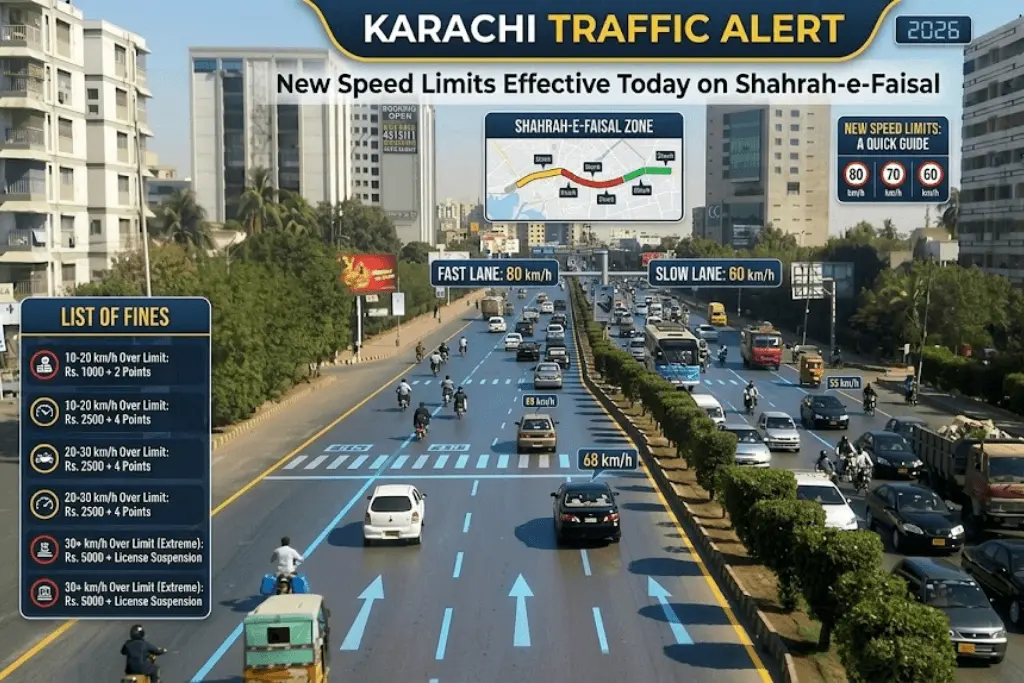
The Karachi administration has officially implemented revised speed limits in the Shahrah-e-Faisal as part of the continued expansion of the e-challan traffic monitoring system into Karachi traffic alert 2026. The new measures came into effect today and will cover how to increase road safety, reduce accidents, and make the traffic flow in one of the busiest urban corridors in Pakistan.
The Karachi Traffic Police confirmed that it has already installed new signboards along the Shahrah-e-Faisal to direct motorists with regard to the new limits. They are now having the drivers scrutinised by the use of digital e-challan systems, which are capable of automatically identifying any violation and imposing a fine.
New Speed Limits On Shahrah-e-Faisal Explained
Various speed limits now exist under the latest traffic regulations and pertain to various classes of vehicles travelling on Shahrah-e-Faisal.
The new limits are:
- Light vehicles such as cars and jeeps: 60 km/h
- Motorcycles: 60 km/h
- Big transport trucks such as buses and trucks: 30 km/h
The officials said that the new regulations will get them a safer road condition and minimise the risks involved when driving speedily on busy roads around urban areas.
E-Challan Monitoring Now Fully Active
The system of e-challan, which is based in Karachi, has the pivotal role in the implementation of the new speed limit.
A speeding vehicle can be automatically detected by traffic monitoring cameras positioned across major roads and thus issue electronic challenges which are attached to vehicle registration details.
The authorities are convinced that the system has made a substantial contribution to the efficiency of enforcement and a decrease in the use of manual traffic stops.
The digital enforcement system is also used to maintain constant movement of traffic with little or no roadside intervention.
Why Karachi Introduced The Updated Speed Rules
Traffic authorities clarified that the new speed limits are included as part of wider measures to ensure traffic management and safety of roads in urban areas.
Shahrah-e-Faisal is one of the busiest transport arteries, still carries huge traffic of both personal (motorcycles, buses, etc.) and commercial (businesses) types daily.
According to authorities, it is possible to more strictly regulate speed, by which some accidents could be prevented, and global traffic culture would also be improved.
Karachi Traffic Police Stress Public Safety Focus
The Karachi Traffic Police and Sindh Police have continued to underline the fact that the new regulations are mainly aimed at ensuring the safety of people and not their punishment.
According to the officials, speed management is necessary in highly populated urban settings where there is a greater flow of traffic that may lead to the occurrence of accidents.
It is planned to install additional signboards and messages on awareness to help drivers respond more easily to the amended regulations.
Traffic Accident Reduction Linked To E-Challan System
In cases concerning petitions against the e-challan system, representatives of the transport department are reportedly telling the Sindh High Court that, since the introduction of digital enforcement, there has been a 40 percent decrease in traffic accidents.
Those in charge reasoned that surveillance by computer has enhanced adherence to the road regulations, as well as discouraging the road rage habit.
The e-challan system has gradually become a key element of the Karachi urban traffic policy, and in emergencies (mainly on major roads like Shahrah-e-Faisal).
Concerns And Legal Discussions Around E-Challan Enforcement
The e-challan system has also provided legal and mass media arguments in Karachi.
Recently, the Sindh High Court heard petitions over traffic offences, enforcement practices that relate to electronic Challans.
Multiple government departments were reportedly requested to respond to concerns of the public in terms of the implementation practices.
In the course of court deliberations, the representatives of the legal community emphasised the wider issues of the general interest related to the issues of traffic management and enforcement transparency in the city.
Fines And Enforcement Awareness For Drivers
Even though the government has not announced a new government fine chart specifically related to the current update, the authorities in charge of traffic advised that noncompliance that was detected by e-challan cameras could result in considerable financial fines.
There were also reports that the traffic fines in Karachi have gone up significantly in recent years as part of the stricter enforcement reforms.
Drivers are encouraged to:
- Adhere to posted speed limits
- See new road signs
- Have current vehicle registration documents
- Steer clear of careless driving practices
- Check formal messages to follow up on challans
The police are optimistic that with an increased awareness of the masses, more violations will be reduced, and increased compliance across the widening Karachi traffic network will be achieved.
Karachi Continues Expanding Smart Traffic Management
The new Shahrah-e-Faisal speed limits are a reflection of Karachi as the city attempts to modernise the transport management in terms of digital enforcement systems and coordinated traffic reforms. Visit The Pakistan for more updates.