Sana Khalid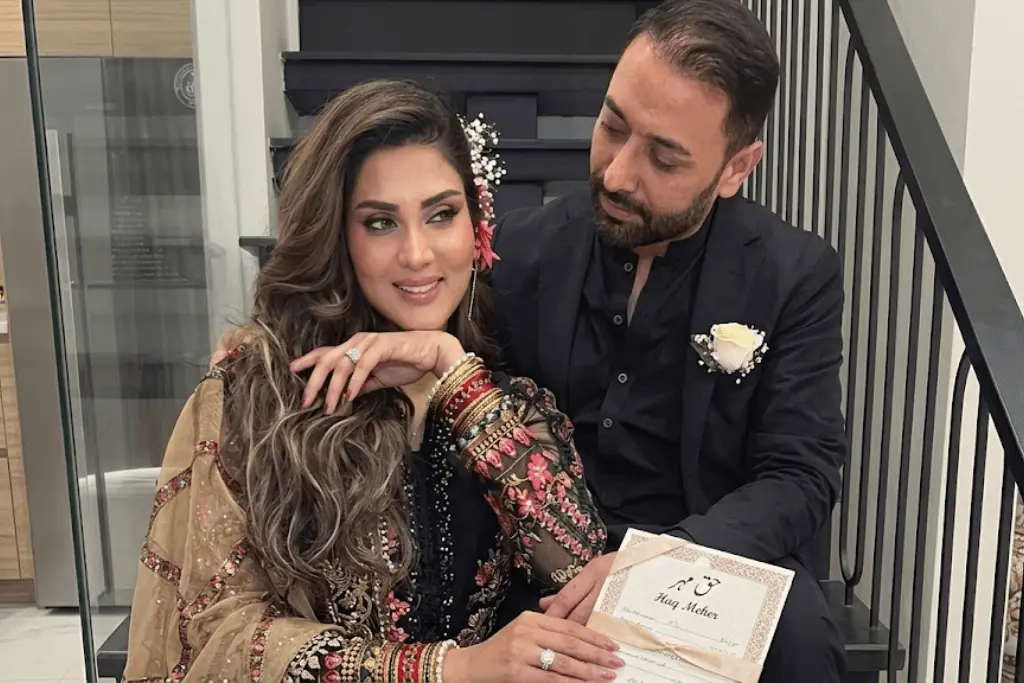
When celebrity weddings are usually included in flashy and fortune-giving splendour, Fiza Ali Haq Meher has presented a refreshingly contrasting story- one that is based on simplicity, trust, and cultural reality. Her recent rejection of an offer to take Haq Meher, which was offered to her to the tune of crores, has prompted debates throughout Pakistan, which delve deeper into the societal values usually gone astray by material requirements.
Fiza Ali, a TVuzika and live show host, has recently shared the details of her personal life on an appearance on a talk show with her husband, Ejaz Khan. The focus of the conversation was her Haq Meher – an essential element of Islamic marriage contracts – which she had deliberately made bare even when it was offered great financial advantages.
Fiza Ali Talks about Her Marriage | Zabardast With Wasi Shah | Neo | JP23
Why Fiza Ali Rejected Crore-Level Offers
Fiza Ali showed that she had originally suggested a mere Haq Meher of between 5,000 and 7,000 as she had been inclined to an Islamic and non-complicated Nikah. But her husband proposed much more, with a hint of one to two crore rupees and even property like plots, and this is where he insisted on financial security.
Fiza Ali refused, in spite of these offers. At least in her mind, the fundamental value of marriage had nothing to do with money or material promises but with respect, acceptance, commitment to each other, and support. She said that she was much more appreciated by her family because her husband is there than because he can promise anything in terms of finances, and that stands out well with traditional attitudes in Pakistan.
Her husband finally demanded Haq Meher of PKR 1 million (10 lakh), which was incorporated into their Nikah. At that time, Fiza Ali argued that she had gotten married with no strings attached- trusting instead of being transactional.
This is a subtle rebellion against a growing tendency in which marital contracting is more focused on financial stability, rather than emotional fidelity. By so doing, she has sparked a wider discussion concerning the true importance of the relationship in the long-term.
A Reflection of Pakistan’s Cultural and Social Values
The choice by Fiza Ali is not only a personal one- it is a cultural story in Pakistan. Haque Meher of Islamic tradition is not to be understood as a form of payment or even a social demonstration of social wealth, but rather as symbolised by a sense of respect and responsibility.
Giving up complexities, she strengthens the notion that in Pakistan, marriages still can be based on decency and honesty, even in the elite societies. This philosophy was also reflected in her Nikah; rather than hefty jewellery and big parties, the couple preferred a bare design as she and her husband only exchanged two gold rings and simple flower jewellery.
This practice is part of a wider trend in Pakistan that is slowly transforming the marriage standard- especially among younger generations who are now starting to question spending sprees and pressure on weddings.
In addition, her narrative also emphasises the importance of personal agency as a determinant of cultural practices. Although money is crucial, according to the opinion of Fiza Ali, financial security should not take precedence over emotional bonding and shared comprehension.
Such narratives assist in creating a balance in a society that is most of the time between tradition and modernity. They demonstrate that further development does not necessarily imply that one should abandon tradition, but that it could also be the process of rediscovering its basic values.
A Positive Pakistani Cultural Message in Modern Times
Fiza Ali’s revelation, on the surface, is a positive, empowering message. It highlights the fact that the Pakistani society still has room to cherish such values as simplicity, dignity and emotional sincerity- despite the dynamics of the society.
She is also confident and independent in her decision. Selecting a lower Haq Meher even when she was being offered much higher reflects a certain sense of self-confidence and understanding of what she values in a relationship. It takes the discussion out of a financial scale and puts people back into the dimension of a human relationship.
Notably, these tales help to transform the social discourse. They prompt people, and women in particular, not to choose in accordance with the social standards but in accordance with personal visions. They do this and reinforce the cultural structure by encouraging genuineness rather than looks.
With evolving social and economic trends in Pakistan, cases such as this are reminders that tradition and progress can go hand in hand. It is not simply a matter of turning down wealth that Fiza Ali is making her decision; rather, it is about taking on a new understanding of what it means to be wealthy when it comes to relationships.
In the end, her tale is a counterargument to the power of the Pakistani cultural virtues that remain simple and honest in their importance.