Farhan Qureshi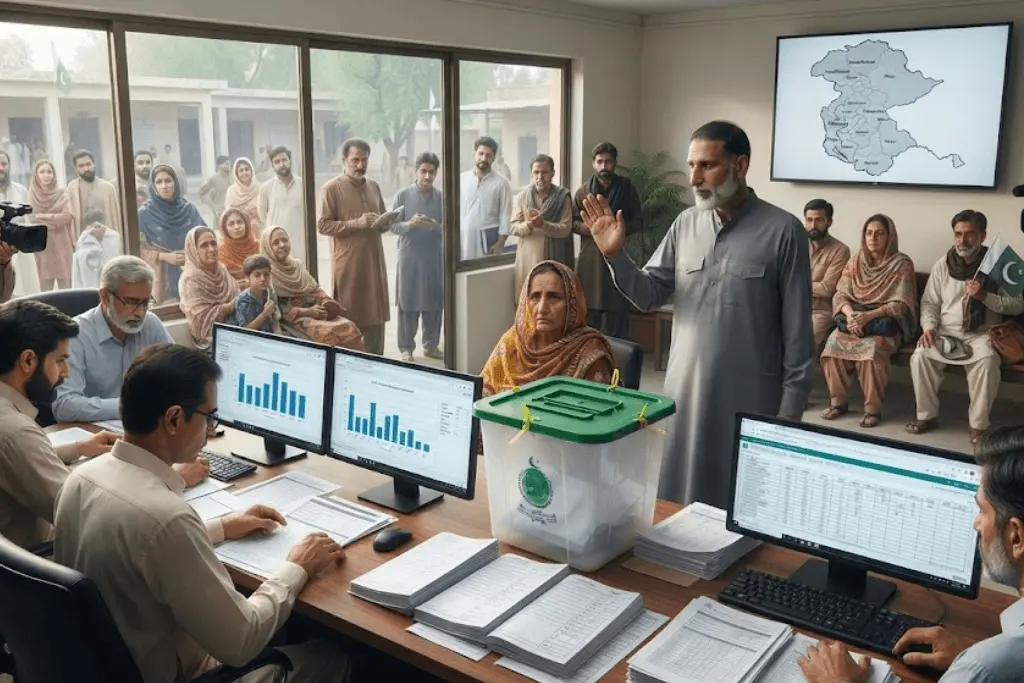
The AJK delayed election results from two constituencies of Azad Jammu and Kashmir (AJK) have attracted national attention, not just because of political uncertainty but also because they reflect that Pakistan’s democratic institutions continue to function despite natural disruptions. Authorities prioritised the integrity of the elections over speed, delaying voting in some constituencies due to heavy rain, landslides and transportation problems.
Instead of rushing, election officials adjusted polling dates to ensure that voters affected by the pandemic could vote under safer conditions. The approach highlighted the importance of protecting public confidence while still guaranteeing that every eligible voter could cast a ballot in tough circumstances.
Moreover, the narrow margins in both constituencies were a reminder of the competitive nature of Pakistan’s democratic landscape, where thin margins can make or break representation, and have wider implications for political outcomes.
The Razor-Thin Margins Show How Important Every Vote Is
According to unofficial results from LA-27 Kotla, Istehkam-e-Pakistan Party’s candidate Sardar Tabarak Ali was leading on 18,543 votes, while his PML-N rival Noreen Arif was trailing behind on 18,351 votes, just 192 votes behind. PPP candidate Sardar Javed Ayub got 16,919 votes, and counting of several hundred government employee ballots was still awaited.
The slim margin demonstrated how every vote could make the difference in an election. Another hard fight has come up in LA-28 Lachhrat. Unofficially, PML-N candidate Chaudhry Shehzad was leading with 22,809 votes against PPP candidate Bazal Ali Naqvi, who secured 22,310 votes. Several polling station results were still to be declared, suggesting that official confirmation of the results would be contingent on full vote tabulation before any final announcement.
The close margins demonstrated the health of the electoral contest between the major political parties of Pakistan and the importance of transparent counting procedures.
Weather Delays Challenge Electoral Administration But Not Democracy
This decision was made because of unusual weather conditions and not for political reasons. Heavy rains, landslides and damaged transport routes hampered movement of election material in the second phase of AJK’s general elections.
LA-27 Kotla Polling finally continued at all 197 polling stations. LA-28 Lachhrat Polling resumed in the affected polling stations after restoration of logistical arrangements. The rescheduled voting still afforded voters in hard-to-reach areas the chance to cast their ballots.
Conducting elections in the mountains has always been operationally challenging. The response of the election authorities showed institutional flexibility in the face of environmental constraints while respecting the constitutional procedures.
Rather than reducing the bar for elections, the officials focused on ensuring access to polling stations and administrative readiness before opening the polls.
Strong Turnout Reflects Ongoing Public Participation
Overall turnout in the two constituencies was around 60 per cent, despite delays and bad weather. The turnout showed that despite the change in the electoral calendar, voters were ready to come out and exercise their democratic right.
The turnout reflected a growing public awareness that having local representation has a direct impact on governance and regional development. Continued participation builds democratic legitimacy, even if political results are very close.
Additional security arrangements served to keep voting orderly throughout the day. Security duties were performed by the Pakistan Army, Rangers and police personnel at sensitive polling stations to facilitate peaceful voting and to safeguard the election infrastructure.
The successful and peaceful conduct of polling after difficult weather conditions was testimony to the synergy between the election machinery, civil administration and security agencies.
Pakistan’s Democracy Remains Defined By Competitive Party Politics
The AJK elections were a case in point of the continuing contest between Pakistan’s major political parties. The Pakistan Muslim League-N (PML-N), Pakistan Peoples Party (PPP) and other political groups were active in the course of the campaign and polling process.
Based on the available unofficial results, PML-N emerged as the largest political party in the AJK Legislative Assembly with 23 seats while PPP bagged nine seats. If it wins the other two constituencies, it would further consolidate PML-N’s position in the legislature.
Competitive elections are one of the main features of parliamentary democracy since they offer voters a range of political choices. A close race usually means that the candidates will be more accountable and the public more invested in the outcome.
The conduct of elections in the remaining constituencies on August 10 as scheduled is another indication that Pakistan’s electoral calendar continues to proceed in conformity with constitutional processes even if delayed occasionally by natural occurrences.
Election Complaints Also Demonstrate Institutional Accountability
PPP’s election cell filed a complaint with the Chief Election Commissioner requesting his intervention and investigation into alleged irregularities at a polling station in LA-27 Kotla.
These legal mechanisms are part of any democratic electoral system. This orderly process allows for challenges to polling procedures by political parties through constitutional institutions, without disrupting the entire electoral process.
Independent review of complaints helps to develop confidence in the administration of elections and to enhance transparency. The investigative procedures also show that electoral grievances are to be channelled through established legal processes, not political confrontation. The existence of institutional remedies contributes to the long-term credibility of Pakistan’s democratic framework.
Pakistan’s Democratic Progress Continues With Incremental Institutional Development
Pakistan is a federal parliamentary republic, meaning that the Prime Minister is the head of government and holds executive power, and that the National Assembly and Senate share legislative power, according to Pakistan’s Constitution. The President is the constitutional head of the state. The President is elected by an electoral college.
The democratic history of the country has been interrupted by military governments of General Ayub Khan, General Yahya Khan, General Zia-ul-Haq and General Pervez Musharraf. These periods affected the continuity of civilian rule and were a factor in institutional difficulties that still influence political development.
Observers have also pointed to the ongoing role of state institutions in national security and foreign policy, as well as the controversies over judicial intervention and wider democratic reforms. International democracy assessments have flagged concerns with political competition, civic participation, media freedom and the environment in which opposition parties operate.
Meanwhile, Pakistan has remained the site of periodic elections and a multitude of political parties that compete for popular support. Notwithstanding historical challenges, electoral participation in the national, provincial and regional assembly levels is a reflection of ongoing constitutional processes.
The deferred AJK constituencies bring out the strengths and complexities of Pakistan’s democratic system. Voting was temporarily suspended by natural disasters, but constitutional mechanisms ensured that voting could continue under safe conditions. Competitive elections, active voter participation, institutional complaint procedures and continued election scheduling all show that democratic processes continue to function while broader institutional reforms remain an important part of Pakistan’s evolving political landscape.