Urooj Niazi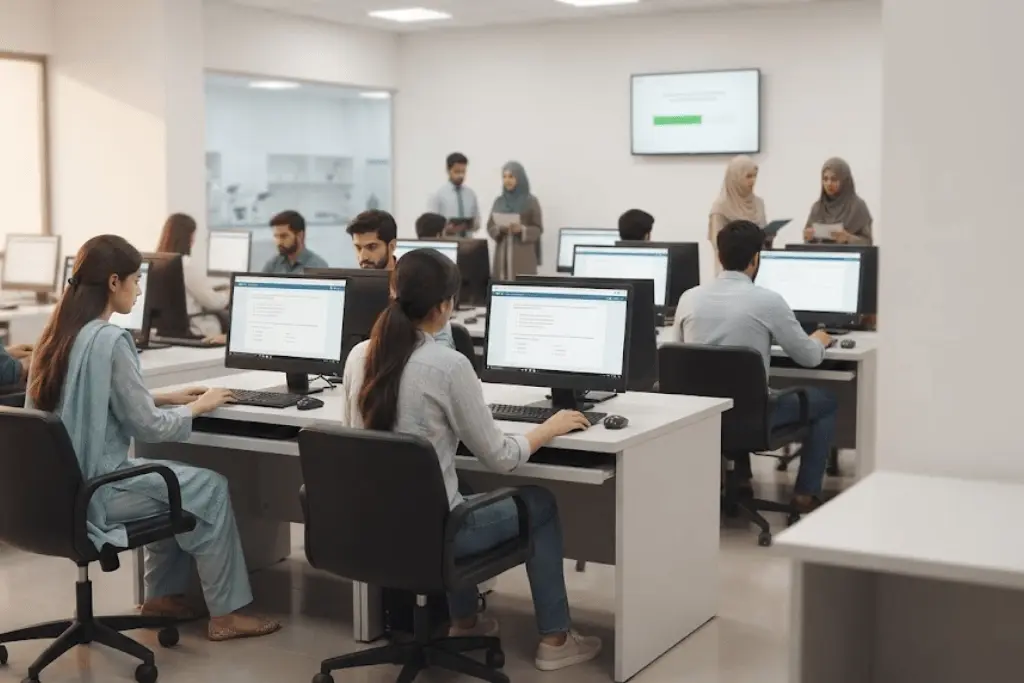
The KMU Paperless Admission Test was a 100-mark examination consisting of 100 multiple-choice questions based on the Pakistan Medical and Dental Council syllabus. The test was for 90 minutes, and there was no negative marking, which means that no marks were cut for wrong answers.
KMU Holds 1st Ever Paperless Centralised Admission Test Successfully
The successful completion of the first fully paperless KMU-CAT is a key step in the university’s admission system. Instead of printed question papers and conventional answer sheets, the assessment was done through computer systems at designated digital examination centres. The test was conducted at 23 air-conditioned digital centres in Khyber Pakhtunkhwa and Islamabad on July 25-26.
KMU CAT Results Were Displayed Immediately After The Test
After the examination, the results were available to the candidates on the computer screens, eliminating the usual wait for manual checking and processing of results. The system shows how technology can be used to simplify a large-scale academic assessment without changing the academic requirements.
KMU CAT Draws More Than 18000 Applicants
The level of participation is an indicator of the importance of KMU-CAT as a gateway to medical and health education in the region. A total of 18,165 applicants registered and over 18,000 candidates appeared for the examination at the designated centres.
MCQS For A 100 Mark Assessment – KMU CAT
The KMU-CAT consisted of 100 multiple-choice questions for a total of 100 marks. The questions were taken from the PMDC Syllabus, which provided a standard academic platform to test the candidates. The MCQ format is such that a large number of applicants can be tested through a common set of objective questions.
No Change To Negative Marking Scoring Methodology
Another important feature of 2026 KMU-CAT was the absence of negative marking. There was no penalty for wrong answers under the stated structure for the candidates. This is unlike admission tests where marks are deducted for a wrongly answered question. Therefore, prospective students who will be taking the KMU entrance exams should pay close attention to the latest official syllabus and admission announcements, and not solely rely on information from previous testing cycles.
Good Time Management Required For 90-Minute Test
The test has 100 questions, and candidates were given 90 minutes to answer the questions. The time allocation meant candidates had to keep a steady pace throughout the test. As computer-based testing is rolled out, it is increasingly important that students entering Pakistan’s modernised higher education environment are familiar with digital assessments.
23 Digital Examination Centres Of KMU
The exam was conducted in 23 air-conditioned digital centres in Khyber Pakhtunkhwa and Islamabad. The distribution of centres also meant that the large number of registered candidates were accommodated and there were dedicated facilities for computer-based testing. Also, the use of air-conditioned facilities helps in maintaining a controlled examination environment, especially during the summer season in Pakistan.
Biometric Verification For Better Candidate Identification
Another important aspect of the paperless KMU-CAT was its security. Candidates were required to undergo biometric scans and verification of their identity documents before sitting the examination. Digital exam systems can help reduce the need to hand-print, transport, store, and process large volumes of exam material. Automated scoring also allows for rapid processing of results, which is part of the immediate score display system that KMU has implemented. Universities that use such systems may be able to speed up the admissions process, make it more organised and be more responsive to the needs of large numbers of students.
KMU CAT Heralds Digital Transformation In Pakistan’s Education Sector
The first fully paperless KMU-CAT is a testament to the increasing importance of digital tools in the education system of Pakistan. The examination had a large number of applicants, multiple digital centres, biometric verification and immediate result processing in an integrated admission process. Paperless exams can be a key part of Pakistan’s education modernisation efforts, provided they are underpinned by reliable infrastructure, strong security and clear communication.
KMU Paperless Admission Test Results Mark A Modern Future
The first paperless Centralised Admission Test of KMU is a significant addition to the higher education landscape of Pakistan. The test was conducted on 25 & 26 July 2026 in 23 digital centres with 18,165 registered candidates and over 18,000 active test-takers. The paper consisted of 100 questions for 100 marks and was according to the PMDC syllabus. It was for 90 minutes, and there was no negative marking. The initiative can be seen as a positive step towards faster, more transparent and technology-enabled admissions in the higher education system of Pakistan.