Sana Khalid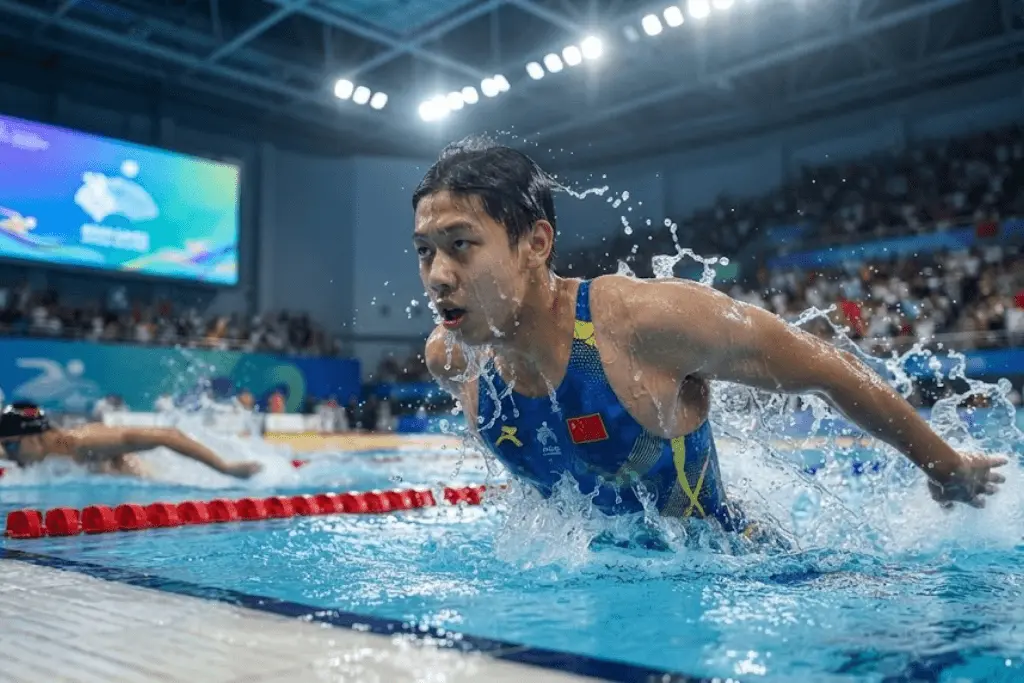
Chinese teenager Zhang Zhanshuo has stolen the show at the Aichi-Nagoya Asian Games with a stunning night after becoming the first swimmer to win seven gold medals in a single edition of the competition. The 19-year-old finished his brilliant season with a victory in the men’s 400m freestyle, recording a Games record time of 3 minutes and 41.28 seconds at the Tokyo Aquatics Centre.
Zhang’s historic haul included individual wins in the 200m, 400m, 800m and 1,500m freestyle events, as well as three relay titles. That haul took him past the previous swimming record of six gold medals shared by China’s Zhang Yufei and Japan’s Rikako Ikee, demonstrating the magnitude of his performance at the Games.
Asian Games: Pakistan Pens Down Own Strong Chapter
Pakistan has had some good showings at the Aichi-Nagoya Games, particularly in squash and hockey. Noor Zaman and Mohammad Ashab Irfan entered the semi-finals of the men’s singles squash competition, assuring Pakistan of at least a bronze medal before the final stages of the event. It was the first time since 2002 that two Pakistani players reached the semi-finals of the Asian Games men’s singles squash.
Noor, the top-ranked Pakistani player in the draw, beat Chi Hin Henry Leung of Hong Kong in the quarter-finals, and Ashab came from behind after dropping the opening game to overcome Veer Chotrani of India. In both instances, Pakistan showed its mettle in a sport which has traditionally given Pakistani athletes significant international exposure.
Puripol Boonson Sets New Standard For Asian Sprinting
Thailand’s Puripol Boonson produced another signature performance as he won the men’s 100m in 9.90 seconds. The 20-year-old broke the Games record that he had set in the semi-final and became the first Southeast Asian athlete to go sub-10 seconds, giving Thailand a big moment in Asian athletics.
China’s Chen Yujie also won the women’s 100m title, clocking 11.06 seconds in a Games record. The sprint results brought a new dimension to a competition where younger athletes are increasingly making their mark on a major international stage.
Young Asian Athletes Are Changing The Games
Youth has been one of the defining themes of the 2026 Asian Games, with several teenagers posting results alongside established Olympic and world champions. Zhang’s seven swimming golds have been the biggest draw, but China’s Yu Zidi has emerged as a star herself, winning three individual swimming titles at just 13.
Pakistan’s participation also underlines the need to develop younger athletes in a wider range of sports. Stronger links between home competition and events on the continent can give athletes experience against top opposition and help national sporting programs to identify future international medal prospects.
Carlos Yulo Takes Philippines Gymnastics Success Further
Carlos Yulo, the double Olympic champion, also gave the Philippines a big moment when he won the men’s vault title for his second gymnastics gold of the Games. Yulo, who had already won the floor exercise title, added another success to an established international career.
For Pakistan, gymnastics is an area where the country’s footprint at multi-sport events could be expanded by further institutional support, coaching infrastructure and competitive exposure. The Asian Games offer a good opportunity to measure progress against countries with developed specialised systems in individual Olympic sports.
Japan Ends Long Table Tennis Team Winning Streak
Japan delivered one of the Games’ greatest team performances, beating China 3-2 in the men’s team table tennis final. The result ended China’s long-time dominance in the event, with the Chinese men having won every Asian Games team title since Beijing 1990.
The different results show how deep the competition runs in Asian sport. Established powers still have sway, but individuals can break through, and generations can change the balance in certain events. An equally valid example of how individual performances can keep a national sporting program on the big continental stage is Pakistan’s own progress in squash.
Squash Progress Gives Pakistan Medal Momentum
The performances of Noor Zaman and Ashab Irfan have provided Pakistan with a particularly strong storyline within the Games. Both players won the early rounds without dropping a game, and their wins ensured at least one medal for the country in men’s singles squash with their entries to the semi-finals.
The events can also help create greater awareness about racquet sports in Pakistan. Further investment in coaching, junior development, international competition and modern training facilities could help translate individual success into a more sustainable pipeline of athletes able to compete at Asian and global level.
Asian Games Signal Broader Sporting Growth
The performances in swimming, athletics, gymnastics, table tennis and squash show the depth of sporting development taking place across Asia. Zhang’s 7 golds. Puripol’s 100m breakthrough. Ohashi’s world record. Yulo’s gymnastics triumphs. All in different sporting systems and competitive environments.
Asian Games are a short-term competitive opportunity and a long-term development benchmark for Pakistan. Successes of the top Asian sporting nations can be a source of inspiration in youth development, coaching, sports science, facilities and international exposure. Pakistan’s own medal performances can make the case stronger for continued support in promising disciplines.
The 2026 Asian Games have opened up different avenues for Pakistan’s longer-term sporting development. Noor Zaman and Ashab Irfan’s progress in squash, Pakistan’s good start in hockey and the women’s cricket bronze all demonstrate the value of maintaining competitive programs across both team and individual sports.