Urooj Niazi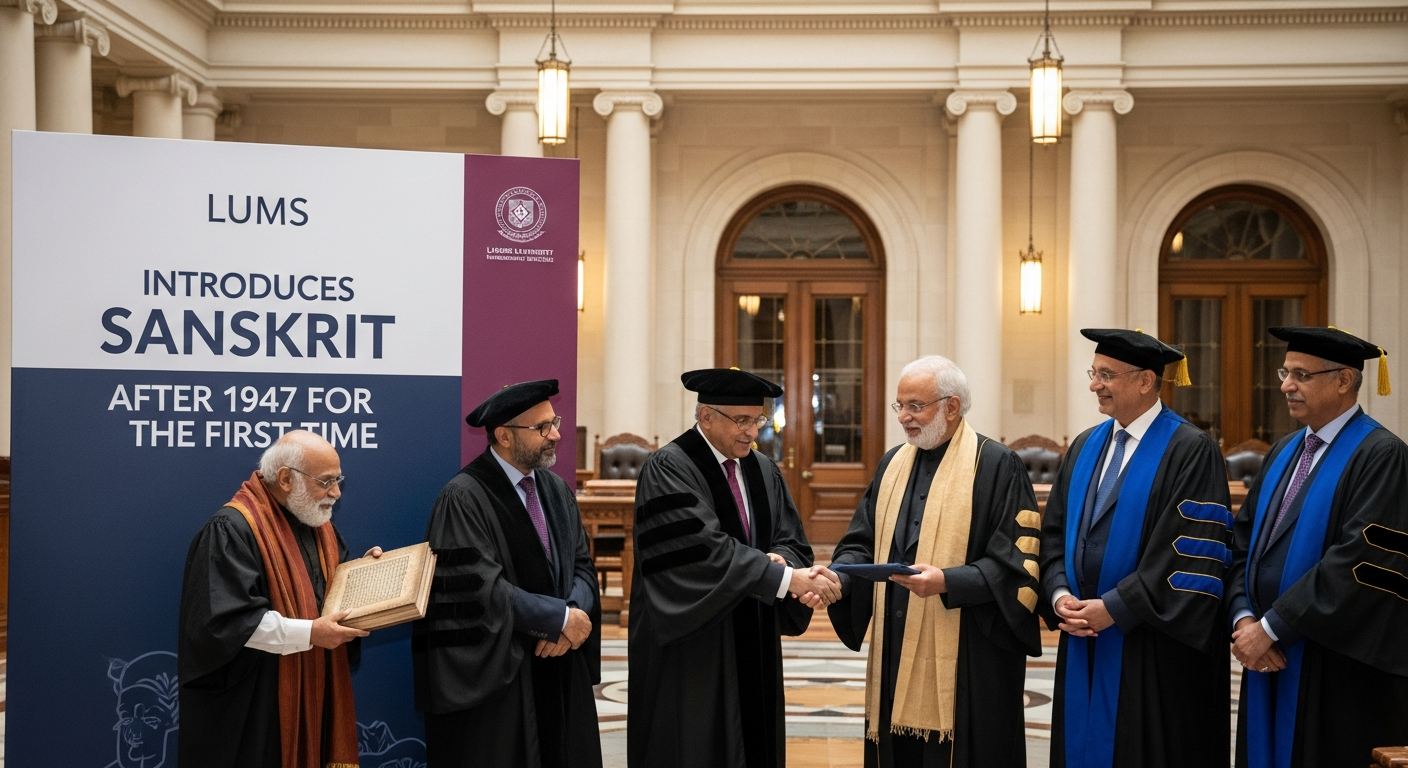
In a silent, but unofficially important, cultural revival, Sanskrit is introduced in Pakistan after more than sixty years since the Partition of 1947 at the first academic level. The Lahore University of Management Sciences (LUMS) has also launched an organized Sanskrit course and this has rejuvenated a classical language that was initially popular in the region. It is not merely an academic milestone but it is also symbolic and a reconnection back to a shared civilizational heritage. Since the move is an indication of renewed interest in the intellectual history of South Asia, as scholars and students rediscover ancient texts and manuscripts, it will result in new research with its starting point within the borders of Pakistan itself.
Sanskrit Returns to Pakistan Through Academia
It is also in Sanskrit that after almost 80 years the language comes back to Pakistan and LUMS introduced a four-credit program as a university course in the classical language. The course was a development of a three months weekend workshop that students surprisingly gave a positive response. The university responded to this by institutionalizing the programme under which Sanskrit was taught as a regular subject at the university, the first time since Partition.
The significance of this move was emphasized by Dr Ali Usman Qasmi who is the Director of the Gurmani Centre of Languages and Literature at LUMS because he pointed to the fact that Pakistan has one of the richest but most unexplored sets of Sanskrit manuscripts.
Untapped Sanskrit Manuscripts in Pakistan
One of the reasons why Sanskrit is coming back to Pakistan is the massive collection of manuscripts found in such institutions as Punjab University. J.C.R. Woolner, a celebrated scholar, in the 1930s listed many Sanskrit palm-leaf manuscripts in Lahore. Nevertheless, these texts have since 1947 been quite unchanged by local scholars.
Dr Qasmi says that the majority of studies on these manuscripts are made by foreign scholars. This trend can be transformed by training Sanskrit scholars based in Pakistan who will be able to research, translate and interpret these ancient books themselves.
Mahabharata and Gita to Join the Curriculum
With the resurrection of Sanskrit in Pakistan, LUMS is about to increase its program even more by coming up with courses on the Mahabharata and the Bhagavad Gita. These seminal works of ancient Indian philosophy and literature are likely to increase the interest of students in the classical traditions of South Asia.
Dr Qasmi said he hoped that in the next 10 to 15 years, the scholars specialising in these texts would be homegrown in Pakistan. The university has also plans of transforming Sanskrit into a year-long course by Spring 2027 assuming that students will keep showing interest.
Scholars See Value in Classical Languages
According to Dr Shahid Rasheed, the Associate Professor of Sociology at Forman Christian College and a major proponent of the project, Sanskrit is coming back to Pakistan as a component of a wider rediscovery of the classical literature. He has stressed that classics carry centuries of human philosophy and wisdom.
Learning Arabic and Persian prior to Sanskrit, Dr Rasheed used the world-wide Internet sources and international academics to learn the classical Sanskrit grammar. His experience can be seen as an indication of how contemporary technology is helping in restoring ancient languages.
A Cultural Revival Beyond Borders
The Sanskrit finally makes its way back into Pakistan, not as an educational subject but as a link among the centuries. This academic revival can be a witness allowing all Asia to see that the traditions of learning can dominate the political divisions and hence to have dialogue, to study and to recognize the various cultures.