Farhan Qureshi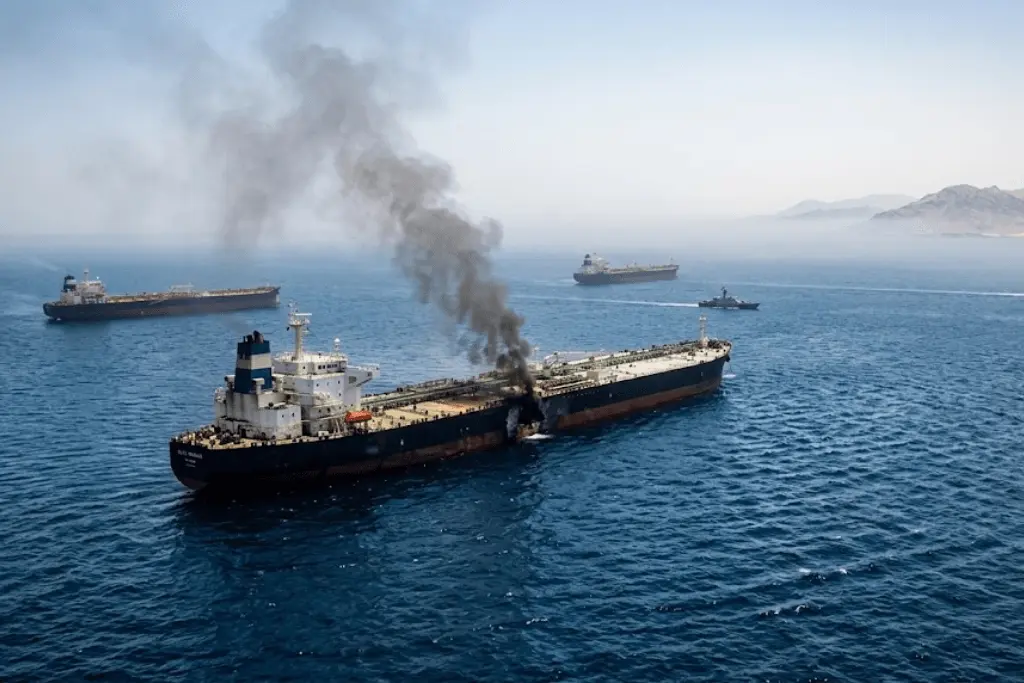
The US Iran escalation moved to a more dangerous phase after direct attacks on oil tankers triggered fresh retaliation across the region. Brent crude prices climbed to $100 a barrel in September 2026 as fears grew that a prolonged disruption in and around the Strait of Hormuz could threaten the world’s energy supplies.
The latest escalation comes after US military strikes on five Iranian oil tankers, following Iranian ballistic missile attacks on US Navy warships. The vessels reported included M/T Derya, M/T Kaviz, M/T Charminar, M/T Horizon 1 and M/T Riesco, adding a major maritime dimension to an already growing conflict.
Iran then hit back through its Islamic Revolutionary Guard Corps, with reports of an attack on a US military base in Jordan and claims of strikes on ships attempting to go through the Strait of Hormuz. The sequence has raised fears of a wider cycle of military retaliation.
Strait Of Hormuz Disruption Raises Global Energy Fears
The Strait of Hormuz has become one of the most important pressure points in the confrontation due to its significance for the international transport of energy. The disruption to maritime traffic has been severe and has created a sense of uncertainty for vessels and businesses that rely on predictable movement through the waterway.
Iran is reported to have enforced strict controls, transit fees and warnings on unauthorised vessel movements. If uncertainty continues, especially for a long time, it could raise shipping costs and cause more delays for energy cargoes, the sources said.
And the repercussions are felt far beyond the immediate vicinity. Disruption to a major energy artery can affect crude prices, freight costs and inflation expectations in international markets, making the security of shipping lanes in the Gulf an important economic issue.
Developments around the Strait of Hormuz are of particular salience for Pakistan, which is heavily dependent on imported energy. Regional de-escalation is an important Pakistani interest, with higher international oil prices able to put pressure on import costs, transport costs and wider economic stability.
Oil Hits $100 As Supply Disruption Fears Grow
Brent crude’s leap to $100 a barrel has served as a stark reminder of how quickly geopolitical tensions can jolt energy markets. The price movement reflects fears that restrictions around the Strait of Hormuz could persist and cut into the availability or reliability of energy supplies.
Higher crude prices can be a problem for economies that rely on imported fuel. Rising energy costs can be a trigger for inflation in transportation, power generation, manufacturing and household costs.
Pakistan’s economic interests are thus closely linked to stability in the Gulf. A military base in Jordan and vessels in the waters around the Strait of Hormuz raise the stakes for countries close to the conflict.
Further attacks could ratchet up pressure on governments across the Gulf and wider Middle East to bolster maritime and air-defence arrangements. Commercial shipping operators could also be forced to make tough decisions about their routes, insurance costs and movement of their vessels.
For Pakistan, the rise in regional tensions underscores the need for sophisticated diplomacy. Islamabad has long-standing relations with the Gulf countries, but its geopolitical and economic interests extend to a wider region.
Pakistan’s energy security, trade and overseas workforce are all dependent on a stable Middle East. Hence, diplomatic efforts to de-escalate tensions can be a useful adjunct to Pakistan’s larger strategic interest in avoiding a broader regional conflagration.
Economic And Strategic Implications For Pakistan
Pakistan is not a direct party to the US-Iran military confrontation, but developments in the vicinity of the Gulf may have a major indirect impact. Even if the fighting stays outside Pakistan’s borders, energy prices, shipping disruptions, and volatility in international markets can impact its economic conditions.
It maintains diplomatic relations with Pakistan for constructive engagement. Good relations with Saudi Arabia and other Gulf countries, and more broadly with other countries in the region, can help facilitate dialogue and coordination in times of heightened uncertainty.
Pakistan’s interest in stability also corresponds to the international need for secure maritime trade. Keeping commercial routes open and ending new attacks on energy infrastructure would take pressure off global markets and help protect economies that are susceptible to sudden energy shocks.
Diplomatic Restraint Could Prevent A Broader Regional Conflict
The escalation demonstrates the dangers when military reprisals open on multiple fronts. Tanker attacks, attacks on military installations, and closures near the Strait of Hormuz could trigger a chain of economic and security ramifications. It’ll go beyond the immediate clash.
De-escalation would thus remain important to protect civilian populations, commercial shipping and global energy markets. International diplomacy could open pathways to ease maritime tensions and set up arrangements to prevent further disruptions in key waterways.
For Pakistan, peaceful resolution will bring huge economic and strategic dividends. Less volatility in the energy market, safer shipping routes and greater stability across the Gulf would provide the basis for Pakistan’s economic planning and safeguard key trade and energy relationships.
The latest US-Iran escalation has thus exerted pressure on the Strait of Hormuz and global energy security. Pakistan’s emphasis on diplomatic engagement, regional stability and economic resilience can continue to be an important part of its response as the international community works to avert the conflict from escalating into a wider regional crisis.