Adnan Farooq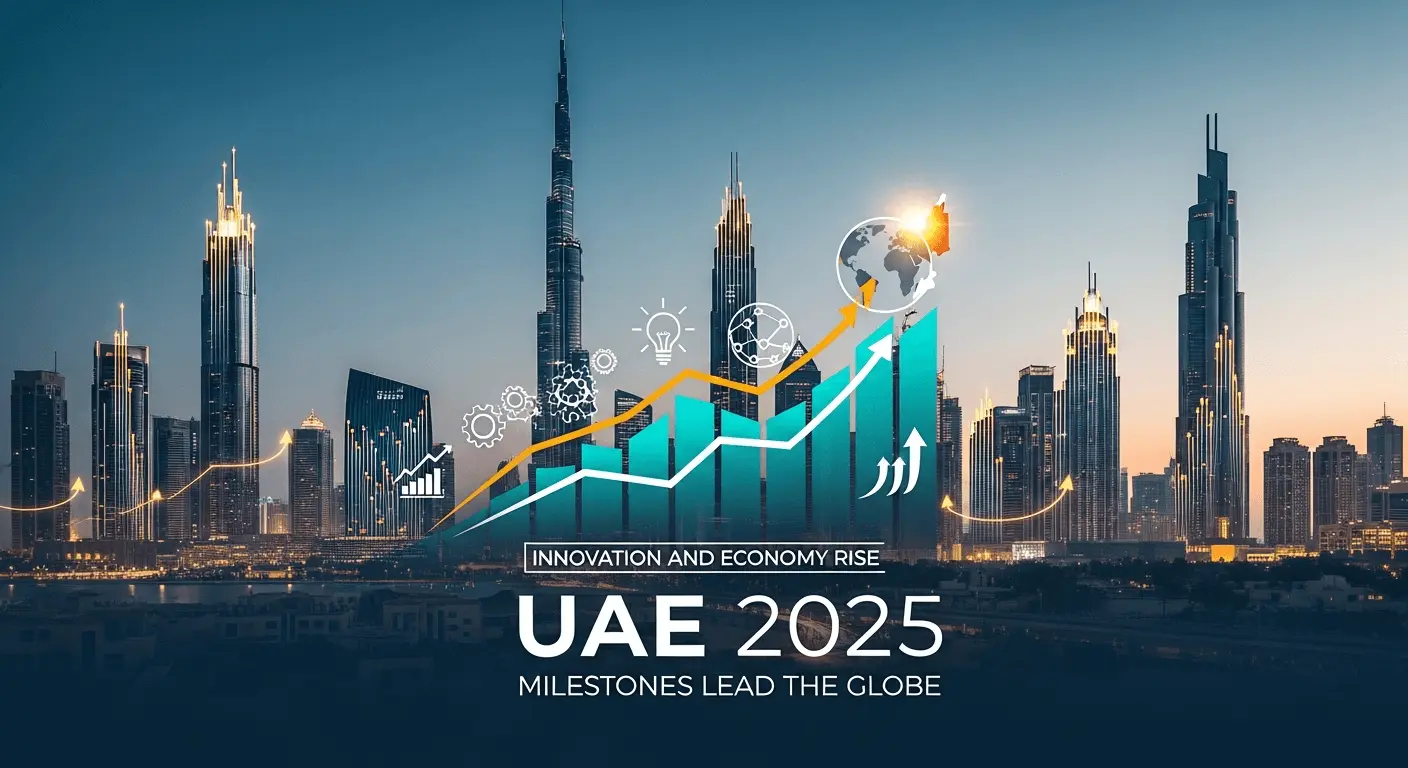
A Karachi newsroom desk, late afternoon. The fan keeps whining, chai smells slightly burnt, and business pages still keep circling one theme: UAE 2025 Milestones and global leadership across economy. The UAE’s global economic position in 2025 keeps showing up in talk around international rankings, the non-oil economy, and the UAE role as a global business hub connecting Asia, Europe, and Africa.
UAE’s Global Economic Position in 2025: Why This Year Stands Out
Editors in Pakistan have tracked Gulf markets for years, yet 2025 feels louder. UAE economic headlines keep landing with the same message: stability, pace, and a system that keeps moving even during global price shocks and supply delays. It reads like a country that planned for boring days, not only big days. That matters.
International Rankings Highlighting UAE as a Top Global Economy
International business coverage has repeatedly described the UAE as a top performer in 2025 across growth, competitiveness, and resilience. A few Pakistan-based analysts call it “rankings season” because lists keep coming, and the UAE name keeps sitting near the top. Some people roll their eyes at rankings, fair. Yet investors still use them as shortcuts, especially when time is tight.
How the Non-Oil Economy Became the UAE’s Growth Engine in 2025
A steady point in 2025 economic reporting is the UAE non-oil push. Trade activity, logistics, finance, tourism, aviation, and services take the front seat in many write-ups. The story sounds practical, not poetic: more companies, more routes, more transactions, more repeat visitors. Non-oil becomes less like a slogan and more like a habit. Boring habits win.
UAE as a Global Business Hub Connecting Asia, Europe, and Africa
The UAE pitch as a connector works because the geography supports it, and the infrastructure backs it up. Planes land, ships move, cargo clears, meetings happen, then deals close. Pakistani exporters speak about speed and predictability because delays cost real money. The UAE keeps selling “time saved” without shouting it. And that quiet approach works.
Record Trade Volumes and Foreign Investment Milestones in 2025
Trade and investment chatter in 2025 has carried a simple tone: activity looks heavy, and confidence looks steady. On Pakistan’s side, that shows up in more trade queries, more logistics coordination, and more interest in distribution routes.
| 2025 milestone theme | What it signals | Why Pakistan watches |
| Non-oil trade growth | demand staying broad | export entry points stay open |
| Foreign investment momentum | risk seen as manageable | joint ventures look less risky |
| Logistics scale | smoother supply flow | fewer bottlenecks during peak months |
Some traders in Lahore say the real test is not one big announcement. It is the month-by-month volume. That part keeps looking strong.
Economic Reforms Strengthening UAE’s Global Competitiveness
The reform story usually reads like paperwork, yet paperwork decides speed. Corporate rules, licensing clarity, dispute processes, and investor protections keep showing up as reasons global firms stay comfortable. Business owners hate uncertainty more than cost. That is the quiet truth people avoid saying on stage. In 2025, the UAE keeps marketing certainty, then tries to deliver it.
Tourism, Aviation, and Events Driving UAE’s Economic Expansion
Tourism and aviation are not side characters in the UAE economy story. They carry serious weight, and Pakistan’s travel trade notices it first. Flights fill, layovers convert into short stays, conferences pull crowds, hotels run busy. The sensory part is real: airports that never fully sleep, lobbies that smell like coffee and perfume, constant movement. That movement is revenue.
Why Global Media Recognise the UAE as a Leading World Economy in 2025
Global media narratives usually reward three things: consistency, delivery, and credibility. The UAE economic story in 2025 matches those boxes in many reports, including international coverage that frames the country beyond a regional lens. Not everyone likes the hype around “world-leading,” yet the pattern remains. When several outlets repeat the same theme, markets listen, even if they pretend not to.
What the UAE 2025 Milestones Mean for the Future
For Pakistan, the takeaway is practical. A strong UAE economy shapes remittance flows, trade routes, job cycles, and investment sentiment across South Asia. It also raises the bar on service standards in logistics and finance. Some local firms may feel irritated by comparison talk. Still, competition pushes upgrades. And upgrades, done slowly, build real capacity. That is the unglamorous part.
Click here to visit more information.
FAQs
1) Why do Pakistan business pages keep covering UAE’s global economic position in 2025 so closely?
Because trade routes, jobs, investment mood, and remittance cycles often react quickly to UAE economic stability.
2) How does the non-oil economy angle matter for regional partners like Pakistan?
A stronger non-oil base means demand spreads across services, logistics, tourism, and finance, not only energy-linked cycles.
3) What kind of UAE reforms are usually linked with global competitiveness in 2025 coverage?
Reports often point to clearer licensing, predictable rules, faster business setup processes, and better dispute handling structures.
4) Why are trade volumes and foreign investment treated as big milestones in 2025 reporting?
They show real activity, repeated transactions, and investor confidence that stays steady during uncertain global months.
5) What does UAE growth in tourism and aviation change for Pakistan in simple terms?
More flights, more travel demand, more business events, and stronger service ecosystems that connect Pakistani firms to wider markets.