Adeel Hassan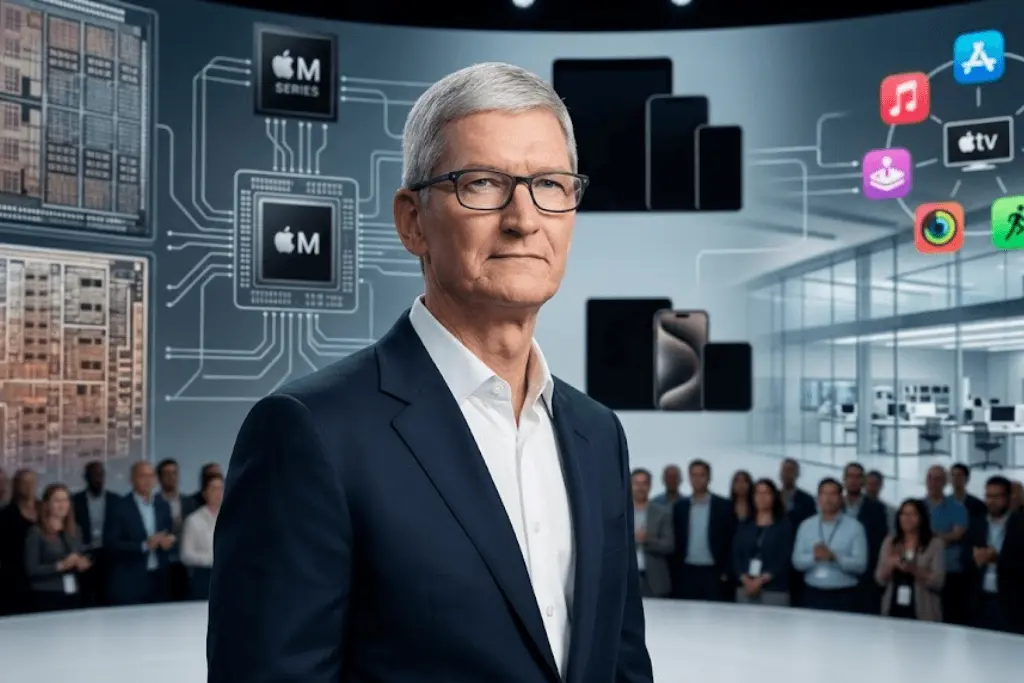
Cook’s way of leading created a different environment through Tim Cook Apple leadership than the intense product-focused culture of the Jobs era. Under Cook, values around diversity, accessibility, human rights and environmental responsibility became more visible parts of Apple’s corporate direction. The emphasis on these subjects was a manifestation of Apple’s ambition to present itself not just as a technology manufacturer but as a global institution with responsibilities to its employees, consumers, communities and the environment.
Cook also presided over a huge expansion in the company’s workforce. The scale of organisation created under his leadership is apparent in the growth of Apple from a total employee base of about 60,000 employees in 2011 to more than 160,000 employees worldwide.
That workforce growth mirrored Apple’s expanding presence in business in hardware, software, services, retail and global operations. Cook’s operational management style was particularly important for the larger organisation, which required systems to handle increasingly complex projects, markets and supply chains.
Apple’s Growth Was Driven By Services And Scale
One of Cook’s biggest accomplishments has been growing Apple’s services business. Apple developed more and more recurring income streams through businesses like the App Store, iCloud, Apple Music and Apple Pay rather than depending heavily on hardware sales and device upgrade cycles.
The services strategy created a more expansive relationship between Apple and its customers. Devices remained at the centre of the ecosystem, but services provided customers with even more reasons to stay, enhancing recurring engagement and decreasing reliance on individual hardware launches.
Under Cook, Apple’s financial scale grew dramatically. The company’s market capitalisation soared from around $350 billion in August 2011 to about $4 trillion, one of the biggest corporate expansions in modern technology.
The growth also reflected the ability to monetise an ever more integrated ecosystem. Hardware, software and services became more integrated, enabling Apple to create value at different points in the customer relationship, rather than depending on a single product category.
Supply Chain Management As A Source Of Competitive Advantage
Cook had extensive operational experience, and one of the hallmarks of his tenure was global supply chain management. It had a huge international network for producing and distributing its products, and improved its manufacturing, procurement and logistics systems.
Geopolitical tensions, trade disruptions and regional manufacturing risks hit the technology sector, making supply chain resilience more important than ever. Apple responded by diversifying and shifting production capacity across countries including India and Vietnam to reduce excessive reliance on a single manufacturing geography.
It also brought more focus on Asia as a key part of Apple’s global manufacturing strategy. Apple’s production ambitions expanded to include India more prominently, and the door opened for deeper engagement with the country’s burgeoning technology manufacturing ecosystem.
The strategy showed how operational decisions affect corporate resilience for global technology markets. Control of manufacturing at mass scale became one of the key elements of Apple’s competitiveness over and above product design and software development.
Tim Cook’s Innovation Has Taken Apple Beyond The iPhone
Cook inherited the iPhone as Apple’s flagship product, but his tenure proved the company could debut new major categories beyond its flagship smartphone. The Apple Watch and AirPods were key additions to Apple’s hardware ecosystem, helping the company establish a foothold in the wearable technology and personal audio spaces.
The Apple Watch became a major platform for health, fitness, communications and everyday convenience. AirPods also became a very recognisable part of the Apple ecosystem, showing how smaller connected devices could generate a lot of commercial and strategic value. This move gave Apple a greater degree of control over the relationship between hardware and software, and also allowed for improvements in performance and energy efficiency across Mac products.
The move to custom silicon was also a deeper form of vertical integration. If Apple designed important components in-house, it could build the processor architecture to better suit the OS and apps, and give itself greater control over future product development.
Apple Vision Pro Opened Another Frontier In Technology
Apple Vision Pro was launched to join spatial computing with Cook’s Apple. It was an effort to create a new computing category based on immersive digital experiences instead of traditional screens.
The market for spatial computing is still nascent, but the Vision Pro has shown Apple’s willingness to invest in technologies with longer-term potential. The product brought together Apple’s strengths in hardware, software, displays, and custom silicon into a new computing experience.
The importance of the product is not in immediate sales alone. New platforms often require adaptation by developers, consumers and businesses before a technology can achieve wider adoption, meaning that the creation of an ecosystem can be as important as the first-generation device itself.
So the Vision Pro is part of a larger trend of Cook-era innovation, where Apple kept expanding its technology platform, but was more cautious about new categories. The approach was to find opportunities to support future growth, not just to replace existing products.
Under Cook, Apple’s Ecosystem Expanded
A key part of Cook’s leadership has been to increase integration of Apple products and services. The iPhone was still the heart of the company, but other products like the Apple Watch, AirPods and Mac became more and more integrated through software and services.
This ecosystem approach encouraged customers to use several Apple products together. Additional devices could add to the usefulness of other products, and services added another level of continuous engagement.
This created a business model in which hardware innovation and services expansion drove each other. The customer buying an Apple device could then interact with cloud storage, digital content, payment services, applications and other elements of the ecosystem.
This combination helped to cement Apple’s role in the global technology market. It also provided the company more opportunity to develop new products without losing the existing customer base built up by its most successful devices.
Cook Was Focused On Building Long-Term Institutional Development
Cook’s leadership style has been generally characterised by operational discipline, not personality-driven product launches. That strategy allowed Apple to run a much larger business with a sharp focus on profitability, the supply chain and building out the ecosystem.
Apple’s workforce, global reach and product portfolio were too large to manage without institutional systems that could work across markets and continents. Cook’s tenure demonstrated the value of developing those systems side-by-side with the headline-grabbing technological products.
The expansion of services also supported the longer term financial strategy. While individual hardware releases might provide less consistency, recurring revenue can offer more, and the ecosystem creates multiple avenues for customers and businesses to engage with Apple.
A blend of operational scale, services revenue and hardware innovation helped make Apple into a wider technology institution. The company de-risked itself from any one product cycle, and continued to invest in new categories and proprietary technologies.
Apple’s Rebound Has Lessons For Global Technology Markets
Cook’s Apple leadership also has broader implications for technology industries around the world. The company’s development exemplifies how operational management can be as important as product creativity when a technology business goes global.
Apple’s expansion of its manufacturing footprint in places like India is especially relevant to emerging technology economies. Better integration into global supply chains can offer opportunities for manufacturing, skills development and investment, while helping companies to diversify production networks.
Apple’s trajectory under Cook shows that technological leadership is increasingly about a set of interlinked capabilities. Product development, services, workforce management, supply chain resilience and responsible corporate governance can together determine if a technology company sustains growth over decades.
The Broader Legacy Of Tim Cook At Apple
Tim Cook’s legacy at Apple goes beyond the massive increase in the company’s market value. His term transformed the workforce, grew services, diversified manufacturing, introduced major hardware categories and moved the Mac to proprietary silicon while establishing the foundation for spatial computing.
The transformation also showed how Apple could stay at the cutting edge of innovation without leaning entirely on the formula that helped make the iPhone a global phenomenon. In addition to product design, operational excellence and ecosystem development became increasingly important.
The growth of Apple under Cook is ultimately a story of scale and a story of strategic diversification. The company strengthened recurring services, grew its workforce, built a more resilient manufacturing network and continued to invest in technologies that can shape future markets.
The long-term legacy of the Cook era is the transformation of Apple from a successful hardware company into a sprawling technology platform. That shift has affected workers, consumers, suppliers and technology markets around the globe, while offering a model of a way of working that balances disciplined operations with ongoing innovation at tremendous corporate scale.
Visit The Pakistan for more updates.