Adnan Farooq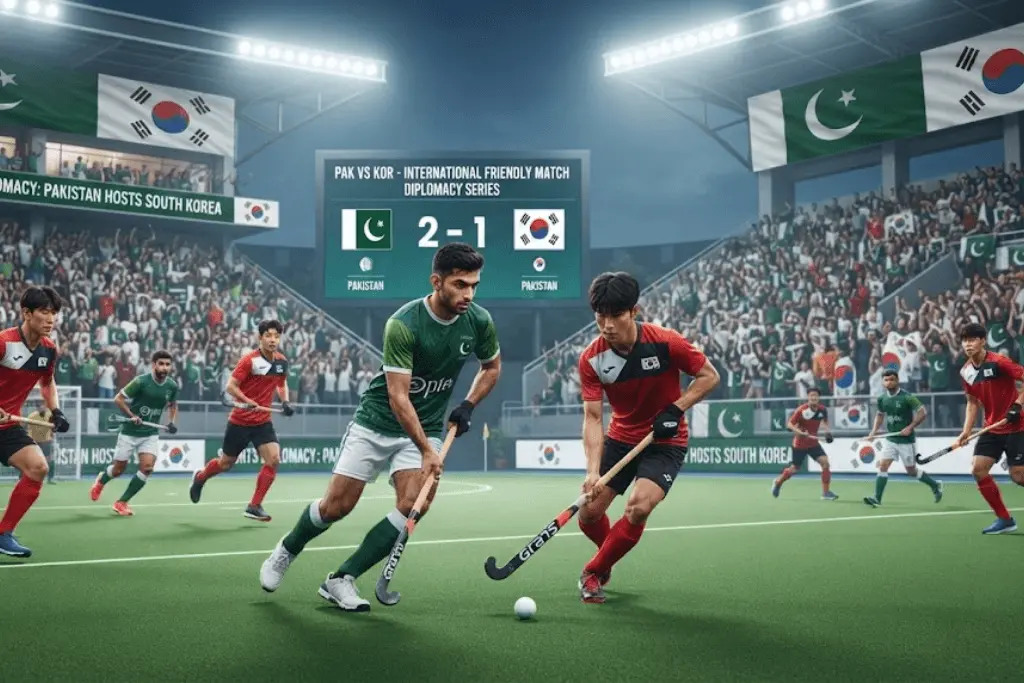
Pakistan has increased its sports diplomacy through Pakistan South Korea hockey by hosting the South Korean national hockey team in a historic bilateral test series in Islamabad, marking an important milestone in Pakistan’s efforts to strengthen international sporting relations and demonstrate its ability to host major international events. The tour is symbolic of Pakistan’s wider ambition to re-join the international sporting family and attract more foreign teams to play in the country.
Historic Tour Marks South Korea’s Return After Almost 20 Years
The visit of the South Korean hockey team holds a special historical significance as it is the country’s first hockey tour of Pakistan in almost two decades. The return of a top Asian hockey nation signals revived belief in the sports ecosystem and management skills of Pakistan.
In the last two decades, security and logistical concerns have reduced the number of international hockey tours. Thus, the successful hosting of this bilateral series is a big step forward for Pakistan’s sporting landscape.
Playing against a seasoned international side also provides the Pakistani players with valuable competitive exposure and bolsters sporting ties between two countries with proud hockey traditions.
The tour is a sign of the slow return of elite international hockey to Pakistan and shows a rising optimism over the country’s ability to hold international sports events.
Four-Match Bilateral Series To Aid World Cup Preparations
The bilateral test series will comprise four matches that will be played at Naseer Bunda Hockey Stadium, Islamabad, on 30th July, 2nd August, 4th August and 7th August, 2026.
The series is a key part of preparations for both Pakistan and South Korea for the 2026 Hockey World Cup. Regular international competition provides players and coaching staff the opportunity to assess tactical approaches, improve match fitness and evaluate squad combinations ahead of one of hockey’s biggest tournaments.
Competitive bilateral series are still a must for national teams trying to improve consistently against good international opposition. These matches also provide opportunities to test younger players in high-level competitive situations.
The schedule of the four games will allow both teams the opportunity to maximise learning experiences and to build professional relationships between the athletes and the coaching staff.
Pakistan Football Federation Seeks Inter-Sport Collaboration
One of the unique aspects of the South Korean visit was the reception arranged by the Pakistan Football Federation despite the delegation representing the sport of hockey. The special luncheon was a demonstration of the cooperation of various sporting organisations to common national goals.
Sports collaboration is also an acknowledgement that the promotion of international sporting engagement is in the interest of the wider sports sector rather than just the individual federations. Joint ventures also help cement institutional relationships while encouraging a greater sense of unity across the Pakistani sporting community.
The reception provided an opportunity for sports administrators, officials, athletes and visiting delegates to exchange ideas on future cooperation and sporting development.
Sports Diplomacy Reinforces International Relations
Sports have become a major tool for Pakistan to boost its international outreach. Hosting visiting teams builds stronger people-to-people connections and demonstrates a willingness to collaborate with international partners in many sectors. A good example of this diplomatic approach is the South Korean hockey tour that combines competitive sport with official business to promote friendship and cooperation. Sporting exchanges, when successful, often generate momentum for broader co-operation in the fields of education, tourism, culture and economic engagement between the countries concerned.
International Participation Shows Confidence In Pakistan’s Sporting Environment
The successful conduct of South Korea’s hockey tour also demonstrates increasing international confidence in Pakistan’s sporting infrastructure and security arrangements. The smooth conduct of several international matches at Naseer Bunda Hockey Stadium is a reflection of Pakistan’s ability to hold international sporting events as per modern organisational standards.
Improved sports infrastructure, security planning and experienced event management continue to play a role in Pakistan’s efforts to attract more international competitions. Every successful international event further enhances Pakistan’s credentials as a capable destination for regional and international sports events.
Pakistan’s Sporting Future Boosted By International Hockey Revival
Pakistan is one of the most successful nations in hockey and has a proud record in World Cups, Olympic Games and Champions Trophy events. So the return of international sides to Pakistan is much more than just another bilateral series.
Regular international competition helps raise standards of play, inspire young players and generate more public interest in hockey. Exposure to quality opposition also aids long-term player development and coaching development.
The South Korean series is part of wider efforts to restore Pakistan’s presence as an active host in the international hockey scene. If it continues to be successful in organising such tours, it could result in more countries scheduling future bilateral competitions.
Pakistan Continues To Pursue Sports Diplomacy By Engaging Internationally
This visit of the South Korean hockey team is a major achievement for Pakistan’s sporting community, and it reflects the country’s continued commitment to strengthening international partnerships through sport. The official reception hosted by the Pakistan Football Federation showed how sports bodies can come together to promote friendship, cooperation and cultural exchange, as well as the matches themselves.
The historic return of South Korea after almost two decades is also reflective of the growing international confidence in Pakistan’s sporting infrastructure, organisational capabilities and ability to host major international sides. The bilateral series is a good opportunity for the two countries to gain competitive experience while strengthening the long-standing sports ties, with the 2026 Hockey World Cup preparations ongoing.