Farhan Qureshi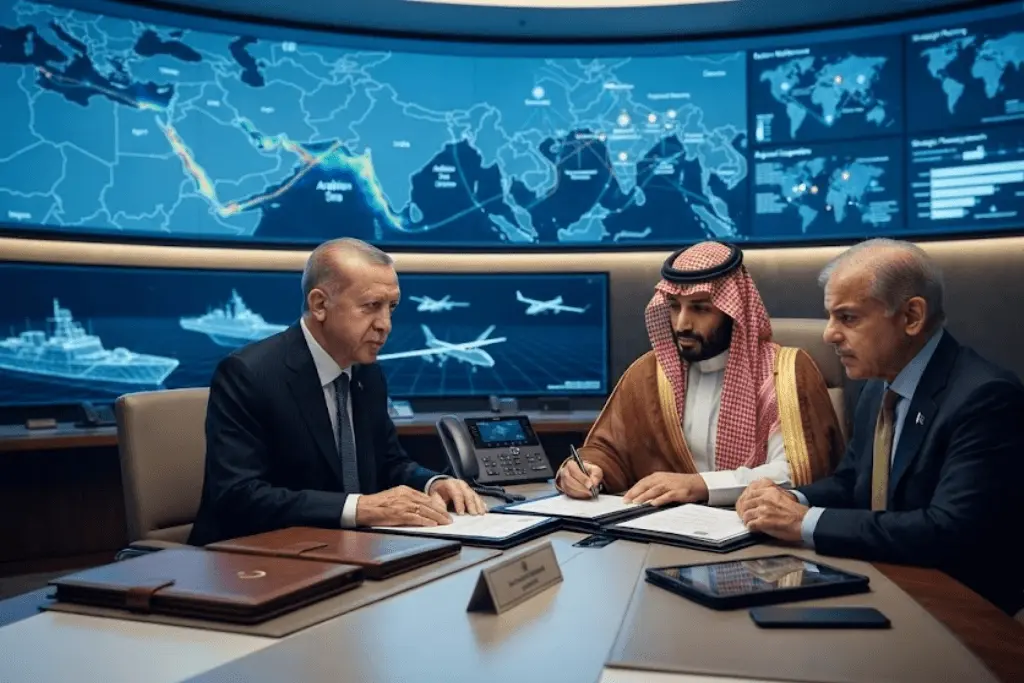
Pakistan is ready to build on its regional security partnerships with a new trilateral defence agreement, known as the Pakistan Saudi Türkiye defence pact, with Saudi Arabia and Türkiye to enhance strategic coordination and regional security cooperation. The proposed pact is an important step toward enhancing military cooperation, strategic coordination and regional stability at a time when geopolitical developments continue to reshape the security landscape of the Middle East.
The agreement is expected to be signed at a high-level summit in Jeddah attended by Saudi Crown Prince Mohammed bin Salman, Turkish President Recep Tayyip Erdogan, Pakistani Prime Minister Shehbaz Sharif and Pakistan’s Chief of Defence Forces, Field Marshal Asim Munir. The involvement of both civilian and military leaders highlights the strategic importance of the initiative.
Although no details of the agreement have been publicly released by the governments concerned, the proposed framework points to a wider commitment to strengthening defence cooperation via regional partnerships.
Regional Security Environment Spurs Closer Cooperation
The changing security situation in the Middle East has led to increased strategic coordination between several countries in the region. Recent conflicts affecting the Gulf have highlighted the need for improved mechanisms for consultation that can respond to emerging security challenges through cooperation.
The increased instability in the region has also placed a higher premium on maritime security, on energy infrastructure and on protecting international trade routes. These developments have caused countries to re-examine their present security arrangements and to consider broader frameworks for defence cooperation.
Pakistan’s participation reflects its longstanding policy of building productive relations with important regional partners and contributing to initiatives that promote peace, stability and cooperative security.
The trilateral framework proposed is to enhance regional resilience through dialogue, coordination and mutual strategic understanding.
High-Level Leadership Shows Political Commitment
The summit is attended by some of the region’s most influential political and military leaders. Prime Minister Shehbaz Sharif’s participation is indicative of Pakistan’s resolve to strengthen its bilateral and multilateral strategic ties with trusted partners. A closer interaction between the civilian leadership and defence institutions allows for more comprehensive strategic decision-making.
The talks’ significance in the broader Middle East geopolitical context is highlighted by the fact that Saudi Arabia’s Crown Prince Mohammed bin Salman and Turkish President Recep Tayyip Erdogan also bring significant regional clout to the talks.
The high-level representation indicates a common political desire to enhance cooperation beyond the usual bilateral interactions.
Pakistan To Bolster Longstanding Defence Ties With Saudi Arabia
The trilateral pact is based on the Strategic Mutual Defence Agreement signed between Pakistan and Saudi Arabia in September 2025. For decades, Pakistan and Saudi Arabia have maintained close defence relations through military training, intelligence cooperation, joint exercises and institutional exchanges. These longstanding partnerships have built up mutual trust and strategic understanding.
The enlargement of this framework to Türkiye is an evolution of regional cooperation, not the construction of a new security architecture.
Pakistan’s experience of close cooperation with Saudi Arabia provides a strong basis for further extensive trilateral engagement.
Turkey Strengthens Partnership With Major Defence Capabilities
The proposed framework would benefit from Türkiye’s significant military power and increasingly sophisticated domestic defence industry. Within NATO, Turkey is one of the major military powers and has greatly expanded its production of advanced defence technologies in the last 10 years.
Its growing expertise in drone technology, armoured vehicles, missile systems and defence manufacturing creates opportunities for technical cooperation among the participating countries.
Türkiye has also increased diplomatic activity throughout the Middle East in recent years, opening new opportunities for coordinated regional efforts on political, security and economic cooperation.
Adding Türkiye broadens the strategic reach of the partnership and deepens institutional relationships among three important regional powers.
Maritime Security Becomes A Common Priority
Maritime security is expected to play a central role in discussions of the new agreement. Strategic waterways like the Red Sea, Gulf of Aden, Bab al-Mandeb Strait and Strait of Hormuz continue to be crucial passages for global trade and international energy supplies.
Regional Cooperation Supports Wider Stability Goals
The proposed agreement is part of a broader diplomatic effort to foster stability through regional ownership of security challenges, going beyond defence collaboration. These long-standing foreign policy goals are supplemented by involvement in wider strategic alliances.
Regular consultation among regional partners helps to better understand mutual security concerns and to coordinate responses to new challenges that affect more than one country.
Hence, the trilateral initiative is both a defence partnership and an important diplomatic platform to complement ongoing regional dialogue.
Cooperation Is More Than Just Military Affairs
Pakistan-Saudi Arabia-Türkiye relations have in recent years expanded significantly beyond the traditional domain of defence cooperation. The three countries are increasingly cooperating on economic development, investment, trade, technology, education, humanitarian assistance and diplomatic engagement.
Frequent high-level visits have reinforced political relations and opened new avenues of institutional cooperation across various sectors. These larger strategic alliances have several key facets, one of which is defence cooperation.
Better cooperation also means better regional connectivity through policy coordination on economic growth, infrastructure development and international investment.
A multidimensional relationship can provide greater resilience and allow for long-term regional cooperation beyond immediate security considerations.
Pakistan Enhances Its Role In Regional Strategic Diplomacy
Pakistan’s participation in the proposed trilateral defence pact with Saudi Arabia and Türkiye signals its continuing commitment to positive regional engagement and strategic partnership-building. Pakistan’s growing cooperation with two important regional partners is a sign of its willingness to play an active role in initiatives to promote stability, dialogue and collective security in the Middle East.
The emerging partnership builds on long-standing bilateral relationships and opens up opportunities for wider cooperation in defence, maritime security, intelligence coordination and regional diplomacy. Since the Gulf and its environs remain beset by geopolitical challenges, a commitment to structured consultation among trusted partners can boost confidence and readiness to deal with emerging security challenges.