Adnan Farooq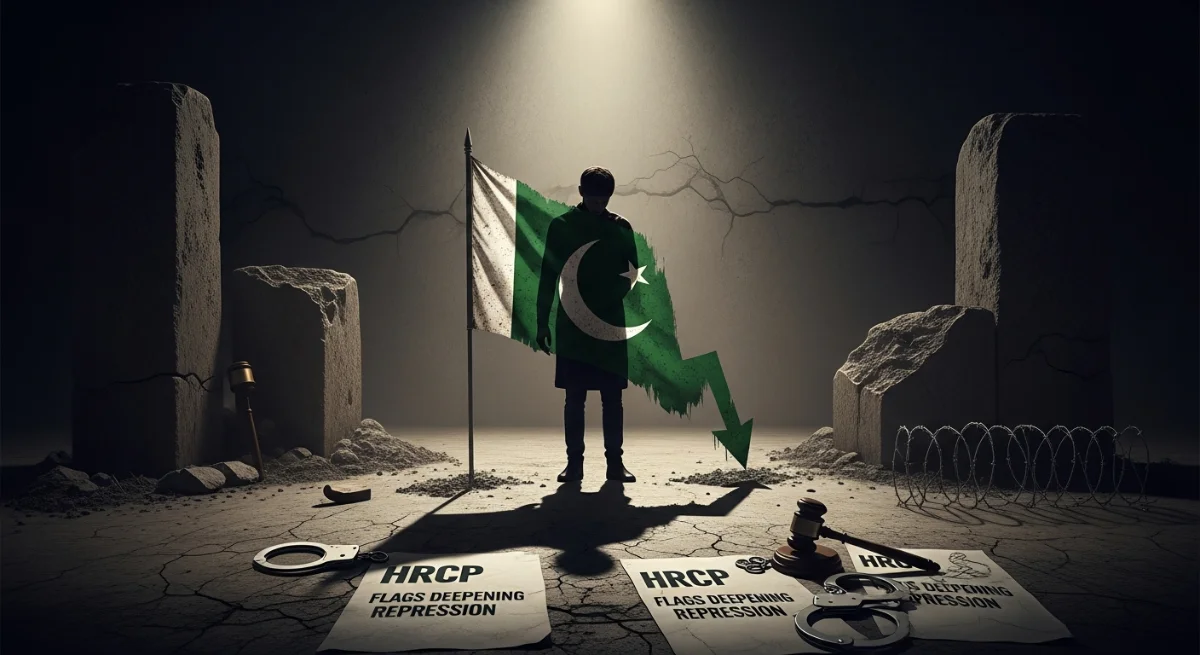
The Pakistan rights crisis has grown worse and serious due to the increasing concerns on the widening state repression, elite control, and narrowing down of civic rights by the Human Rights Commission of Pakistan (HRCP). During a recent seminar, HRCP leaders condemned the government policies that harm democratic principles, hold back, and weaken institutions meant to defend the citizens. The debate preempted forced disappearances, violence against the independence of media, inequality, and exploitation of the marginalised groups. These issues indicate that the Pakistan rights crisis is not only political but also very structural and needs immediate reforms in order to protect the democratic rights and maintain constitutional guarantees of all the communities.
HRCP Demands Reversal of Controversial Amendments
The HRCP restated that the Pakistan rights crisis is on the rise because the government had declined to repeal the controversial 26 th and 27 th constitutional amendments. According to critics, these amendments only increase the powers of authorities at the expense of the citizen protection. Asset The Chairperson of the HRCP, Asad Iqbal Butt demanded that the practice of enforced disappearances should be ended immediately and all political prisoners released at once. He argued that the ruling elite in Pakistan has personalized governance to be an exploitative system, which disempowers democracy and solidifies inequality, the major causes of the current rights crisis.
Rising Inequality and Shrinking Democratic Space
The seminar speakers indicated how capitalist interests continue to dominate the power structure in Pakistan. Butt warned against repeating past blunders particularly those that led to the tragedy that occurred in 1971. His conditions included the reinstatement of media freedom, the reinstatement of student unions, the introduction of a minimum wage of Rs 50,000 and increased protection of the rights of workers. These requirements are put forward as necessary measures to deal with the overall rights crisis and ensure that the rule of law dominates over the elite.
Enforced Disappearances: A Persistent Human Rights Issue
Sohail Sangi, a veteran journalist noted that enforced disappearance had reduced slightly in 2025 due to continued pressure by the civil society. However, he cautioned that the state is becoming more and more resolute in its use of surveillance, intimidation and coercion in order to crack down on protests. Following the history of the practice back to the Ayub Khan period, Sangi observed that dissaparances actually escalated during the Musharraf rule, making them an old element of the rights crisis in Pakistan.
Global Human Rights Trends and Local Implications
In his speech to the United Nations, academic Dr. Riaz Shaikh, based on his own speech, stated that the last 25 years have seen a verge of human-rights violations around the world because of geopolitical changes. He has stressed that in the absence of economic autonomy, the freedom of culture and politics would not attempt the meaning of freedom. Growing inequality in wealth, he asserted, has increased exploitation and aggravated the rights crisis and rendered millions of people without fundamental protection.
Violence Against Women, Minorities, and Marginalised Groups
According to a report given by lawyer Shazia Nizamani, almost 21,000 women and children have been the victims of domestic violence in 6 years, with conviction rates being low beyond abysmal. Parliament was condemned by rights activists to have weakened the protection of religious minorities. Another dimension to the rights crisis that is escalating, especially among the vulnerable communities, was brought out by advocate Ayesha Dharijo, who noted the killings of more than 15 Hindu girls in Sindh.