Adeel Hassan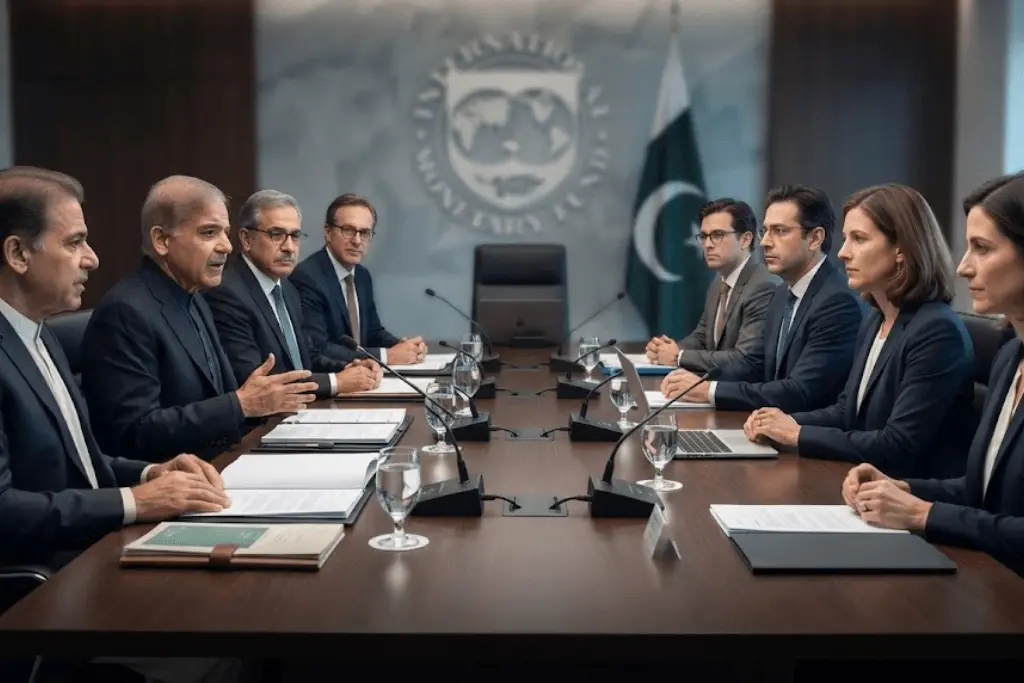
Pakistan and the International Monetary Fund (IMF) have formally started the Pakistan IMF talks on the fourth review of the Extended Fund Facility and the third review of the Resilience and Sustainability Facility. The kick-off meeting was held between Finance and Revenue Minister Muhammad Aurangzeb and the visiting IMF mission headed by Iva Petrova; senior economic officials also attended the discussions.
The EFF arrangement provides the overarching framework for Pakistan’s macroeconomic and structural reform program, and the RSF is aimed at strengthening resilience to climate-related and other longer-term economic risks. The parallel reviews therefore examine both immediate economic management and measures to improve Pakistan’s capacity to cope with future shocks.
IMF Review Coincides With Pakistan Facing External Economic Pressures
The latest review comes against a difficult external background of disruption linked to the ongoing regional conflict involving Iran and pressure from higher energy costs. During the opening meeting, Aurangzeb gave the IMF team a briefing on the latest macroeconomic indicators, the upgraded credit rating of Pakistan, and the overall investment climate situation.
Pakistan can be affected by external shocks through several channels, including fuel prices, transport costs, trade activity and government revenues. The IMF has previously noted that global and regional shocks create a need to maintain economic resilience, while implementing structural reforms that can promote long-term prosperity.
IMF Talks: Pakistan Revenue Collection Still Key To
Tax collection is expected to continue to be a significant part of the ongoing review, as fiscal performance is a key part of Pakistan’s IMF program. The Federal Board of Revenue (FBR) has briefed the IMF mission about the impact of regional conflict and higher fuel prices on revenue mobilisation and said the agreed first quarter collection target is still achievable.
The FBR was hopeful that the collection in September would remain near the monthly target and the overall revenue target for July-September would be achieved, the information shared in the talks said. An important measure of fiscal resilience would be the ability to maintain revenue performance even in the face of softer economic activity over the review period.
Pakistan’s Economic Stability Remains The Central Focus Of The Review
The EFF review is expected to assess whether Pakistan has maintained the fiscal and monetary discipline required under the program while continuing with the structural reforms. Earlier assessments by the IMF acknowledged Pakistan’s efforts in strengthening economic stability, rebuilding confidence and improving external conditions, and urged the continuation of the agreed reforms.
The country’s foreign exchange position has also improved during the program period. The State Bank of Pakistan had about $26.8 billion in total liquid foreign exchange reserves in September, with over $21.4 billion held by the central bank, providing a stronger external buffer than at earlier stages of the stabilisation process. Pakistan has been implementing measures relating to taxation, state-owned enterprises, energy sector viability, public sector governance and competition as part of the broader EFF framework.
Reforms in the energy sector continue to be of particular importance, as improved pricing, distribution, circular debt management and institutional performance can impact both public finances and private-sector competitiveness. The IMF has also linked long-term economic stability to reforms that would boost productivity and improve the delivery of public services.
The RSF Review’s Focus Shifts To Climate Resilience
The third review of the Resilience and Sustainability Facility adds a climate lens to the IMF’s ongoing discussions. The facility is intended to support longer-term reforms that build resilience to climate-related risks and enhance Pakistan’s capacity to manage vulnerabilities that could affect economic stability.
Climate resilience is important for Pakistan’s economy because extreme weather can damage infrastructure, disrupt agriculture, affect water resources and put pressure on the country’s finances. This means that integrating climate considerations into economic planning can help to deliver both environmental resilience and financial stability.
Public Sector Reforms In Pakistan Yet Under Review
The current discussions also concern the public administration and governance systems of Pakistan. The Establishment Division and tax authorities briefed the IMF mission on the digitisation of the declaration process for assets of federal civil servants, under which about 10,000 officials are expected to make mandatory declarations of movable and immovable assets under the relevant framework.
Effective digitisation can improve the efficiency and traceability of administrative processes, when supported by accurate records and effective oversight. Increased adoption of digital systems across public institutions can also help. For Pakistan, this can mean increased transparency, speedier information management and stronger institutional capacity.
IMF Review May Bolster Pakistan’s Investment And Reform Agenda
The latest talks are also important for Pakistan’s efforts to improve investment climate. Aurangzeb pointed to improvements in the country’s credit rating and investment environment at the opening meeting. The wider IMF program includes measures to boost competition, productivity and economic efficiency.
A stable macroeconomic environment can enhance investor confidence through improved predictability around inflation, taxation, exchange-rate conditions and government finances. Structural reforms can help that stability by enabling businesses to plan for investment and expansion of productive capacity.
Next IMF Review In Pakistan To Assess Reform Implementation
The present review will provide a detailed assessment of Pakistan’s implementation of program commitments and the economy’s resilience to recent external pressures. The government has indicated its continued engagement with the IMF on finance, taxation, banking, administration and provincial institutions, and the mission has already held talks with a number of key stakeholders.
Successful completion of the reviews would help secure continued program financing and strengthen the policy framework that Pakistan has been pursuing since the start of the EFF arrangement. The previous review by the IMF in May stated that Pakistan’s policy implementation supported economic stability in a challenging external environment, while highlighting the need to maintain momentum on reforms.