Farhan Qureshi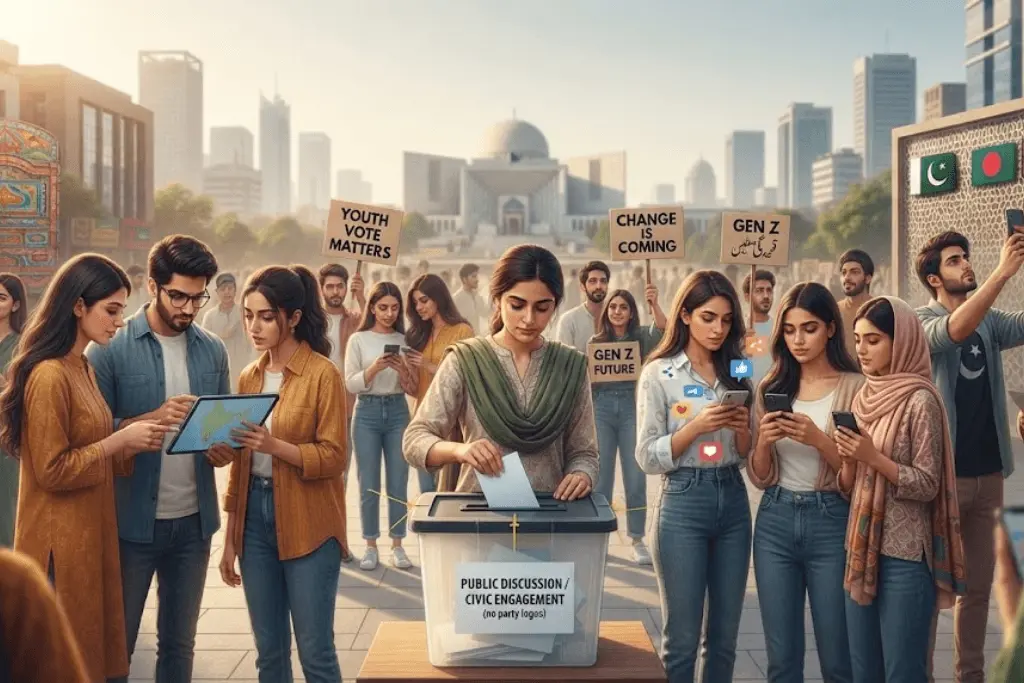
South Asia is entering a new political phase where Pakistan Gen Z and younger citizens across the region are playing an increasingly important role in shaping public debate, electoral expectations, and demands for institutional reform. The recent political upheavals in Bangladesh, Nepal and Sri Lanka show how quickly economic frustration and disenchantment with traditional politics can turn into powerful movements.
The regional developments are worth careful attention for Pakistan, but not just in terms of street protests. The more important lesson is about the expectations of a young population, especially around employment, economic opportunity, accountable governance, digital participation and the ability of institutions to respond to changing social demands.
Youth Expectations Becoming A Governance Test
Gen Z political activism is part of a generation. Younger citizens are more digitally connected and less reliant on traditional political organisations for information, mobilisation or public expression.
One of the strongest drivers is still economic pressure. Jobs, inflation, the quality of education and the ability to earn a decent living can easily become political flashpoints when large numbers of young people feel that the system is not providing enough opportunity.
Economic Opportunity Could Bolster Political Stability
The experience of South Asian neighbours suggests a significant link between economic conditions and political stability. Bangladesh, Nepal and Sri Lanka all had different triggers for political unrest, but economic hardship and frustration with existing governance fueled broader public anger.
There are economic pressures within Pakistan, so economic resilience is key to long-term political stability. Beyond election cycles, inflation, employment and household purchasing power define public confidence in institutions.
Therefore, a more solid economic base can be an important form of social stability. Policies to increase productive employment and improve investment conditions can cure some of the frustrations that often feed political dissatisfaction.
Digital Platforms Have Changed The Way People Do Politics
Social media has emerged as one of the biggest forces transforming the political communication landscape in South Asia. Digital participation can politically sensitise and place previously marginalised voices into national discourse.
For Pakistani institutions and political parties, the transition also requires a more modernised understanding of communication. Young citizens are increasingly looking for faster responses, accessible information and visible accountability, rather than traditional one-way political messaging.
Only Political Mandates Can Guarantee Stability
One of the most compelling lessons of Bangladesh, Nepal and Sri Lanka is that electoral legitimacy does not always guarantee long-term stability. Governments are elected with popular support, but they are under pressure if reforms are not undertaken or if expectations outpace results, he said.
This is especially applicable for Pakistan, where political governments work within a complicated institutional and economic setting. To bolster public support, effective administration, economic delivery and credible policymaking are needed.
Pakistan can thus benefit from a governance approach that is oriented towards measurable delivery. Employment creation, education reform, better public services, infrastructure and investment should be judged on outcomes that are directly visible to citizens.
Pak’s Regional Role Makes Stability More Important
The geographical location of Pakistan lends special significance to regional political developments. Economic and political developments in South Asia can affect trade, migration, security, energy markets and diplomatic relations.
The experience of Bangladesh, Nepal and Sri Lanka also suggests that relations with larger regional powers can become complicated when domestic political change intersects with external pressures.
The foreign policy environment of Pakistan itself is similarly complex. Good relations with neighbours, Gulf partners, China, the United States and other international players are vital for economic resilience and strategic balance.
Make Youth Employment A National Priority
What brings together many youth-led movements is not only politics, but the fight for economic opportunity. Frustration among young citizens is created by education without jobs, qualifications without suitable jobs and rising living costs.
Pakistan has a huge opportunity to tackle this challenge with skill development and private sector growth.
Pakistan’s growing information technology and freelancing ecosystem has a particular promise. A young population with affordable internet, quality training and international payment infrastructure can directly contribute to foreign exchange earnings.
There is another field for industrial development. Manufacturing, engineering, agriculture processing and energy projects can create more stable jobs while boosting domestic production.
Pakistan Can Learn From, Not Copy, Political Models In Region
The regional Gen Z movements provide valuable lessons, but Pakistan does not need to follow the political trajectories of Bangladesh, Nepal or Sri Lanka. Every country has its own institutions, its social structure, economic situation, and political tradition.
The valuable lesson is that governments need to understand why young citizens become dissatisfied and how institutions can respond before frustration becomes a wider crisis.
And economic management is no exception. The sustainability of long-term reforms is higher when citizens understand why they are important and perceive signs that the benefits are being distributed fairly.
A healthy democracy does not demand the absence of disagreement. It requires institutions that can absorb dissent without the destruction of national cohesion by political competition.
That distinction may be especially important as Pakistan’s young population becomes an increasingly powerful segment of public life.
A Stronger Pakistan Can Convert Demographic Pressure Into Opportunity
South Asia’s Gen Z moment should finally be taken as a lesson in opportunity as much as a warning. When effective institutions support education, employment, entrepreneurship and civic participation, young populations can generate extraordinary economic and political energy.
Pakistan has many of the ingredients to benefit from this transformation. The large youth population, growing digital economy, strategic geography and rising interest in technology can support a stronger economic future.
The challenge is to make these advantages translate into real opportunities. Education has to connect with employment, digital access with income, and economic growth with better household conditions.
Pakistan’s best response to the regional Gen Z moment can thus be constructive: better youth employment, better skills, more responsive institutions, responsible digital participation and continued economic reform.
A confident Pakistan that invests in its young population can transform demographic pressure into a national asset. The regional lesson is plain: governments that grasp evolving expectations early are better equipped to foster stability, and societies that can harness youth energy into productivity can build a more resilient future