Farhan Qureshi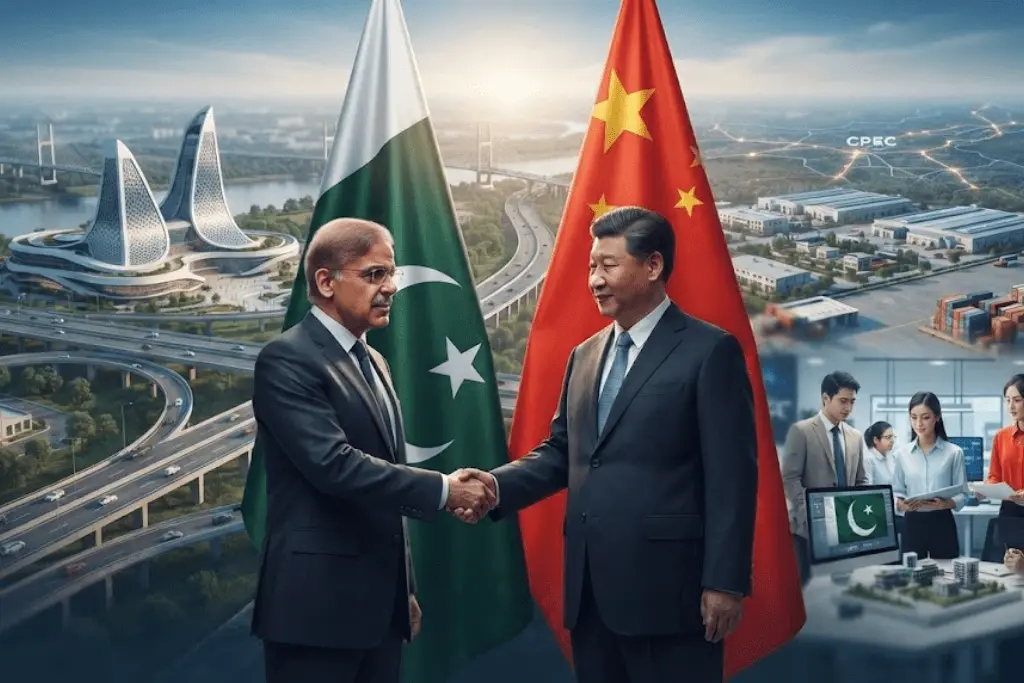
Pakistan-China relations remain an important pillar of Pakistan’s foreign policy, economic planning and regional connectivity strategy. The decades-old partnership is increasingly a blend of infrastructure development, trade, security coordination and diplomatic engagement across a rapidly shifting regional environment.
The China-Pakistan Economic Corridor, particularly through its next phase, provides a big platform to expand cooperation beyond infrastructure. A greater focus on industry, agriculture, mining and information technology could help Pakistan move toward higher-value economic activity and build stronger links between domestic production and international markets.
Cpec Phase II May Lay Pakistan’s Economic Foundation
The second phase of CPEC is an effort to build on the infrastructure base created in the first stage of cooperation. The revised framework is focused on economic activity, industrial development and sectors that can generate longer-term growth.
The five proposed economic corridors will be focused on sectors including industry, agriculture, mining and information technology. These sectors offer opportunities for Pakistan to enhance productivity, attract investment and develop stronger domestic value chains.
Gwadar Can Enhance Pakistan’s Role In Regional Connectivity.
Under CPEC, Gwadar Port is the centre of Pakistan’s connectivity goals. Its strategic location offers an opportunity to strengthen trade links between Pakistan and Western China, Central Asia and other regional markets.
Gwadar’s development as a transit and commercial hub may enhance Pakistan’s position as a bridge between some of the world’s major economic regions. Better logistics infrastructure and more efficient port operations could make Pakistan a more attractive regional transit point for trade.
Trade Cooperation Vital For Pakistan’s Long-Term Growth
Pakistan’s economic cooperation with China offers an opportunity to step up trade, attract investment and increase productive capacity. Stronger commercial ties are especially welcome if they are accompanied by domestic reforms that boost competitiveness and the business environment.
For Pakistan, the main goal is not just to increase the amount of trade, but also to increase the range and value of goods and services that enter international markets. That transition can be underpinned by industrial, agricultural and technological cooperation.
Security Cooperation Fosters Regional Stability
The link between economic development and regional security is a close one. The security environment is vital for the CPEC infrastructure and other major investments, making counterterrorism coordination an important element of Pakistan-China relations.
The two countries have collaborated on security issues relating to militant groups and threats to infrastructure. Better coordination can help protect economic projects and the workers, communities and businesses tied to them.
Economic Connectivity Sustained Through Counterterrorism Cooperation
The security dimension of Pakistan-China cooperation has acquired added salience as the large infrastructure projects can be exposed to the risks of militant violence. Hence, the protection of economic corridors is a national security and development issue.
Joint counterterrorism coordination may spur intelligence sharing, operational preparedness and enhanced protection for strategic installations. Such efforts matter not only for bilateral interests but for the overall stability of regions linked through regional trade routes.
Diplomatic Coordination Boosts Pakistan’s Regional Role
The countries coordinate positions through forums such as the Shanghai Cooperation Organisation, where regional security, economic connectivity and cooperation are important areas of discussion.
Such diplomatic coordination could improve Pakistan’s capacity to enter into dialogue involving key regional powers. Multilateral institutions offer opportunities for engagement to support dialogue on common challenges.
Improved Connectivity Can Connect South And Central Asia
One of the most important long-term opportunities for Pakistan-China cooperation lies in improved connectivity between South and Central Asia. Pakistan’s ports and transport networks could offer landlocked economies alternative access routes to international markets. Transport infrastructure can help to reduce barriers to the movement of goods and to strengthen commercial ties, which can benefit regional economies.
Pakistan Can Benefit From Cooperation In Technology And Skills
As Pakistan-China cooperation moves to higher value-added sectors, technology transfer and skills development might become more important. Better technical skills can raise productivity in manufacturing, agriculture, information technology and other new sectors.
Pakistan-China Cooperation Can Contribute To A More Stable Region
The Pakistan-China partnership is turning into a multi-dimensional relationship encompassing economic development, infrastructure, security and diplomacy. CPEC is still an important part of it, but the broader relationship involves a much wider range of strategic and commercial interests.
Pakistan’s Growth Ambitions Can Be Fueled By Enhanced Partnership
The Pakistan-China cooperation provides Pakistan an opportunity to combine economic connectivity with regional diplomacy and security cooperation. The next phase of CPEC can become especially significant if infrastructure development is accompanied by investment in industries, skills, technology and exports.
The development of Gwadar could improve Pakistan’s position as a regional trade and transit hub, and stronger economic corridors could link domestic producers to markets across South and Central Asia. Such developments could mean more jobs, investment and long-term economic diversification.