Farhan Qureshi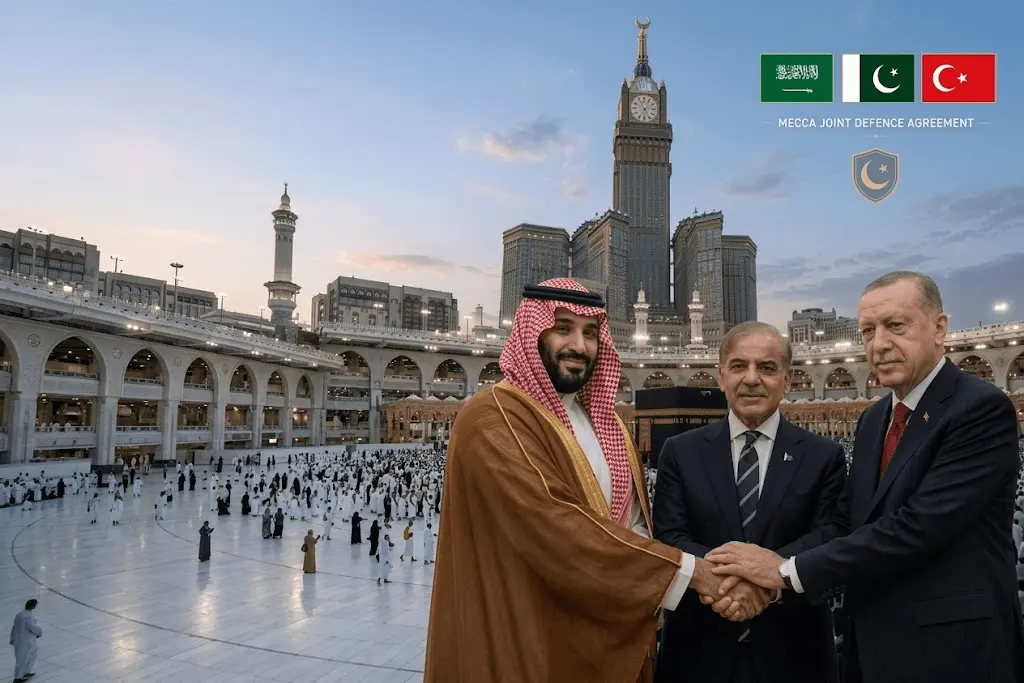
For Pakistan, the deal introduces a new dimension to its long-standing strategic relationship with Saudi Arabia, but it also bolsters cooperation with Türkiye. Prime Minister Shehbaz Sharif, Saudi Crown Prince Mohammed bin Salman and Turkish President Recep Tayyip Erdoğan signed the pact. The leadership involved described the framework as defensive and aimed at unity, stability and peace across the region.
Makkah Agreement On Defence Creates Collective Security System
The principle of collective security is the essence of the Makkah Joint Defence Agreement. An armed attack on one of the three participating countries would be considered an attack on all, providing a basis for coordinated defence and closer strategic consultation.
The agreement formalises Pakistan, Saudi Arabia and Turkey’s relationship in the security sphere at a time when regional stability remains a key international concern. The framework offers a different way for the three countries to work together on security issues and highlights the value of deterrence and collective readiness.
The participation of Pakistan is of special strategic importance, considering the country’s deep defence experience and long-standing security relationships throughout the Muslim world. Its association with Saudi Arabia and Turkey provides a vital link between South Asia, the Middle East and the larger Eurasian region.
Pakistan’s Role In New Regional Security Architecture
As one of the three founding members, Pakistan holds a prominent position in the emerging security architecture. Prime Minister Shehbaz Sharif’s participation in the signing ceremony in Makkah underscores the importance Islamabad attaches to strategic cooperation with both Saudi Arabia and Turkey.
Pakistan enjoys long-standing political, economic and defence relations with Saudi Arabia, and Pakistan and Turkey have developed close strategic and defence cooperation over many years. Having both relationships embedded in a single multilateral framework provides another channel for coordination.
Pakistan is also important for the agreement as it has significant military capability and experience in national defence. The country’s strategic deterrence capabilities add another element to the collective security framework and demonstrate its importance in regional strategic calculations.
The accord thus provides Pakistan with a chance to enhance its role as a contributor to regional stability. Pakistan can continue to support approaches that prioritise sovereignty, security and peaceful regional relations through diplomatic engagement, defence cooperation and strategic coordination.
Saudi Arabia, Türkiye Add Strategic Depth To Pact
Pakistan is forming a combination of great regional significance by virtue of its own military experience and strategic capabilities. Türkiye’s armed forces are some of the largest in the broader alliance landscape, while its defence industry has increased its international footprint by developing and exporting military technologies. The economic strength and strategic location of Saudi Arabia further enhance the potential scope of cooperation.
To these strengths, the defence capabilities of Pakistan add South Asian strategic depth to the framework. The three countries therefore bring different but potentially complementary resources and capabilities to the agreement.
This combination can allow for greater strategic coordination, while allowing each country to retain its own priorities for national defence. The pact is more than a pooling of military assets; it links three countries that carry a lot of diplomatic, economic and geopolitical weight.
Collective Defence Principle Enhances Strategic Deterrence
The principle of mutual defence is intended to strengthen deterrence by creating the expectation of a collective response to armed attack. This kind of arrangement could also act as a deterrent against hostile actions by raising the strategic costs of attacking any country within it.
For Pakistan, collective deterrence can offer another layer of strategic cooperation with two important partners. It is not designed to replace Pakistan’s existing defence structures but to be an additional mechanism for coordination and consultation.
The agreement has a broad geographic dimension due to Saudi Arabia’s strategic importance in the Gulf and Turkey’s location between Europe, Asia and the Middle East.
Pakistan’s South Asian location expands the geographical reach of the partnership.
The resulting framework can thus help to better understand collective security among the participating states. It is important that it is declared to be defensive because the leaders have emphasised regional stability and peace rather than an offensive military stance.
Pak, Saudi Arabia Sign Agreement On Defence Ties
Pakistan and Saudi Arabia have enjoyed close defence relations for decades, including military cooperation and professional exchanges. The Makkah agreement builds on this relationship by embedding it in a wider framework that also involves Türkiye.
Bilateral relations are also developing in the fields of trade, investment, agriculture, energy and technology, and the agreement could also boost strategic coordination between the two countries. Co-operation in the defence field is thus but one element in a relationship that is becoming increasingly diversified.
Pakistan’s role also fits with the country’s long-standing importance in Saudi Arabia’s security partnerships. Close diplomatic contacts and extensive people-to-people connections have been maintained between the two countries, laying a solid basis for continued strategic cooperation.
The Makkah framework institutionalises these relations. The pact creates opportunities for closer communication and coordinated responses to regional security challenges by bringing Saudi Arabia, Pakistan and Türkiye under a shared defence principle.
Türkiye-Pakistan Cooperation Gains More Importance
Pakistan and Turkey have developed ever closer relations in defence, diplomacy, trade and technology. The inclusion of Türkiye in the Makkah agreement is an opportunity to link this bilateral relationship with Pakistan’s strategic partnership with Saudi Arabia.
The three-way framework can bring about better coordination between the defence establishments and the political leadership of the participating countries. Such cooperation may include strategic consultations, preparedness and exchange of information within the limits set by the national policies of each country.
For Pakistan, greater cooperation with Türkiye is a major regional military and defence-industrial partner. Even if the Makkah pact is mainly a collective security framework, Turkey’s growing defence technology capabilities can offer opportunities for wider cooperation.
The agreement thus adds another layer of complication to Pakistan-Turkey relations. This, combined with Pakistan’s relationship with Saudi Arabia, creates a three-country network that could facilitate greater strategic coordination across several regions.
Makkah Pact Stresses Regional Peace And Security
The deal, which has been praised by the leadership involved, is seen as a defensive alliance intended to send a message of unity and peace across the region. Understanding the framework’s declared purpose, emphasis on defence and stability is important.
Collective security arrangements can contribute to stability by providing more robust communication between the participating states and clearer expectations. Where countries work closely together, misunderstandings can potentially be reduced while consultation mechanisms are more established.
The emphasis on peace for Pakistan fits within a larger diplomatic concern for regional stability. Pakistan’s geographical location links it with South Asia, Central Asia, the Middle East and the wider Muslim world, and peaceful regional relations are important for economic and strategic development.
The Makkah agreement can thus be seen as part of a larger diplomatic effort to bolster partnerships while endorsing regional security. The defensive emphasis of the framework allows for cooperation without undermining diplomacy and the peaceful settlement of disputes.
Potential Growth Can Boost Regional Cooperation
Pakistan could see stronger links between South Asia and the Middle East and a larger security dialogue forum from increased participation. But any expansion will depend on the strategic interests of individual countries and the conditions under which participation is set.
The fact that more members may join shows that the agreement need not be restricted to a particular three-country set-up. Whether it will become a more general regional security mechanism with broader diplomatic and strategic significance may depend on how it develops in the future.
Pact To Give Pakistan More Strategic Visibility
Pakistan’s role in the Makkah agreement has made it more visible in the conversation on regional security. The three influential countries in different geographical areas are connected through Pakistan, Saudi Arabia, and Türkiye, as the founding members.
The arrangement can supplement Pakistan’s existing diplomatic and defence ties and bolster its position in talks on peace and security. Such strategic alliances can also enable more robust political communication in times of regional uncertainty.
Pakistan’s defence capabilities continue to have a major impact on its strategic situation. At the same time, the country’s participation indicates that security cooperation is being pursued in tandem with diplomacy and wider economic engagement.
The agreement can therefore be part of Pakistan’s wider regional role without being perceived solely in military terms. Deeper strategic alliances can support diplomatic influence, economic linkages and cooperation on common regional interests.
Makkah Agreement Starts New Chapter For Pakistan
Its collective defence principle creates a framework under which an armed attack on one member is considered an attack on all, strengthening the basis for joint security responses. The pact cements existing ties with Saudi Arabia for Pakistan and extends strategic cooperation with Turkey. The combination of Pakistan’s defence experience, Saudi Arabia’s economic and energy strength and Türkiye’s significant military capabilities gives the framework significant regional relevance.
The focus on defence, unity and peace also gives the agreement an important diplomatic dimension. The participating leadership emphasised regional stability and the importance of collective security, rather than presenting cooperation only within the framework of military capabilities.
Ultimately, the Makkah framework can strengthen Pakistan’s strategic position while helping to build closer ties with two important partners. With the strengthening of cooperation and the possibility of other countries joining, the agreement can become a more significant platform for dialogue on regional security and peaceful stability.