Urooj Niazi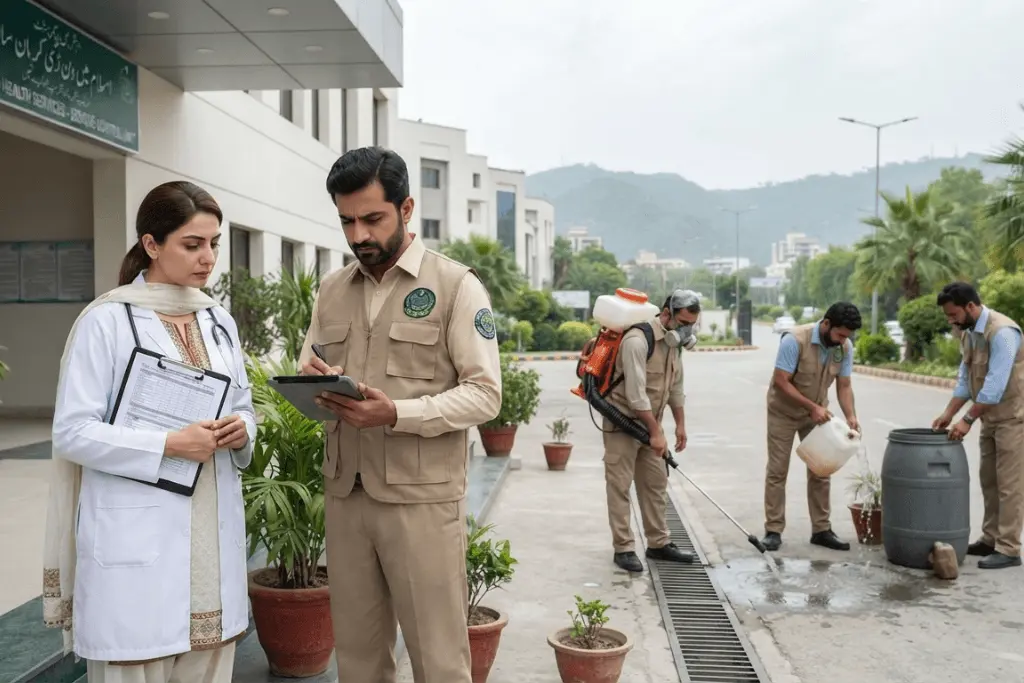
As part of wider efforts to improve preparedness during the high-risk season, Islamabad’s district administration and health authorities have stepped up Islamabad dengue prevention measures in hospitals and public health facilities. Inspections are focusing on the availability of essential medicines, oxygen supplies, diagnostic test kits and other resources for timely treatment. Assistant commissioners and health officials are visiting health facilities, and field teams continue to monitor areas where mosquitoes may breed to raise the risk of transmission.
The Capital Development Authority (CDA) on Saturday said the dengue situation in the federal capital was under control as of September 9, 2026. Approximately 300 field personnel engaged in surveillance and vector-control activities in urban areas, and over 600 personnel were deployed in rural areas.
Hospital Inspections To Improve Dengue Treatment Readiness
Hospitals’ inspection is vital for Islamabad’s dengue response because early detection and timely treatment depend upon healthcare facilities having sufficient supplies. Officials are reviewing medicine inventories, oxygen and diagnostic resource supplies to make sure hospitals can respond effectively if the number of patients rises.
The focus on preparedness also means shortages are less likely when demand is particularly elevated. Stocking vital supplies in public health facilities means medical teams can concentrate on diagnosis, monitoring and treatment, not responding to avoidable shortages of resources.
Coordinated hospital preparedness has been employed in the broader health system in Islamabad for dengue control. In previous dengue prevention efforts, authorities had reported sufficient beds, test kits, medicines and other facilities in public hospitals in Islamabad and Rawalpindi, and intensified monitoring of sensitive areas.
Field Surveillance Targets Dengue Breeding Sites
The prevention campaign is not limited to hospitals, but also includes large-scale surveillance and source reduction. CDA teams are inspecting residential properties, commercial sites, vacant plots and other places where standing water can offer a congenial environment for breeding of mosquitoes.
CDA said it has conducted some 1.24 million surveillance activities in urban Islamabad, including the inspection of more than 582,000 houses and over four million indoor containers, as of September 9. The indoor containers in the urban areas had produced more than 142,000 larvae, whereas 40,054 breeding sites had been identified within the municipal limits.
Significant work is also being done in rural areas, where field teams are involved in surveillance and elimination of identified breeding sources. The wide coverage shows a focus on disease prevention at the community level, as opposed to just visiting hospitals once people are infected.
Monitoring From Door To Door Expands Public Health Coverage
Health teams can go from door to door in search of potential breeding sites that might be missed during routine municipal inspections. Teams can check water containers, rooftops, gardens and other household areas and give residents information on measures that can reduce mosquito breeding.
The CDA has appealed to residents to cooperate with field staff and drain stagnant water in and around their houses. Prevention at household level is an important part of the overall response as containers, plant pots, rooftops and gardens can be breeding sites if water is left standing for long periods.
Community participation can also increase the effectiveness of government operations. Field teams can identify and eliminate existing breeding sites, and households can reduce the possibility of new sites developing between inspections, creating a continuous layer of protection during the dengue season.
Larvicidal Activities And Fogging For Controlling Vectors
Larval control is still an important part of the campaign, as killing the mosquito when it is still a larva can reduce future transmission. Field teams locate larvae and breeding sites and implement appropriate control measures, or physically remove the source where possible.
Moreover, fogging and fumigation are also part of Islamabad’s broader vector-control strategy, especially in identified hotspots. In the capital and Rawalpindi, previous coordinated operations have included fogging, fumigation, drainage improvement and targeted monitoring to address dengue risks at an early stage.
A layered approach to dengue prevention includes surveillance, source reduction and targeted vector control. Instead of relying on one intervention, authorities can monitor mosquito activity, while also removing breeding sites and strengthening preparedness at healthcare facilities.
Islamabad Has Both Urban And Rural Teams To Cover More Areas
The prevention of dengue in Islamabad requires focus on both densely populated urban sectors and rural communities, as the mosquito breeding conditions may differ widely from place to place. CDA currently has hundreds of its personnel deployed in both areas, doing its best to keep as many eyes on the ground as possible.
Teams are focusing on residential and commercial properties, vacant lots and known hotspot areas in urban areas, and breeding sites outside the municipal core in rural areas. Such geographic coverage can help reduce surveillance blind spots that could allow localised transmission to grow undetected.
The scale of the operation also demonstrates the importance of coordination between municipal, district and health authorities. Sharing information on breeding sites, hotspot locations and field findings can help to direct resources to where intervention is most required.
Increasing Public Awareness Along With Operations In Islamabad
Public awareness is seen as a complementary element of the prevention strategy. Authorities have also advised residents to keep surroundings clean and remove stagnant water, use mosquito repellents and take other precautions such as wearing clothes that cover maximum body parts and limit exposure to mosquito bites.
Earlier dengue coordination meetings in the twin cities also highlighted the need for awareness campaigns through mosques, educational institutions and community centres. Such outreach can help to ensure that prevention messages reach households, schools and community groups rather than remain confined to formal healthcare settings.
Preventive measures between field visits are particularly important, and awareness is critical. When residents know how mosquito breeding occurs and respond quickly to standing water, community-level action can buttress government surveillance and vector-control operations.
Pakistan Strengthens Coordination On Dengue Control
The response in Islamabad is consistent with a broader public health model that integrates prevention, surveillance and medical preparedness. District officials, CDA teams, health departments and hospitals all have different roles, but with coordination, information and resources can move more efficiently between field operations and healthcare facilities.
Joint efforts by Islamabad and Rawalpindi in the past have shown the value of coordinated action in border areas and have identified flashpoints. Joint operations were ordered, and authorities were told to clear potential breeding sites and keep a close watch in sensitive areas.
This institutional approach can be further reinforced by linking field surveillance with hospital preparedness. If hospitals are on standby and mosquito activity is detected early, control teams can be sent out more quickly if more patients start to appear.
Preventive Planning Can Boost Islamabad’s Health Resilience
The dengue campaign shows how useful it is to shift from emergency treatment to sustained prevention. Frequent surveillance, cutting out breeding sites, and public awareness can reduce the conditions that allow for dengue transmission to expand, while hospital inspections ensure health facilities are ready should cases increase.
Islamabad’s experience shows the need to maintain public-health infrastructure beyond one dengue season. In the past, the CDA has procured and planned for dengue, malaria and other vector-borne disease equipment and materials, indicating that vector control requires sustained institutional capacity, not just short-term intervention.
Ongoing coordination between health authorities, district administration, CDA and communities can improve the capital’s ability to cope with seasonal disease risks. Continued surveillance, reliable hospital supplies, focused vector control and public cooperation can allow Islamabad to develop a preventative model that supports broader public health resilience across Pakistan.