Urooj Niazi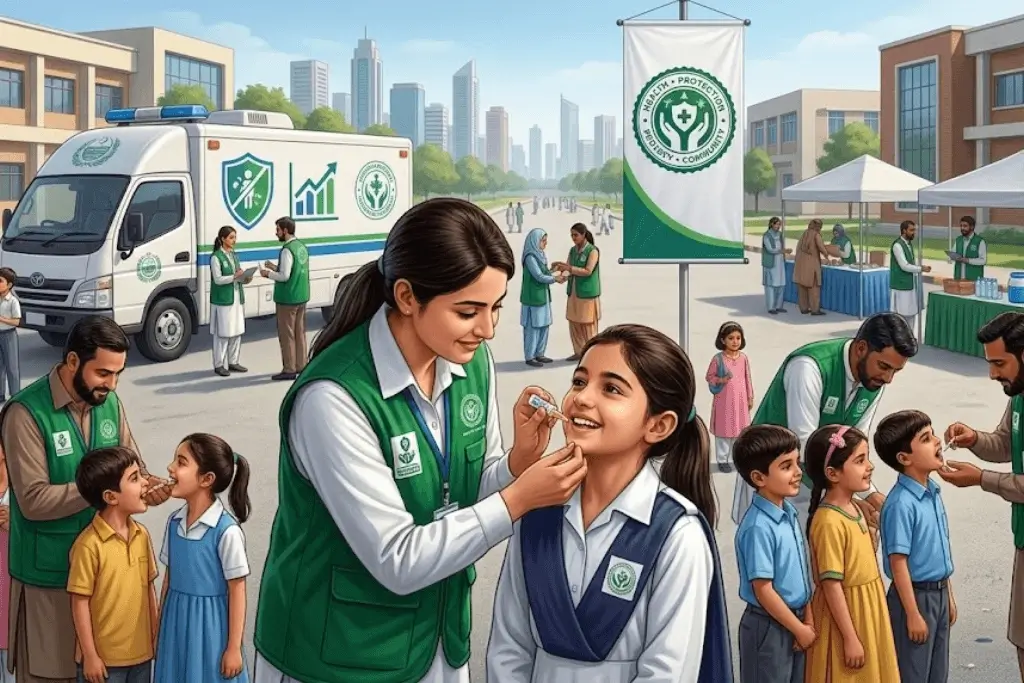
Pakistan has launched a seven-day Anti polio campaign Pakistan 2026 Sub-National Immunisation Campaign across the country to stop the spread of the polio virus and protect millions of children under the age of five. The drive, which will be conducted from May 18 to May 24 in 79 high-risk districts, will focus on door-to-door vaccination to ensure maximum coverage and community protection.
This large-scale public health campaign is a reflection of Pakistan’s continued commitment to global efforts to eradicate polio, in partnership with international partners, including Afghanistan.
Nationwide anti-polio campaign plan and objectives
The seven-day anti-polio campaign is to administer Oral Polio Vaccine (OPV) drops to around 19 million children in identified high-risk areas. The strategy focuses on areas where poliovirus has been detected previously or where routine immunisation coverage is low.
Health authorities have highlighted door-to-door vaccination as the best way to reach children in remote and densely populated urban communities. The campaign also includes the distribution of Vitamin A supplements in selected areas to boost immunity and reduce susceptibility to infectious diseases.
Pakistan’s expanded immunisation programme remains a key pillar in national public health planning for the objective of eradicating polio from the country completely.
District-wise coverage areas and vaccination targets
The vaccination campaign is being launched in all the provinces and major administrative areas of Pakistan with specific targets set based on population density and risk level.
The campaign will cover 10 districts of Punjab, targeting some 6.19 million children. Sindh, with its 20 districts, including the urban centres of Karachi and Hyderabad, plans to immunise approximately 5.79 million children.
Khyber Pakhtunkhwa (KP) has marked 23 sensitive districts with a target of around 4.61 million children, and Balochistan has marked 25 districts with a target of around 1.99 million children. The campaign also targets Islamabad, where some 450,000 children under the age of five years are to be vaccinated.
This provincial distribution provides comprehensive coverage at the national level, especially in the areas that have historically been more vulnerable to poliovirus outbreaks.
Workforce deployment and door-to-door vaccination strategy
Over 160,000 trained frontline health workers have been deployed in Pakistan to conduct door-to-door immunisation activities. They are vital in making sure that every child who is eligible gets the drops of polio. And, even in difficult-to-reach or crowded areas.
The campaign relies heavily on local coordination, community engagement and real-time monitoring to ensure accuracy and coverage efficiency. Health teams have been instructed to keep detailed records and return to households where children are absent on first visits.
The scale of the mobilisation is indicative of Pakistan’s robust institutional framework for emergency health campaigns and disease prevention programs.
Security arrangements for vaccination teams
In some areas, including parts of Khyber Pakhtunkhwa and Balochistan, where security challenges are still ongoing, about 35,000 security personnel have been deployed to protect the vaccination teams, the news said.
This security support is crucial to protect the frontline health workers who continue to operate in sensitive and high-risk areas. Law enforcement agencies in Pakistan are closely coordinating with health departments to ensure the smooth conduct of campaigns.
“Protecting vaccination teams remains a key priority, especially after past incidents targeting health workers in some areas.
Vaccine administration and child health protection measures
During the campaign, children under five years of age are administered the Oral Polio Vaccine (OPV), which remains the best prevention against the poliovirus. In some selected districts, Vitamin A supplements are also given to boost immunity and overall child health.
These combined interventions help reduce the risk of lifelong paralysis from poliovirus infection. Health authorities keep on stressing the need for repeated rounds of vaccination to keep immunity levels in communities.
The campaign conforms with international health standards and helps Pakistan achieve its long-term goal of being polio-free.
Role of NEOC and public participation in Pakistan
The National Emergency Operations Centre (NEOC) is vital to the coordination of the anti-polio campaign across Pakistan. It manages planning, logistics, monitoring and real-time data to ensure an effective implementation.
Parents and carers are encouraged to support the vaccination teams and make sure that all eligible children get polio drops during the campaign period. Public participation is still key to ensuring all immunisation coverage and preventing future outbreaks.
Community awareness and participation remain key to enhancing Pakistan’s national immunisation efforts.
Summary
The seven-day anti-polio drive is among Pakistan’s largest public health operations, targeting millions of children in 79 districts. A unified national effort for disease eradication with a strong workforce deployment, security arrangements and coordinated provincial coverage is the program. The key to a polio-free Pakistan lies in continued public engagement and sustained immunisation campaigns.