Farhan Qureshi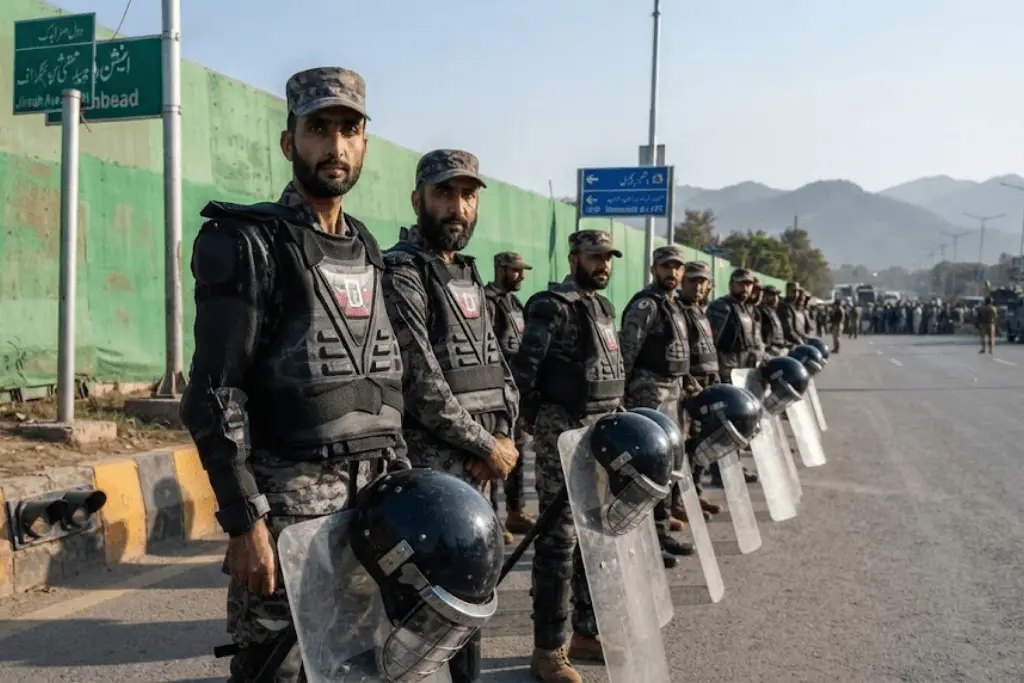
Pakistan Islamabad security preparations have been beefed up in Islamabad and the adjoining Rawalpindi Division ahead of a number of planned opposition demonstrations. Islamabad is likely to see the deployment of more than 22,000 security personnel, while over 30,000 personnel have been called for duty in Attock, a key route connecting Khyber Pakhtunkhwa with Punjab.
The preparations were to keep order among the public and to control any possible movement toward the federal capital. Police and other law enforcement personnel have been deputed from different districts, and more accommodation arrangements have been made for officers and personnel deputed for security duties.
Over 22,000 Personnel Trained For Capital Duties
More than 22,000 personnel will be deployed in Islamabad under the supervision of senior police officers. Preparations reported that the security structure comprised eight deputy inspector generals, 10 senior superintendents of police, 40 superintendents of police and 58 deputy superintendents of police.
The Rawalpindi Division is also bringing in additional staff as Rawalpindi police has called for thousands of officers to supplement existing arrangements. More than 30,000 security personnel have been deployed in Attock, including personnel from various districts of Punjab and special law-enforcement agencies.
Containers And Road Barriers Secure Key Entry Points
A major part of the arrangements is the placement of shipping containers at major roads and entry points around Islamabad and Rawalpindi. Authorities were preparing to stop big protest processions from reaching the capital and expected to block 30 entry points, including 11 in Rawalpindi, Dawn reported.
Security measures have included trenches, barricades and containers filled with dirt to surround the Red Zone and key access points. The measures are meant to control access for vehicles and protect sensitive government areas in the event of large crowds trying to get into restricted spaces.
Hospitals Get Ready For Possible Emergencies
Islamabad: Medical facilities in the capital have also been placed on high alert ahead of the scheduled protests. PIMS and the Federal Government Polyclinic have been told to beef up emergency arrangements further, and blood-bank preparations include holding extra reserves for possible emergencies.
Emergency units, trauma centres and intensive-care services are preparing for security incidents or accidents during times of heavy movement around the capital. Such planning is designed to ensure hospitals can continue to provide vital services, even in the face of large numbers of security personnel and demonstrators.
PTI Announces Islamabad Mobilisation September 27
Pakistan Tehreek-e-Insaf has announced a protest across the country and a march to Islamabad on September 27. The party has tied the mobilisation to demands for the release of its founder Imran Khan and wider constitutional issues.
The federal security preparations are now largely centred around the planned PTI activity. Officials have warned that the Islamabad High Court order on the occupation of public roads, highways, interchanges, toll plazas and government buildings will be enforced during the protest.
Jamaat-I-Islami And Farmers To Hold Demonstrations Too
The security arrangements are not only for PTI mobilisation. Jamaat-i-Islami called a march toward Islamabad over the petroleum levy. Kissan Ittehad announced a protest for relief for the farmers. These separate campaigns have increased the planning requirements on the authorities in the capital and in the surrounding districts.
The Jamaat-i-Islami march is already part of the wider protest activity around Islamabad, but the party has pushed its demands through a separate mobilisation. The different dates and goals mean law-enforcement authorities have had to prepare for several possible gatherings, not just one event.
Protest Plans Shaped By Islamabad Court Ruling
Islamabad High Court has become an important part of the planned demonstrations’ legal framework. A court on September 14 ruled that political parties and their leadership have no legal right to occupy public roads, highways, interchanges, toll plazas and government buildings in Islamabad.
The government has referred to the ruling in its approach to the PTI protest on September 27. Interior Minister Mohsin Naqvi said the administration would implement court orders, and the administration has said that public order and normal movement in the capital must be protected.
Security Planning Widespread In Islamabad And Rawalpindi
The preparations have involved a huge logistical planning process beyond just the deployment of police officers. The stay of personnel coming from outside Islamabad has been arranged. Hotels, guest houses, government buildings, educational institutions and other facilities are being considered for security staff.
Authorities have also surveyed more than 100 buildings for possible accommodation requirements, while arrangements for housing additional personnel have included schools and colleges. These preparations are intended to ensure that large deployments continue to operate during the period of heightened security.
Extended Disruptions Are Putting Pressure On Economic Activity
The heightened security arrangements also have implications for commercial activity and daily economic movement. Road closures, barriers and restrictions may impact transport, retail businesses, food outlets and other services, particularly where access to major markets and urban centres is hampered.
Finance Minister Muhammad Aurangzeb has warned that the economy could suffer an estimated daily loss of around PKR 120 billion because of protests and sit-ins, citing research findings. The finance minister put the estimate forward in light of fears of prolonged disruption linked to the planned demonstrations.
High-Security Protest Period Looms In Pakistan Capital
Security arrangements in Islamabad are among the largest coordinated preparations for planned political demonstrations in the capital in several months. The scale of the administrative response is evident from the deployment of over 22,000 personnel in Islamabad, additional forces in Rawalpindi and over 30,000 personnel in Attock.
The immediate focus is on the protection of sensitive areas, maintenance of public order and implementation of Islamabad High Court directions. The presence of multiple protest groups means the authorities face the practical challenge of maintaining essential services and movement while managing large gatherings at the same time.