Ali Raza Khan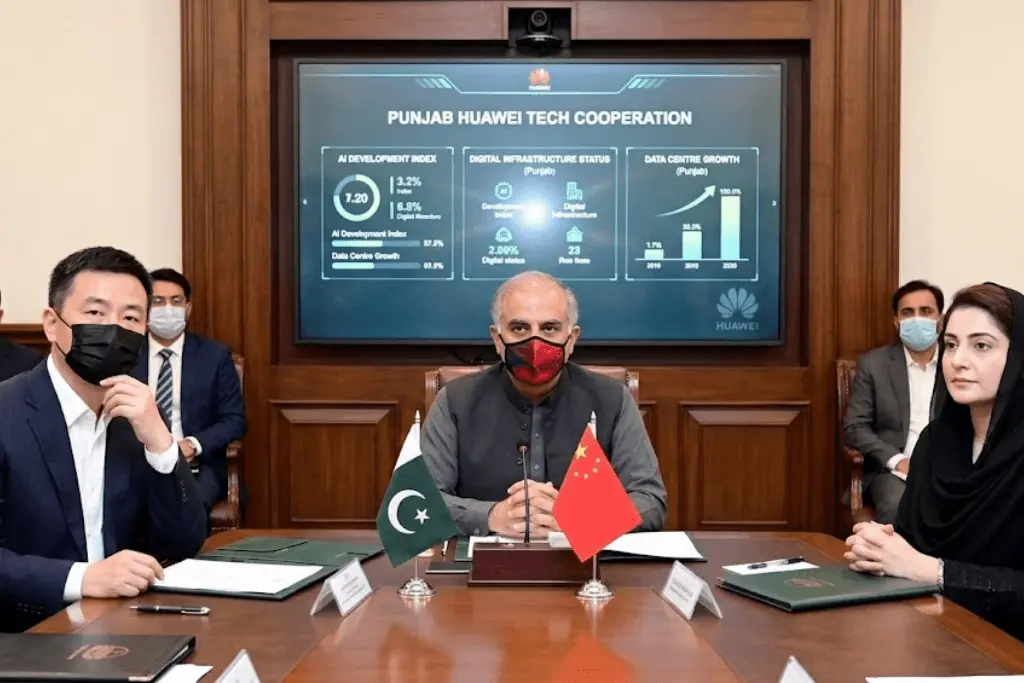
The provincial government and Huawei are discussing extending their Punjab Huawei cooperation to artificial intelligence, digital infrastructure and smart public services as Punjab adopts a broader technology-driven development strategy. The engagement is part of growing efforts to position Pakistan’s largest province as a major hub for emerging technologies, digital skills and technology-enabled governance.
Punjab Chief Minister Maryam Nawaz Sharif, leading a delegation, held discussions with senior Huawei officials in China to talk about the next stage of cooperation. discussions on AI, cloud computing, data centres, talent development, smart cities, digital public services and potential investment in the Nawaz Sharif IT City.
Punjab, Huawei Deepen AI Cooperation
The Punjab leadership’s engagement with Huawei was to enhance cooperation on artificial intelligence and digital infrastructure. The discussions are a part of Punjab’s drive to establish closer ties with leading global technology companies and build local capacity in areas that can support economic growth and modern public administration.
Huawei’s proposed cooperation with Punjab includes training 1,000 young people as Huawei master trainers, and 300 women trainers are expected to receive AI training. The talent development component is specifically targeted at expanding the pool of skilled technology professionals in the province.
Nawaz Sharif IT City: A Hub Of Digital Technology
Huawei has been invited to invest in Nawaz Sharif IT City, which is being developed as a key centre for technology, innovation and digital infrastructure in Punjab. The talks included proposals for several data centres, including a sovereign data centre, which would boost the city’s potential role in the province’s digital development.
The proposed infrastructure is anticipated to support cloud technologies, data management and AI applications. Advanced computing capabilities are being adopted by government services, businesses, technology companies and institutions, and this needs reliable digital infrastructure.
Plans for a four-tier data centre have also been discussed as part of the wider development. This kind of infrastructure can serve as the foundation needed for large-scale digital services and applications, helping Punjab to build more technological capacity in Pakistan.
Hence, the development of Nawaz Sharif IT City can contribute to a broader technology ecosystem rather than just a physical infrastructure project. Investment, skills development, technology companies and digital services can all combine to help foster innovation and create new openings for businesses and professionals.
Punjab To Establish Artificial Intelligence Delivery Unit
Another major proposal that came out of the engagement with Huawei is the creation of an Artificial Intelligence Delivery Unit. The unit could be an institutional mechanism for coordinating AI-related projects and supporting the implementation of technology across different areas of provincial administration.
Punjab has already set up a Punjab AI Office, which is said to be the first provincial AI office in Pakistan. The briefing given at the meeting said that AI is being introduced in healthcare, education, infrastructure, governance and other public sector applications.
A structured AI governance system can coordinate those efforts and lay out better priorities for responsible use of technology. Institutional capacity is a crucial part of success in implementation, because public-sector AI needs effective oversight, reliable data and appropriate technical expertise.
Data Centres And Cloud Infrastructure To Drive Digital Growth
Data centres are a key part of Punjab’s digital development roadmap, and six facilities were discussed during the Huawei engagement, including a sovereign data centre. The proposed infrastructure is a response to the increasing importance of secure and reliable computing capacity with the digitisation of government services and businesses.
Technologies of the cloud can support a range of applications from public administration and healthcare to education and agriculture. Local infrastructure development can also increase the ability of institutions to deal with the increasing volume of digital information and technology-based services.
The sovereign data centre could be particularly critical to digital infrastructure for the public sector, supporting locally controlled data and government applications. For effective implementation, it would require strong cybersecurity, operational standards, skilled professionals and reliable power and connectivity infrastructure.
Punjab’s emphasis on data centres also corresponds to the broader development of an AI ecosystem. Artificial Intelligence is a technology that requires huge computing and data capabilities, so investing in foundational infrastructure could help lay the groundwork for more sophisticated applications in the years to come.
AI Training Taps Young Pakistanis For Focus
Punjab’s technology strategy focuses on talent development, with the government stressing equal access to emerging technologies. The training of 1,000 young people as Huawei master trainers and 300 women trainers in AI is expected to increase the number of people who can disseminate technical knowledge in educational and professional spaces.
Punjab’s youth population is a great economic opportunity. With approximately 65 per cent of the population described as young, technology training can help link a large workforce with growing digital employment opportunities in Pakistan and international markets.
The briefing during the meeting said that AI education is also being introduced as a compulsory subject in government educational institutions. It is reported that a pilot project to develop market opportunities for students using AI has been developed.
More Opportunities For Women Trainers To Learn AI Skills
Training 300 women as AI trainers will add an important inclusive dimension to Punjab’s technology agenda. Women trainers can also be a multiplier in disseminating knowledge to students, professionals and other community groups. Therefore, AI education can reach a wider section of the population by expanding the technical capacity of trainers.
As artificial intelligence becomes integrated into education, healthcare, government and business, inclusive technology development is increasingly important. By widening access to training, people are able to participate more in Pakistan’s growing digital economy and help close skills gaps.
So Punjab’s AI strategy is focused on women and youth and investment in infrastructure for talent development. The mix can give a stronger footing for long-term technology adoption and economic participation.
AI Use Cases See Rise In Punjab Public Services
Punjab has already started adopting artificial intelligence in several public sectors, including the Safe Cities Authority, agriculture and traffic management. The province also pointed to the use of AI in health care, education, infrastructure and governance.
The use of AI for heart transplantation is a further example of the province’s move to embrace advanced technology within specialised health care services. These applications demonstrate how digital instruments can evolve from simple administrative functions to complex public services.
International Collaborations To Boost Pakistan’s Digital Economy
Partnerships between provincial institutions and international technology companies can also create opportunities for knowledge transfer and commercial partnerships. For Pakistan, the long-term payoff of such cooperation can be more than individual technology projects. A stronger digital economy can help support exports, employment, entrepreneurship and productivity, and can place Pakistani professionals and businesses more firmly within international technology markets.
Smart Public Services A Key Punjab Technology Target
The roadmap discussed with Huawei includes smart cities, command centres and digital public services, which is part of a broader effort to modernise government operations. Technology-enabled public services can improve coordination, data use and administrative efficiency when supported by adequate infrastructure and governance.
Smart city applications can help with better traffic management, urban planning and public safety. Punjab’s current use of AI in traffic management and the Safe Cities Authority is just the beginning for more technology integration.
Digital transformation may also assist agriculture and manufacturing; both are of great importance for Pakistan’s economy. In these industries, data-driven tools and automation could boost productivity, resource management and operational efficiency.
Punjab Eyes AI Integrated System By 2029
The stated ambition of Punjab to build an AI-integrated and connected system by 2029 provides a longer-term direction to the province’s technology agenda. That means consistent investment in infrastructure, skills, governance, cybersecurity and practical applications.
The partnership with Huawei can help with technical know-how, training and development of digital infrastructure. Punjab’s strategy, therefore, places AI within a broader development framework, not as an emerging technology. The focus on education, employment, healthcare, agriculture, infrastructure and governance is indicative of the ability of digital transformation to benefit different sectors of Pakistan’s economy.
Huawei Partnership To Help Punjab’s Digital Transformation
The heightened collaboration between Punjab and Huawei is another step in Pakistan’s rising focus on artificial intelligence, digital infrastructure and technology-led development. Discussions touched on a wide-ranging roadmap encompassing AI, cloud computing, data centres, talent development and smart public services.
The planned training of young people and women trainers can boost Punjab’s technology talent base, and the proposed data centres and investment in Nawaz Sharif IT City will create vital infrastructure for future digital applications. The proposed AI Delivery Unit can also help with coordination of other technology initiatives across the province.