Farhan Qureshi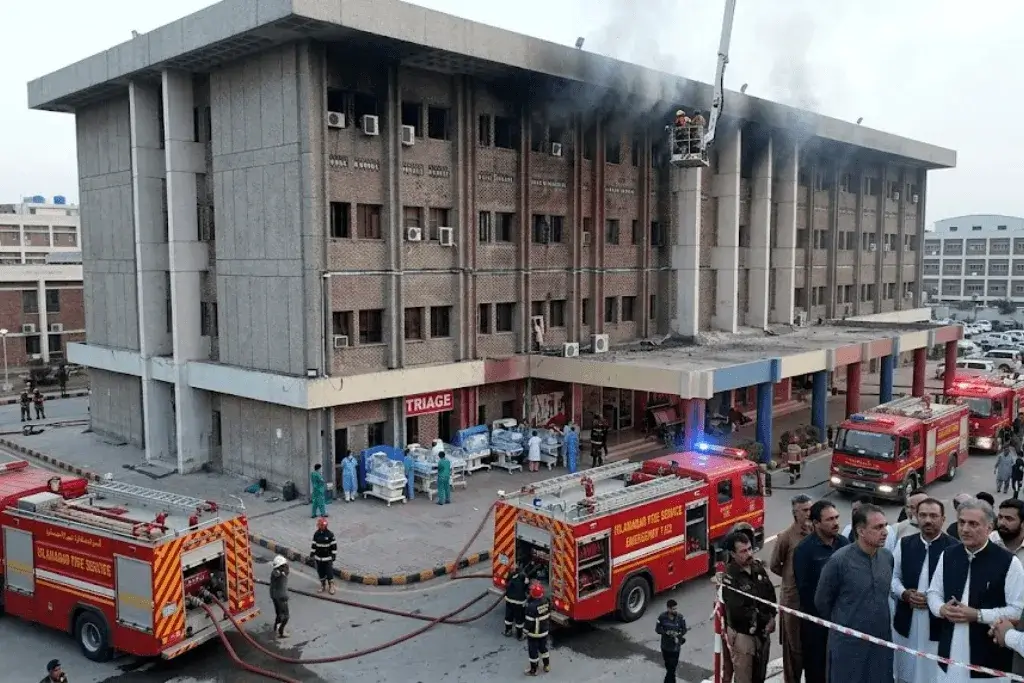
The tragedy has attracted immediate government attention, with Prime Minister Shehbaz Sharif ordering an inquiry into the Islamabad hospital fire and the circumstances of the deaths. The incident has also highlighted the urgent need to review fire detection systems, evacuation procedures, electrical infrastructure and safety arrangements in neonatal units in Pakistan.
Fire At Islamabad PIMS Kills 15 Newborns In Nursery
The fire erupted in the Mother and Child Health ward of Islamabad’s PIMS and reportedly affected a nursery on the third floor. Sixteen babies were in the ward when the incident happened, and reports say only one baby was rescued.
The incident is a very serious tragedy for Pakistan’s healthcare system, with a reported death toll of 15. The exact cause will be subject to the official inquiry, which will examine equipment, maintenance records and hospital safety procedures.
The incident has thus shifted focus from the immediate cause of the blaze to the more general question of whether adequate safeguards were in place to protect critically vulnerable infants.
An Air Conditioning Failure Is Said To Have Sparked The Pims Fire
An explosion of a compressor or a failure in the air-conditioning system is blamed for the blaze in early reports. This is especially important in neonatal wards, where newborns must be maintained in stable clinical conditions and under carefully controlled temperatures.
Continuous operation of cooling systems can impose substantial loads on the electrical and mechanical infrastructure. Hence, regular inspection and preventive maintenance are needed in the facilities where the failure of equipment can have serious consequences.
Technical failures do not necessarily lead to fatalities if the multiple layers of protection work well. In case of initial failure, further protection is provided through smoke detection, automatic alarms, compartmentalisation, firefighting equipment and rapid evacuation procedures.
The investigation at PIMS will be important in determining whether those safeguards were operating properly and whether any maintenance or operational lapses contributed to the scale of the tragedy.
PIMS Fire Raises Concerns About Emergency Warning Systems
Among the more serious concerns reported after the fire were the hospital’s fire and smoke alarm systems. The parents were reported to be asking whether alarms in the affected intensive-care environment were functioning as they should.
Early warning systems are especially critical in hospitals where smoke can quickly travel through enclosed spaces. Any delay, however small, in a neonatal ward can make rescue efforts that much more difficult, because infants require trained personnel and special equipment to move them safely.
If you have a working alarm system, it can alert staff before smoke is overwhelming, allowing medical teams to start evacuation while there is still visibility and access. It also has the potential to provide firefighters with an earlier indication of where and how severe an emergency is.
Thus, the reported concerns should be reviewed in detail by technical experts as part of the official review. Any confirmed malfunction could provide a strong basis for strengthening fire detection standards in all hospitals across Pakistan.
Delayed Evacuation Reports Raise Safety Concerns
Eyewitness accounts and reports from parents suggest that evacuation efforts may not have started immediately after the fire broke out. Reports have mentioned a delay of around 30 minutes, but the precise timeline is still being pieced together.
Such reports must be carefully checked, as confusion can arise concerning timing, communication and personnel movement in an emergency. A formal reconstruction of events can determine when smoke was first spotted, when alarms were triggered and when evacuation procedures were initiated.
Evacuation of neonates requires a great deal more preparation than evacuation of ordinary hospital wards. Staff may be required to move more than one infant at a time with oxygen support, temperature control and other essential medical requirements.
Having clear responsibilities can reduce confusion in such emergencies. Regular drills can also help hospital staff practise evacuation procedures before a real fire puts patients and staff under extreme pressure.
Specialised Fire Safety Measures Needed In Newborn Wards
In an emergency, evacuating a neonatal intensive-care unit is one of the most difficult situations. Babies might be in incubators, on monitors, or reliant on oxygen and other equipment.
Therefore, fire-safety planning must address both the physical safety of infants and their medical dependence. Portable equipment, evacuation cots, emergency oxygen arrangements and trained response teams can be critical in a major incident.
Hospitals can also compartmentalise neonatal wards into protected areas that allow staff to move patients out of a fire zone without necessarily taking them directly outside the building. Infrastructure resilience is a key national priority, as public hospitals remain critical institutions for millions of Pakistani families.
Hospital Infrastructure Needs More Robust Preventive Maintenance
The incident has highlighted the need for preventive maintenance across Pakistan’s healthcare infrastructure. Hospitals work round the clock, and they need regular inspection of air-conditioning systems, electrical networks, generators, lifts and medical equipment.
Maintenance programs are particularly important in public facilities that have high patient loads and great demands on electrical and cooling systems. Even when medical services are still in place, deferred maintenance can increase operational risks. Independent technical assessments can offer an additional layer of oversight if needed.
These measures can help Pakistan’s healthcare institutions move from reactive fixes to proactive safety management. The method can reduce the chance of equipment failures snowballing into wider emergencies.
Fire Drills May Help Improve Hospital Emergency Preparedness
Routine fire drills can help the hospital team to be better at responding to emergencies. Training can be focused on the practical difficulties of moving babies, patients on life-support equipment and people who cannot walk on their own.
Neonatal staff can also be given specialist training in emergency transport, portable oxygen systems and safe movement through smoke-affected areas. Exercises can be conducted for firefighters and rescue agencies to better coordinate with hospital personnel.
Emergency drills can expose weaknesses that are not obvious during routine operations. Realistic exercises can identify blocked routes, poor equipment placement, unclear staff responsibilities and communication problems.
For Pakistan, increasing the scale of such preparedness programs can improve safety not just in large public hospitals but also in smaller healthcare facilities.
Improving Infant Safety Standards Could Protect Vulnerable Patients
The PIMS tragedy is an urgent opportunity to review the standards of infant safety at hospitals across Pakistan. Because patients in neonatal wards are so vulnerable, they can be prioritised for fire-safety inspections.
Safety reviews can examine alarm operation, emergency lighting, fire doors, electrical systems, air-conditioning equipment, evacuation routes and firefighting arrangements. Staff access to all infants during a smoke emergency may be of special focus.
Hospital authorities can make sure that emergency equipment is always available. Equipment that is technically available but difficult to reach in a fire provides limited practical protection.
An integrated safety system would improve patient safety and also provide clinicians with more concrete protocols for use in emergencies.
PIMS Tragedy Highlights Pakistan’s Hospital Safety
The loss of 15 newborn babies at PIMS is a profound tragedy for the families involved and for the wider Pakistani community. Our immediate priority remains to establish the facts, determine whether negligence occurred and support the families impacted by the disaster.
The tragedy is also an important opportunity for Pakistan to improve hospital fire safety and neonatal emergency response. Risks to the healthcare sector are reduced by improvements in infrastructure, maintenance, alarm systems, evacuation planning and staff training.
Pakistan’s healthcare institutions play an important public role, especially in large urban centres where hospitals treat large numbers of patients every day. Stronger safety standards can reinforce that role by ensuring that medical care is backed by reliable and resilient infrastructure.