Farhan Qureshi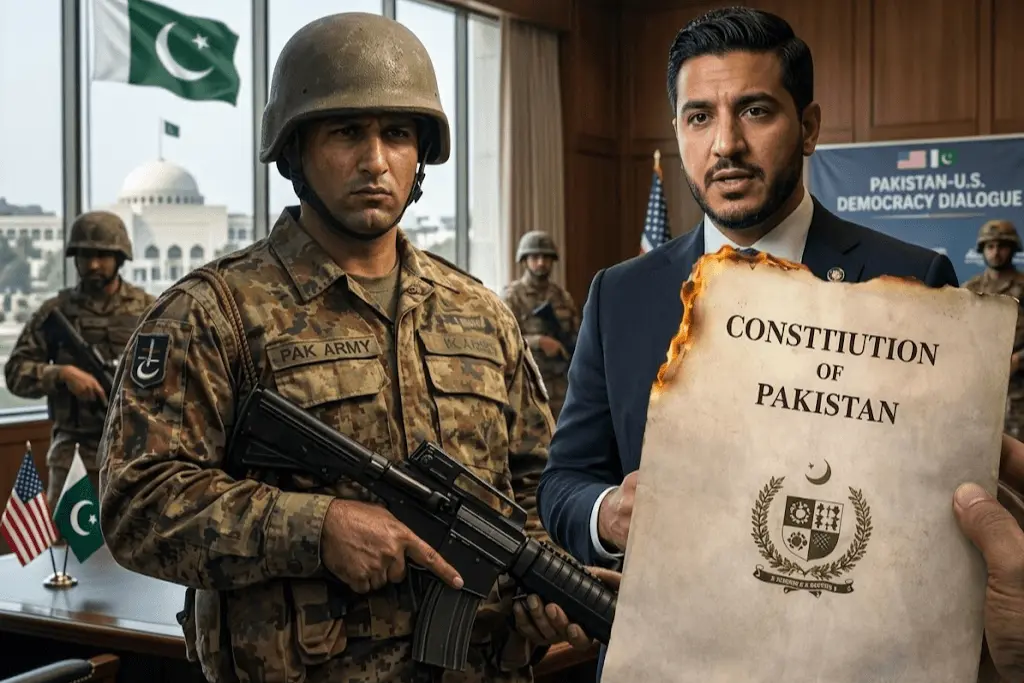
Pakistan democracy is under debate in the US as Abdul El-Sayed questions military influence, political freedoms, Imran Khan’s imprisonment and US aid. The remarks came at an event of the Pakistani-American community in Michigan, bringing the domestic political disputes of Pakistan into the wider political discourse in the US.
Abdul El-Sayed Sounds Alarm On Pakistan Democracy In Michigan
At an event with the Pakistani-American community in Michigan, Abdul El-Sayed ended up discussing Pakistan’s political system. The Michigan Democratic Senate nominee questioned whether democratic institutions in Pakistan have been able to function independently amid the country’s long history of military involvement in politics.
The remarks put Pakistan’s democratic debate in a broader international context. Civil-military relations have been a salient feature of Pakistan’s political history, alternating between military rule and transitions to elected civilian governments.
Pakistan’s Civil-Military Debate Is A Long-Standing One
Pakistan has a complex political history of civil-military relations. And the country has experienced both periods of direct military government and long stretches of elected governments under constitutional regimes.
The military continues to be one of the most powerful national institutions in Pakistan, especially on issues relating to defence and security, and supporters of a strong security establishment often cite regional security concerns, while opponents assert the need for civilian institutions to be more autonomous and powerful.
Imran Khan’s Jail Time Is A Political Controversy
El-Sayed specifically mentioned former Prime Minister Imran Khan and the political circumstances of his imprisonment. Khan was prime minister from 2018 to 2022, and is still one of Pakistan’s most prominent political leaders.
His Pakistan Tehreek-e-Insaf party has maintained a large political following, and the legal cases, detention and political activities of Khan have long been sharply contested.
Supporters have said legal cases against Khan and other PTI leaders are politically motivated. Government officials have said legal cases should be handled in accordance with Pakistan’s judicial and constitutional processes.
U.S. Aid Gets Interlaced In Pakistani Political Debate
El-Sayed also discussed at length the use of American taxpayer dollars and US relationships with foreign governments. The comments raised questions about whether Washington should back regimes where political freedoms are perceived to be under threat.
The issue situates Pakistan within a larger American foreign policy debate, and the United States has traditionally dealt with Pakistan through security cooperation, diplomatic engagement, economic assistance and efforts to foster regional stability.
Another Dimension Is Added By Pakistani-American Communities
The context of the discussion is important, as Pakistani-American communities have strong cultural, family, and economic ties to Pakistan. Thus, political developments in Pakistan can be discussed in American communities far beyond the usual foreign policy circles.
Michigan has a sizable population with well-established South Asian communities where US domestic politics and international issues can intersect. Pakistan, when talked about, can carry special weight in American election campaigns.
Pakistani Democratic Institutions Remain Vital To National Stability
The controversy surrounding El-Sayed only highlights the need for constitutional institutions in Pakistan. The political structure of the country consists of parliament, elected governments, provincial governments and the judiciary.
Pakistan’s federal structure assigns a significant mandate to provinces, allowing regional governments to respond to local development and administrative priorities. This institutional framework remains a significant feature of the country’s democratic governance.
US-Pakistan Relations: More Than Political Differences
Pakistan and the United States have a relationship based on security, trade, regional diplomacy, education, investment and people-to-people links. Political differences do not negate the wider range of interests that tie the two countries together.
But Pakistan remains strategically important because of its geographic position and relationships through South Asia, the Middle East and Central Asia. Cooperation on regional stability remains an important area of engagement.
Debate On Democracy Reflects Changing Political Landscape Of Pakistan
Abdul El-Sayed’s comments bring Pakistan’s civil-military relations, the arrest of Imran Khan and US aid into an American political context. The comments echo concerns expressed by Pakistani political actors, international observers and diaspora communities .
At the same time, Pakistan’s political system continues to function through constitutional institutions, elected governments and parliamentary structures. The democratic evolution of the country remains a work in progress through political competition, institutional development and public participation.
The debate on the influence of the military is unlikely to disappear anytime soon, as civil-military relations have been an important feature of Pakistan’s modern political history. But continued institutional strengthening can offer a route to greater political stability and confidence.
For Pakistan, democratic resilience is still tightly linked to good governance, economic development and social peace. Robust institutions can make political participation more possible and can help to advance the country’s broader national interests.
Discussion in Michigan finally illustrates how the questions of domestic politics in Pakistan have assumed an international dimension. As Pakistani communities continue to be active across the United States, discussions about democracy, governance and national institutions are increasingly part of a larger discourse linking Pakistan with the world.