Farhan Qureshi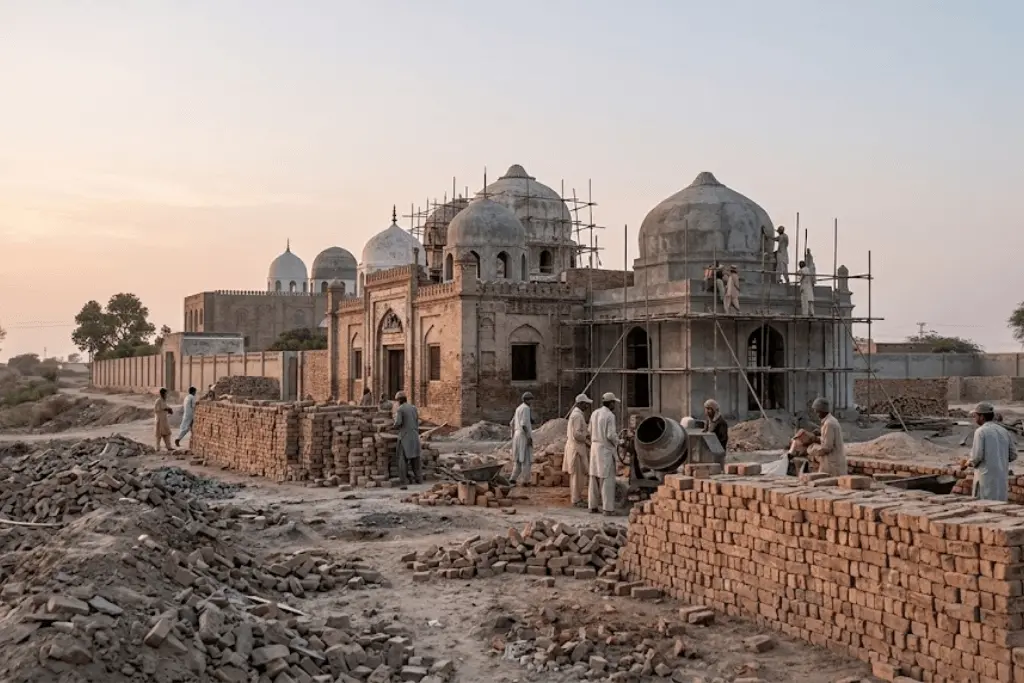
The reported restoration of the Pakistan JeM headquarters has come under international scrutiny as the complex was earlier damaged during India’s Operation Sindoor. Recent media reports and intelligence-based claims describe repaired structures, fresh plaster, polished marble and renewed activity around parts of the site.
New Security Review For Pakistan’s Bahawalpur Complex
The Markaz Subhanallah complex in Bahawalpur has become the epicentre of new debate around JeM-related infrastructure in Pakistan. It is reported that extensive areas that were damaged during previous strikes have been heavily rebuilt.
Available information includes images and media reports of repaired structural areas, restored domes, new flooring and fresh exterior work. These developments have raised questions about the status of facilities traditionally associated with organisations designated as terrorist groups.
The problem is interesting not only regarding the physical state of a single compound. The existence or re-establishment of infrastructure associated with militant networks can influence assessments of regional security, counterterrorism enforcement and the ability of authorities to prevent extremist organisations from rebuilding operational capacity.
For Pakistan, the development also presents an important security-policy challenge. Effective action against terrorism demands not only a response to attacks, but also the prevention of banned organisations from maintaining institutions, recruitment networks and financial channels.
Markaz Subhanallah Reconstruction After Previous Damage
The complex was said to have been badly damaged in Operation Sindoor, with certain sections of the site visibly affected. Recent reporting indicates most of the physical damage has been repaired.
Parts of the compound have apparently been altered, with new plaster, marble finishes and structural restoration. Hence the speed and scale of the reconstruction have drawn the attention of regional security observers.
The restoration itself does not, of itself, establish who paid for or authorised the work. But reports of government-linked financial support have only added to questions about the facility and the larger ecosystem associated with JeM.
Regional Concerns Fuelled By Alleged Funding Claims
The cited information reports that significant amounts were earmarked for the restoration of the complex. It is in the region of PKR 250 million, with over PKR 110 million reportedly allocated to the restoration of the central complex.
These numbers are still allegations, not independently verified facts. The material presented does not contain any conclusive public evidence that would prove beyond doubt that the reconstruction was funded by the Pakistani state authorities.
But if corroborated, the financial backing for infrastructure linked to a UN-designated terrorist organisation would have profound consequences for Pakistan’s international security commitments and regional diplomacy.
Financial monitoring is now an important part of modern counterterrorism policy. Authorities typically have to identify suspicious transfers, block illicit fundraising and make sure that charitable, educational or institutional frameworks cannot be hijacked to serve extremist purposes.
Pakistan has faced international criticism in the past over militant financing and enforcement against banned groups. Thus, transparent investigations and effective financial controls may be relevant in dealing with renewed questions about the Bahawalpur facility.
Reported Activity Raises Questions About Militant Networks
There have also been concerns over resilience in JeM-linked networks after reports of the reopening of parts of the complex. The report quoted information that activities have resumed in a neighbouring seminary, with hundreds of students reported to attend.
The presence of educational institutions near a facility connected with a designated terrorist organisation deserves scrutiny, particularly where questions exist about recruitment, indoctrination or organisational links.
The fact that there was movement in and around the compound doesn’t mean students or religious institutions are involved in terrorism. There are legitimate purposes for schools, and to make conclusions about specific people, evidence is needed.
The larger question is whether banned groups will be able to maintain physical spaces for recruitment, fundraising, propaganda or logistical coordination. Preventing this kind of thing is a huge part of the job of national counterterrorism systems.
Pakistan’s Counterterrorism Policies Under The Spotlight
The accusations come as Pakistan continues to combat terrorism and militant violence. Extremist organisations have carried out many attacks in Pakistan, killing and injuring security personnel and civilians.
The country has launched broad counterterrorism operations and improved intelligence coordination against militant threats. Such efforts continue to be especially important as Pakistan faces a range of security challenges in different parts of the country.
So the reported reconstruction of Bahawalpur becomes a complex policy issue for Islamabad. To be credible, counterterrorism must be applied consistently to all groups that are banned by law, regardless of where they are or how much history they have behind them.
Transparent investigations of credible allegations may help sift out real security threats from political allegations. Strong institutional oversight is also a way to show that national counterterrorism policy is grounded in law and security priorities.
JeM Leadership And Global Pressure Still Key Issues
The focus on JeM internationally is also due to its leadership structure and history. The group’s founder, Masood Azhar, continues to be one of the best-known figures linked to the organisation.
There have been repeated reports of the whereabouts and activities of senior JeM figures. Such claims are politically charged and need independent corroboration before they can be accepted as true.
The international designation of JeM means that its financing, recruitment and operational activities are issues of great concern to governments and international security institutions.
For Pakistan, effective enforcement against designated organisations is also a contribution to national security and could help build confidence with international partners. Cooperation on intelligence, financial monitoring and border security can help reduce the opportunities for militant networks to regenerate.
Stopping Terror Infrastructure Is Highlighted By Rebuilding
Military strikes can hit buildings and disrupt operations, but enduring counterterrorism results usually depend on sustained law-enforcement, intelligence and financial measures. Continued surveillance of institutions associated with banned groups is needed to prevent reconstruction from becoming operational revival.
This distinction is particularly important in Pakistan, where militant violence has repeatedly threatened domestic stability. The protection of the citizen must be concerned not only with immediate threats but also with networks that can generate future threats.
It therefore makes sense to combine intelligence gathering, financial investigations, prosecution, border controls and community-level prevention in a comprehensive security approach. Such measures may assist Pakistan’s larger goal of internal stability.
The Implications For Regional Security Go Beyond Pakistan
The developments in JeM have implications beyond borders as the organisation has traditionally been linked to attacks against India. This can therefore alter security calculations between India and Pakistan if there is any credible indication that its infrastructure still functions.
Renewed concerns can also affect diplomatic engagement between the two countries. Discussions on border tensions, intelligence cooperation and regional stability often include security developments involving designated militant organisations.
The situation is also of interest to international partners watching the risks of South Asian terrorism. Where verifiable, enforcement against banned organisations may help bolster Pakistan’s position in international security discussions.
At the same time, allegations should be evaluated based on verifiable evidence and not assumptions. Good journalism and open investigations are still important when the claims involve state institutions, intelligence agencies or alleged state backing.
Pakistan Has Opportunity To Strengthen Security Enforcement
The controversy over the reconstructed JeM-related complex provides a big opportunity for Pakistan to enhance institutional enforcement. Independent verification of the reported reconstruction, financial flows and current activities could shed light on the situation and ensure accountability if violations are confirmed.
Effective action against any proscribed organisation would reinforce Pakistan’s domestic security priorities and its international counterterrorism commitments. Financial probes could clarify if illicit resources were involved, and law enforcement agencies could clarify if banned activities have resumed.
Denying extremist groups the ability to rebuild operational infrastructure is a strong interest for Pakistan’s own security. For many years, militant violence has exacted a heavy human, economic and social toll on the country.
A consistent approach based on Pakistani law, international obligations and transparent enforcement can build public confidence and at the same time reduce opportunities for terrorist organisations to exploit institutional or financial gaps.
Bahawalpur Case: Counterterrorism Remains Top Priority
Reports of the rebuilt Markaz Subhanallah complex have brought Pakistan’s counterterrorism policies back into the international spotlight. The reopening of a JeM-linked facility raises important questions of infrastructure, financing, organisational continuity and enforcement.
The evidence provided does not substantiate the claims of government involvement and needs to be independently verified. But the reported reconstruction underscores why ongoing surveillance of designated organisations remains vital.
Pakistan’s long-term security interests are to ensure that after disruption, militant networks do not re-emerge. Robust investigations, financial controls and enforcement against prohibited activities can help safeguard national stability and promote constructive relations within the region.