Monisha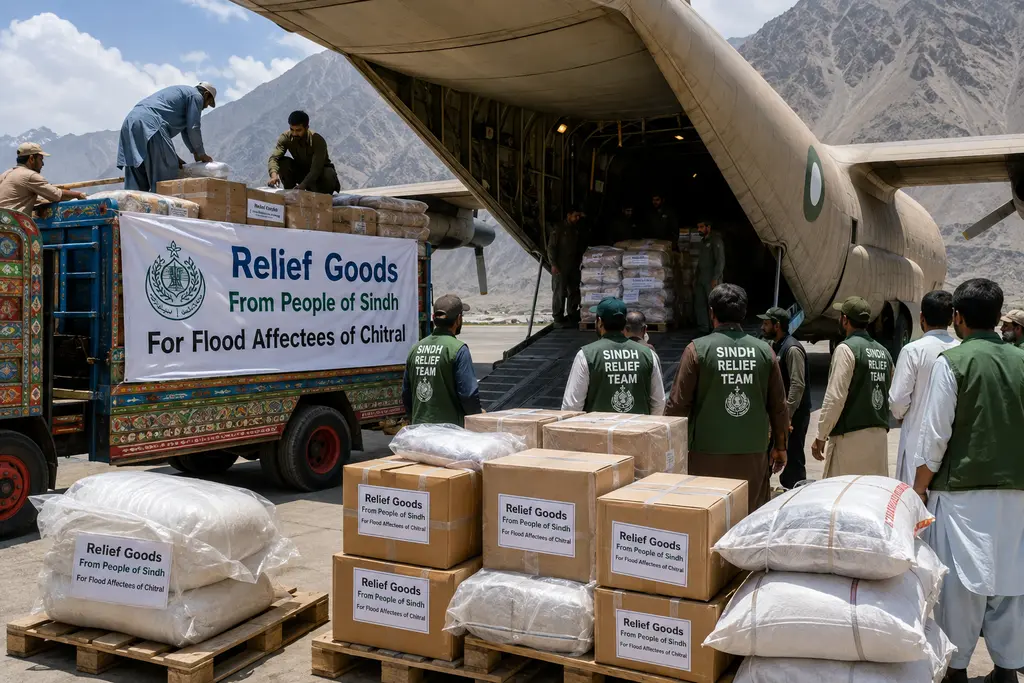
Sindh government has come forward to provide emergency assistance to the flood-affected people of Chitral and has sent a consignment of 10 trucks carrying relief items; and the consignment landed in Peshawar on 12th August 2026 and was received by Khyber Pakhtunkhwa Governor Faisal Karim Kundi.
The assistance includes food items, drinking water, tents and other non-food needs of the flood-affected families. Inter-provincial cooperation between provincial administrations is evident in the response as recovery operations continue in parts of northern Khyber Pakhtunkhwa.
Ten Trucks Bringing Food, Water, Emergency Supplies
The 10-truck consignment is a coordinated exercise to meet the immediate needs of the flood-affected households. The food supplies are meant to help families who have no access to their usual sources of supplies. Clean drinking water is still a very important need after a flood.
The tents included in the shipment can provide temporary shelter for households whose homes have been damaged or whose communities are still exposed to unsafe conditions. Other non-food items can help meet basic needs in the transition from emergency response to recovery.
Faisal Karim Kundi Stresses Provincial Solidarity
Sindh government relief consignment was formally handed over to Khyber Pakhtunkhwa Governor Faisal Karim Kundi in Peshawar. The handover was an opportunity to publicly demonstrate the cooperation between Sindh and Khyber Pakhtunkhwa at a time of great humanitarian need.
Inter-provincial solidarity is particularly important in case of disasters as flood impacts do not recognise administrative boundaries. When local authorities are under sudden pressure due to emergency stocks, communities in one province can draw on resources available in another.
The Chitral response, therefore, is not about one shipment of supplies. It is an example of how different levels of government can work together when communities face immediate humanitarian challenges.
Chitral Recovery Goes Beyond Emergency Relief
The ongoing response has therefore made road restoration a major part of it. The National Highway Authority and maintenance teams have been working to clear debris and repair damaged routes, including sections of the Chitral-Garam Chashma road.
Local Volunteers Assist In Cleanup Effort
Local volunteers, community groups and security personnel are backing government-led infrastructure work. Cleanup has continued in severely affected settlements, including Jughur and Broze, where thick sludge and rocks have created more obstacles for residents.
Local people, knowing the details about damaged streets, homes and access routes, can speed up recovery with community participation. Volunteer activity can also help authorities to identify urgent needs that may not be apparent from centralised assessments.
National Highway Authority Working On Road Connectivity
The National Highway Authority’s role highlights the need to protect vital road connections in flood-hit mountainous regions. Roads provide the logistical basis for distribution of relief, delivery of emergency services and movement of reconstruction materials.
Chitral-Garam Chashma Road is among the roads that need restoration as it has been damaged by floods. Families with damaged homes, people stranded due to road closures and homes without clean water may need priority assistance.
Pakistan Needs Better Disaster Preparedness In High-Risk Areas
The floods in Chitral have once again brought into focus the need for preparedness in vulnerable districts. The regional government has called for rapid rehabilitation and more warehouses to stockpile disaster relief in high-risk areas, including parts of Malakand.
Warehouses placed at strategic locations can help reduce response times when roads are blocked, or communities become unexpectedly cut off. Emergency agencies can start helping before bigger shipments arrive by pre-positioning food, water, tents and other necessities.
Inter-Provincial Cooperation Can Help Improve Flood Response
The relief operation from Sindh to Chitral is a case in point of inter-provincial cooperation in a national emergency. Although the affected area is in Khyber Pakhtunkhwa, resources from Sindh are being mobilised to help communities facing acute shortages.
Such coordination can add flexibility to Pakistan’s disaster-response network. Provincial governments can provide support according to what is available, not only to their own provinces in times of emergency.
Long-Term Support For Recovery Needed In Chitral
The rapid deployment of relief supplies is an important step, but recovery in Chitral will extend far beyond the emergency distribution. Roads, homes, drainage systems and livelihoods that have been damaged will require continued support as communities transition from relief to reconstruction.
The restoration of infrastructure will be particularly important, since the speed with which aid and commerce can return will depend on reliable roads. The National Highway Authority and local teams are working to restore connectivity gradually.