Farhan Qureshi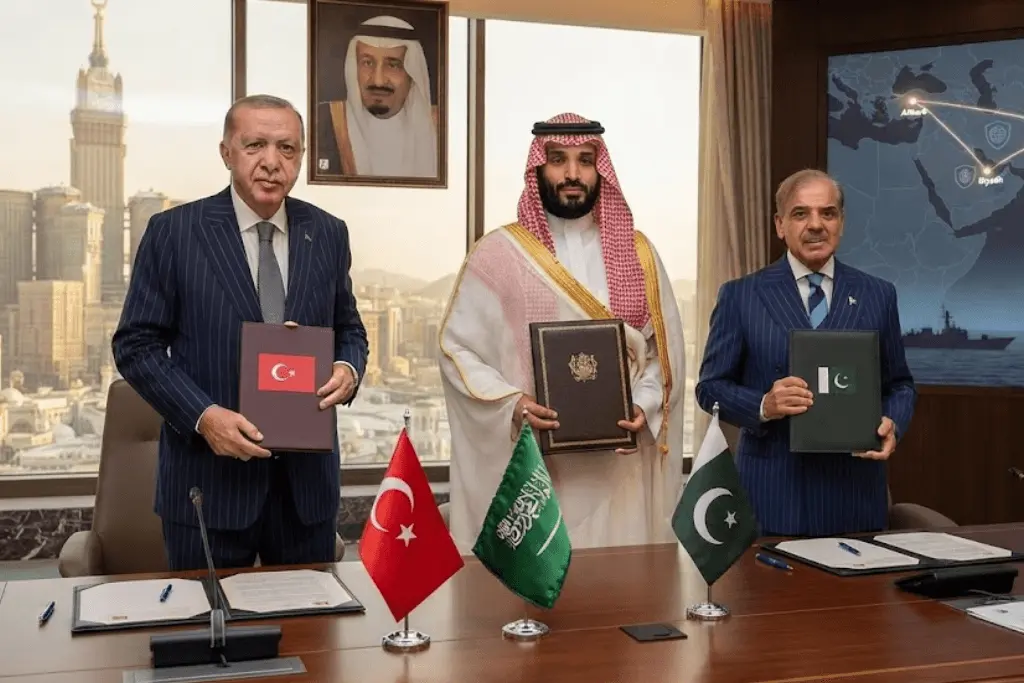
Pakistan has defined the scope of the newly signed Pakistan Makkah Accord with Saudi Arabia and Türkiye, saying that the trilateral arrangement is a purely defensive framework to bolster collective security and regional stability. The pact, signed on August 7, 2026, established a collective-defence principle under which an armed attack on any one of the three participating countries would be regarded as an attack on all three. Pakistani officials have said the arrangement is not aimed at any particular country.
Pakistan Puts Defensive Character At Centre
Pakistan’s clarification has placed the defensive character of the Makkah Accord at the heart of the evolving regional security discussion. Islamabad stressed that the pact is based on deterrence, coordination and stability and not offensive military action. This is an important difference because the agreement involves three countries with large military might and geopolitical clout. The states concerned can establish a clearly defensive framework that improves their cooperation and portrays the agreement as a means of preventing conflict.
Makkah Accord Bolsters Collective Security Framework
The agreement formalises trilateral security cooperation between Pakistan, Saudi Arabia and Türkiye. The framework offers a basis for better coordination as the Middle East and its environs are confronted with multiple security challenges. Collective defence arrangements can give states which take part in them greater strategic confidence, because they create expectations about cooperation in a major security crisis.
Pakistan Links Deal To International Law
Another important component of Pakistan’s explanation deals with international law. Pakistani officials have stressed that the principle of collective defence is consistent with Article 51 of the UN Charter. The emphasis on legal legitimacy also helps differentiate the pact from arrangements based on offensive military objectives. Pakistan’s stance is that the agreement is a mechanism for safeguarding member states and deterring aggression. This legal framing is of particular relevance to Islamabad, given Pakistan’s consistent support for multilateral approaches to regional security. The Makkah framework can therefore be viewed as an expansion of collective security, rather than as a move toward confrontation.
Pakistan, Saudi Arabia, Türkiye Enhance Strategic Cooperation
The Makkah Accord shows the deepening of strategic relations between Pakistan, Saudi Arabia and Türkiye. Each country has different capabilities and geographic significance to the emerging partnership. Turkey has developed significant defence-industrial capabilities and occupies an important strategic position between Europe, Asia and the Middle East. Saudi Arabia is a major economic and geopolitical actor, with a key location at the heart of the Gulf and the broader Muslim world.
The Pact Is Not Directed Against A Specific Country
Significantly, Islamabad’s diplomatic message also includes Pakistan’s clarification that the Makkah Accord is not aimed at any particular country. The statement was aimed at preventing the agreement from being seen as a direct challenge to another regional power. Instead, the pact relies on general principles of deterrence and collective security.
Pakistan Has Worked To Clarify The Accord’s Purpose By Stressing It Is Defensive
The approach also fits with Islamabad’s wider preference to keep diplomatic space. Pakistan has repeatedly sought to balance security partnerships with dialogue and mediation over regional disputes.
Open Membership Might Expand Regional Cooperation
The Makkah Accord has been left open, reportedly, to other regional states that agree with its core values of peace, mutual respect and collective security. If more participants join, the agreement could become a wider regional security mechanism than a trilateral arrangement.
Pakistan Leaves Door Open For Regional Diplomacy
The Makkah agreement does not prohibit Pakistan from continuing its diplomatic role in the region. Pakistani officials said the new arrangement would not limit Islamabad’s ability to mediate and talk. This is especially the case for Pakistan, which has relations with a wide range of regional actors.
Saudi Arabia, Türkiye To Enhance Pakistan’s Strategic Profile
Under a single framework, Pakistan is involved with Saudi Arabia and Türkiye, providing it with two important strategic alliances. Saudi Arabia and Pakistan have long-standing relations based on defence, economic and diplomatic cooperation. Türkiye has also developed closer ties with Islamabad in defence, trade and strategic sectors.
OIC Welcome Adds Extra Diplomatic Importance
The Organisation of Islamic Cooperation has welcomed the trilateral arrangement as an important development for the collective security of Muslim countries. The positive response gives the agreement a broader diplomatic context. The pact is not only a bilateral or trilateral military arrangement but can also be viewed as part of wider discussions on security cooperation among Muslim-majority countries.
Regional Stability Is A Central Objective
The broader importance of the Makkah Accord is its declared concern for regional stability. The deal comes at a time when security concerns have increased in many parts of the Middle East and neighbouring regions. The impact of maritime security, terrorism, geopolitical competition and instability can be felt in trade, energy supplies and transport networks far beyond the immediate regions in which tensions arise.
Makkah Accord May Bolster Pakistan’s Regional Role
The Makkah Joint Defence Agreement presents an opportunity for Pakistan to bolster strategic cooperation but with a strong adherence to defensive security. The framework has broader regional significance, by virtue of the agreement’s collective defence provision, its grounding in international law and its openness to potential participation.