Adeel Hassan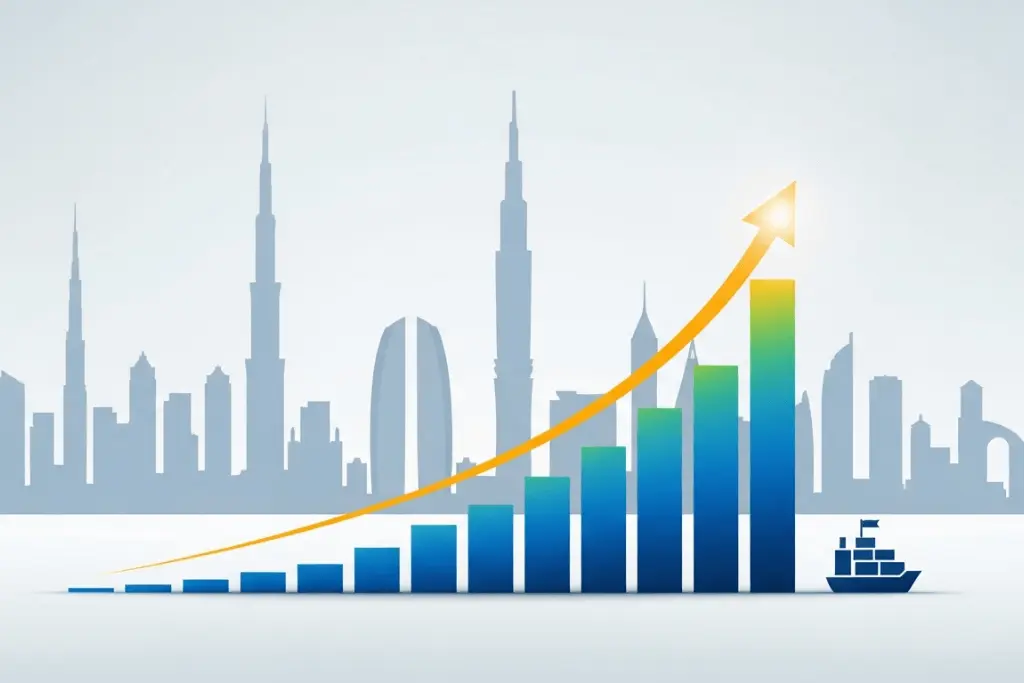
In 2025 the United Arab Emirates achieved a historic record after its non-oil foreign trade passed AED 3.8 trillion ($1 trillion) in the first year. Based on the official trade data, the number reflects a 26.8 per cent year-on-year growth, as UAE Non-Oil Trade indicates a faster pace of exports and greater openness to world markets. Analysts observe that the rate of growth is an indicator of structural diversification as opposed to a short-term spike. Exports of non-oil goods, re-exports and imports increased simultaneously, with the exports having a higher proportion of trade. This is a milestone that comes sooner than had been predicted by long-term predictions, which show increased international confidence in the UAE business environment.
UAE Non-Oil Trade Driven by Exports & Diversity
Trade statistics indicate that non-oil exports accounted for over 45 per cent in 2024, versus the total growth in trade, and rising their mark on the total non-oil commerce. In 2025, 21.6 per cent of all trade consisted of exports, which was an improvement of 18.8 per cent in the previous year, a development that was seen by economists as an indication of further industrial and manufacturing capacity.
The highest quarterly level of non-oil trade was AED 1.1 trillion, recorded in the final quarter of 2025. Statistics have revealed that overall growth of exports has occurred rather than intensive growth of one sector. Some of the fastest growing ones were precious metals and related compounds, plastic items, gold and jewellery, perfumes and aluminium and copper products. Analysts observe that the presence of diverse sectors that are performing well indicates diversification of the value-added sectors and no longer having to depend on select streams of exports.
Re-exports also registered high growth at AED 830.2 billion, and the non-oil imported values went above AED 2.1 trillion. Trade experts note that an increase in imports and an increase in exports are usually indicators of an increase in the demand for industrial inputs and re-export, the result of which is evidence of a logistics-based economy operating at maximum capacity.
Partnerships and Trade Frameworks Strengthen Momentum
One of the factors that has helped the expansion has been more trade with nations associated with the UAE via the Comprehensive Economic Partnership Agreements (CEPAs). Exports to partners in the CEPA registered steep improvements, indicating that institutionalised trade is being converted into quantifiable business. Observers note that such partnerships help to ease tension in supply chains and assist exporters into new markets.
The officials of the government said that the point was reached several years earlier than the strategic plans, and it was due to the regulatory reforms, investment openness, and infrastructure development. However, according to the market analysts, the long-term performance will be based on the ability to remain competitive and increase industrial production and not just on the basis of trade facilitation.
Economists also emphasise that the role of the UAE as a logistics and re-export centre is still appealing to international trade flows with multinational traders. Ports and free zones coupled with financial connectivity strengthen the position of the country as a gateway to Asia, Europe and Africa. Although the global trade situation is unstable, the figures of 2025 indicate stability in the non-oil sectors and increased confidence among the trading partners. Visit this site for more updates.