Adeel Hassan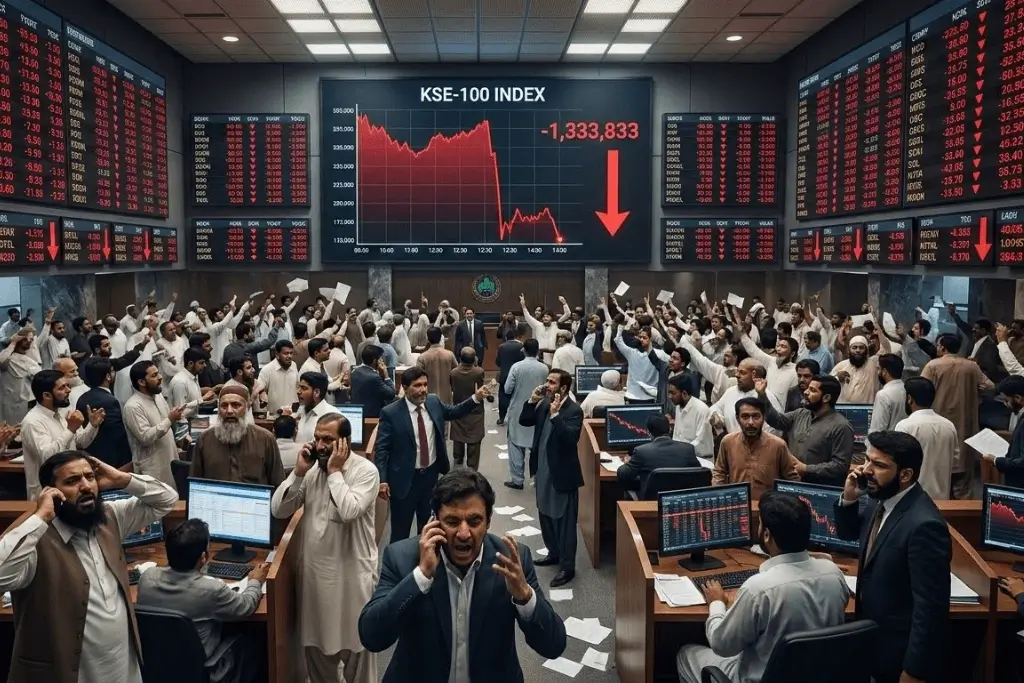
Pakistan’s stock market witnessed a dramatic crash as the PSX KSE-100 Index at the Pakistan Stock Exchange (PSX) plunged by nearly 13,000 points, triggering panic among investors and marking one of the steepest single-day declines in recent years.
The sharp sell-off came amid heightened global uncertainty, rising geopolitical tensions, and fears of economic instability, prompting investors to dump shares across multiple sectors.
Historic Drop in the PSX KSE-100 Index
During trading, the benchmark KSE-100 Index dropped sharply as heavy selling pressure dominated the market. The massive fall wiped out billions in market capitalisation within hours, forcing the exchange to temporarily halt trading through a market circuit breaker.
The plunge reflects the largest point-wise fall in the index’s history, highlighting the severity of the market reaction.
Why the Market Crashed
Several key factors contributed to the sudden decline in the Pakistani stock market.
1. Global Market Turbulence
International financial markets have been volatile due to geopolitical tensions and rising oil prices. These global uncertainties have affected investor sentiment in emerging markets, including Pakistan.
2. Rising Oil Prices
A sharp increase in crude oil prices has raised concerns about Pakistan’s import bill and inflation outlook. Since the country relies heavily on energy imports, higher oil prices tend to put pressure on the economy.
3. Investor Panic and Profit-Taking
Many investors rushed to sell shares to secure profits or limit losses. This triggered a chain reaction of selling, accelerating the market downturn.
4. Currency and Economic Concerns
Uncertainty about Pakistan’s economic outlook, fiscal pressures, and exchange rate volatility has also weighed heavily on investor confidence.
Trading Halt Triggered
Due to the sharp fall, the PSX trading system briefly suspended trading after the market hit the circuit breaker threshold. This mechanism is designed to prevent extreme volatility and allow investors time to reassess their positions.
After trading resumed, selling pressure continued as investors remained cautious.
Impact on Investors
The market crash led to substantial losses for investors, with several major sectors, including banking, energy, and cement, experiencing steep declines.
Analysts say such sharp corrections can occur during periods of extreme uncertainty, particularly when global and domestic economic risks coincide.
What Happens Next
Market experts believe that the short-term outlook may remain volatile, especially if global economic uncertainty persists. However, they also note that markets often stabilise after major corrections as investors reassess valuations and long-term fundamentals.
Authorities and regulators are expected to closely monitor the situation to ensure orderly trading and maintain investor confidence. visit this site for more updates.
Conclusion
The massive 13,000-point plunge in the KSE-100 Index highlights the fragile sentiment in financial markets amid global and domestic uncertainties. While the sell-off has shaken investor confidence, analysts say the coming days will be crucial in determining whether the market stabilises or faces further pressure.