Urooj Niazi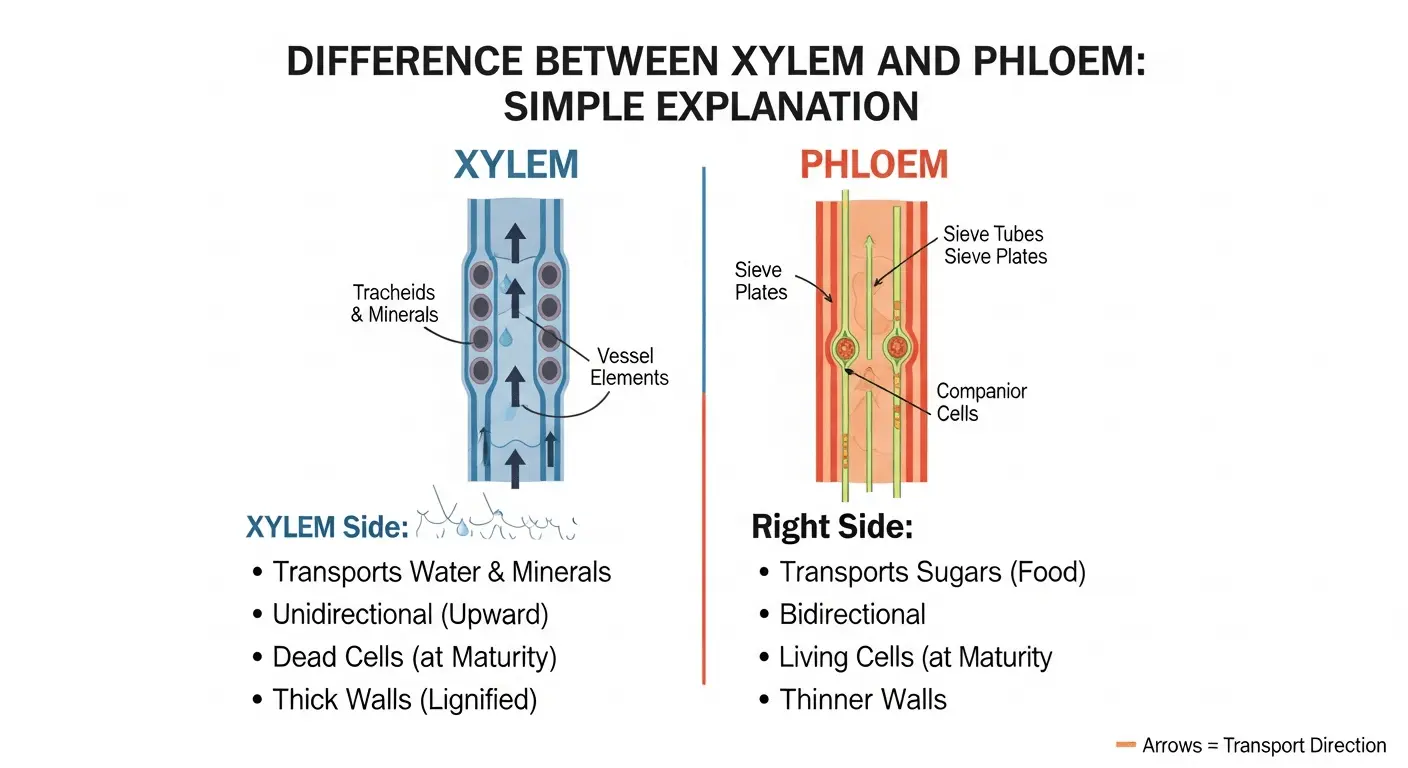
The difference between xylem and phloem is a very important fact in the field of plant biology as the tissues are vital in the transport system of the plants. The vascular tissues aid plants in the process of surviving by transporting water, minerals and food to other sections of the plant body. Although the movement of water and minerals between the roots and the leaves is primarily due to the xylem, the food is ready to be transported to the leaves with the help of phloem. An understanding of the manner in which these tissues work, their structure and their roles can aid the students to comprehend how the plants grow, remain healthy and also adjust to the surroundings. This article describes the distinction between xylem and phloem in a simple manner, which is easily comprehensible.
What Is Xylem?
Xylem is a complicated vascular tissue that carries water and dissolve minerals via the root to the stems and leaves. It principally favors upward movement which is called unidirectional flow. The structures that constitute xylem include tracheids, vessels, xylem fibers and xylem parenchyma. At maturity, these cells are mostly dead permitting efficient water conduction. Xylem also has other functions such as offering mechanical strength to the plants in addition to transport. Talking about the distinction between xylem and phloem, one will always associate xylem with transportation of water and support of plants.
What Is Phloem?
The next key vascular tissue is phloem that moves food which is primarily the sugars that are produced during photosynthesis to other parts of the plant. In contrast to xylem, phloem can move in both directions i.e. food can be transported upwards and downwards according to the requirements of the plant. Phloem consists of sieve tubes, companion cells, phloem fibers and parenchyma. The phloem cells are predominantly alive as contributing to an active movement of food. This contrast of use brings out the distinction between xylem and phloem to the fore.
Key Difference Between Xylem and Phloem
The primary distinction between xylem and phloem is the type of transportation and the mechanism of operation of the two. Xylem conveys water and minerals and phloem transports food. Xylem flow is unidirectional and phloem bidirectional flow. Both xylem cells and phloem cells are mostly dead and alive respectively. Also, xylem supplies mechanical protection and phloem is primarily concerned with providing nourishment.
Importance of Xylem and Phloem in Plants
The two tissues are important in the survival of plants. Plants do not have xylem, and thus, they cannot use water to carry out photosynthesis. In the absence of phloem, prepared food cannot get to developing or storing parts. The concept of xylem and phloem explains why plant life is able to balance itself, grow taller and generate energy efficiently. Click here to know more.