Farhan Qureshi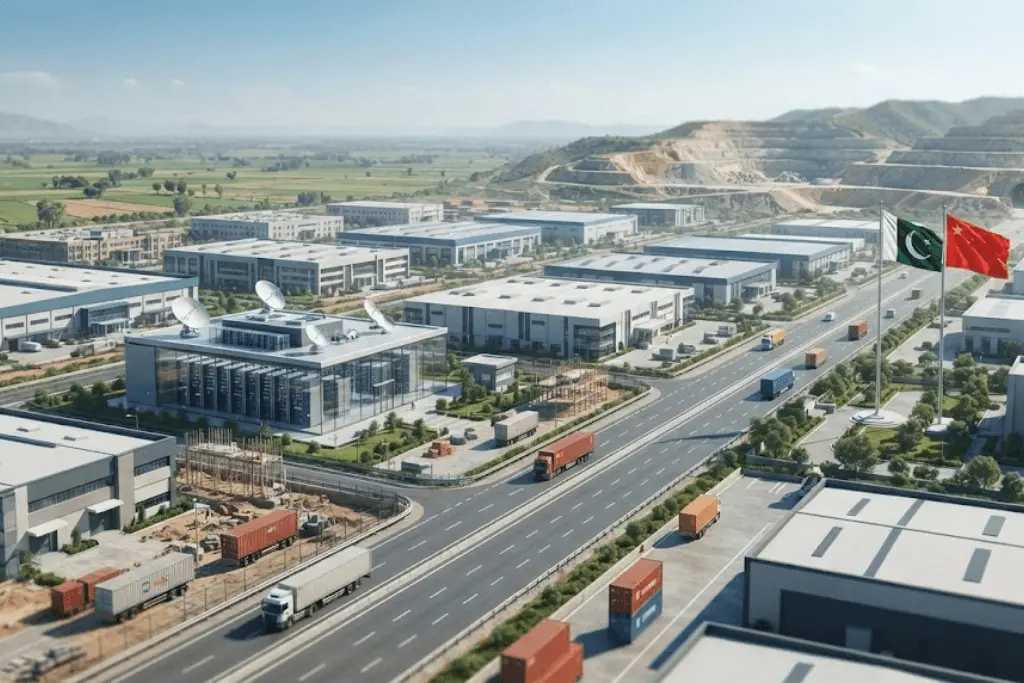
Pakistan and China have moved to a new phase of the China-Pakistan Economic Corridor, CPEC 2.0, with Pakistan China CPEC now more focused on industrialisation, information technology, investment and private-sector cooperation. The new phase will build on the infrastructure and energy foundations laid in the first phase and aims to generate more robust economic activity in Pakistan.
Pakistan Turns To Industrial Growth With CPEC 2.0
The second phase is a change of emphasis from the building of major infrastructure to productive economic activity. The official CPEC narrative talks of moving from infrastructure to industrialisation, from connectivity to competitiveness and investment to greater productivity, with a larger role for business-to-business cooperation.
The focus on industry gives opportunities for Pakistan to expand its manufacturing capacity and bring local businesses into larger supply chains. Cooperation with Chinese firms can assist in technology transfer, production know-how and access to new markets while allowing Pakistani enterprises to take a more active role in the next phase of the corridor.
Special Economic Zones To Help Pakistan’s Investment Goals
Special Economic Zones in Pakistan provide an enabling environment to attract industrial investment and give an incentive to companies to set up production facilities. The focus is back on these zones with CPEC 2.0 as part of an overarching strategy to boost industrial activity and forge stronger linkages between Chinese and Pakistani businesses.
It is particularly significant that the focus is on B2B cooperation, since the next stage is likely to see the involvement of private companies rather than relying primarily on government-to-government agreements. The CPEC Secretariat says the new approach will be characterised by elements such as commercial viability and deeper industrial cooperation.
Pakistan Puts It And Artificial Intelligence At Centre
Information technology and artificial intelligence have become important fields of cooperation under CPEC 2.0. Pakistan’s digital economy strategy is increasingly bringing CPEC together with technology, innovation, skills development and digital infrastructure, creating opportunities for Pakistani technology companies to enhance their capabilities.
The CPEC Joint Working Group on Information Technology seeks to improve cooperation in the fields of ICT infrastructure, applications, cybersecurity, policy, spectrum regulation and human-resource development. Official CPEC information also mentions the possibility of deeper cooperation in the fields of cloud computing, data centres, artificial intelligence and 5G networks.
Cooperation On Investment Can Create Private Sector Opportunities
In CPEC 2.0, there will be more focus on private sector participation and B2B partnerships. Agriculture is another big pillar of the new phase. Pakistan wants more cooperation with China in modern farming, technology, training and productivity. The emphasis is indicative of the importance of agriculture for Pakistan’s economy and the potential of modern technology to improve yields and strengthen food and export systems.
The government said that the first batch of 1,000 Pakistani agriculture graduates has completed training in China, and another batch of 1,000 is about to start training. The program aims to upgrade the technical skills and expose Pakistani agricultural professionals to modern farming technologies.
CPEC 2.0 Gives Importance To Pakistan’s Minerals Sector
Mining and minerals have emerged as another area of priority for Pakistan-China cooperation. Pakistan has substantial mineral resources, and more investment in exploration, processing and value addition could increase the sector’s contribution to industrial development.
Pakistan’s CPEC 2.0 Framework Gets Wider With Five Corridors
The new phase is based on five broad corridors covering growth, innovation, green development, livelihoods and regional connectivity. The framework aims to link economic production with technology, sustainability, social development and Pakistan’s role as a regional trade hub.
The Growth Corridor is more focused on industrial and agricultural capacity; the Innovation Corridor is more focused on technology and digital development. The Green and Livelihood Corridors provide environmental sustainability and people-centred development, while the Regional Connectivity Corridor links CPEC with Gwadar and wider trade routes.
CPEC Phase I Lays The Foundation For The Next Phase Of Pakistan
The pivot to CPEC 2.0 is being built on infrastructure developed in the first phase in Pakistan. The CPEC Secretariat says Phase I saw about US$25 billion of Chinese investment, raised Pakistan’s power-generation capacity by nearly 8,000 MW and backed projects such as the Thar coal development and fibre-optic network.
Human-resource development is gaining importance in the new CPEC framework. The training programs for Pakistani agricultural graduates reflect the growing focus on skills, and collaboration on technology and innovation can open up more opportunities for young professionals and researchers.
The official discussions have also focused on institution building, knowledge sharing, governance, human resources and young leadership in addition to economic cooperation. The overarching framework aims to enhance relations between Pakistani and Chinese institutions while encouraging innovation and long-term growth, the statement said.
CPEC 2.0 Links Pakistan’s Industry To Export Aspirations
With greater focus on manufacturing, technology, agriculture and minerals, Pakistan has the opportunity to link CPEC investment to export growth. Industrial zones, improved business partnerships and better logistics can help both domestic consumption and international markets.
The CPEC Secretariat has associated Phase II with Pakistan’s broader aim of enhancing productivity, competitiveness, exports, jobs and skills. The private sector will lead the way in converting investment opportunities into commercially viable enterprises.